Category: News

  • The Eagle has landed

    The Eagle has landed


    Today, fifty years ago, on the Sunday of 20 July 1969, at 20:17 UTC, aeronautical engineer, test pilot, and astronaut Neil Armstrong reported to the Mission Control’s CAPCOM(beginfootnote)capsule communicator(endfootnote) Charles Duke, and transmitted already historic words.

    NEIL: ‘Houston, Tranquility Base here. The Eagle has landed.’

    CAPCOM: ‘Roger, Twan— Tranquility, we copy you on the ground. You got a bunch of guys about to turn blue. We’re breathing again. Thanks a lot.’

    Of course, ‘Twan'(beginfootnote)’Twan’ is (at least) a Dutch version of the French name ‘Toine’, usually given to males.(endfootnote) was a mistake but who cared because humanity had just achieved the greatest accomplishment thinkable.

    This was and continued to be the stuff that dreams were made of. Many decisions to become a scientist and engineer were due to the hardly over-estimable inspiration the landing on the Moon brought to many of us and the next generations. We can only hope that a sufficient percentage of humanity will be allowed by society to continue to perform scientific research and explorations(beginfootnote)And that scientific data won’t be confused with opinions and/or regarded as part of the larger scheme of deception from a hidden agenda of those who really control the world. ??(endfootnote).

    Here is a clip of the landing, courtesy of NASA: ‘It’s a 16mm film clip showing the final forty seconds of descent. It begins when Charlie Duke calls out sixty seconds of fuel remaining, and with the Little West Crater at the bottom of the window. The time-lapse video runs faster than real-time. Audio runs at normal, real-time speed, however.’


    If you have time (three hours and two minutes), by all means, watch NASA’s restored Apollo 11 Moonwalk.

    Science

    While it was indeed an unprecedented achievement of courage, skill, and applied maths and science, the astronauts also carried out several scientific experiments, yielding some very interesting data on our solar system. Dr. Becky Smethurst, astrophysicist and research fellow at the University of Oxford, highlights the following five things we didn’t know before we went to the Moon, in a video on their YouTube channel:

    • the distance to the Moon,
    • the structure inside the Moon,
    • what the solar wind is made of,
    • what the Moon is made of,
    • how the Moon was formed.

    We highly recommend subscribing to their channel with ever informative and entertaining nuggets of knowledge you both knew and didn’t know you wanted to know about that little agitation called Universe. Happy lunar anniversary! To everyone.

    Screenshot of Becky's video. Click to open their YouTube clip.
    Screenshot of Dr. Becky’s video. Click to open their YouTube clip.

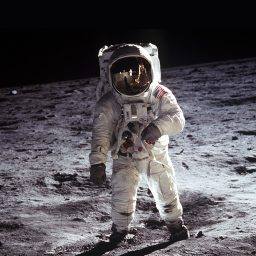
    Featured image: Buzz Aldrin, made by Neil Armstrong. Courtesy of NASA.
  • Professor Karen Uhlenbeck wins the prestigious Abel Prize 2019

    Professor Karen Uhlenbeck wins the prestigious Abel Prize 2019


    Karen Keskulla Uhlenbeck received the prestigious Abel Prize 2019 for her revolutionary theories in geometric analysis and gauge theory. Her mathematical work proved to be fundamental in our understanding of minimal surfaces in our three-dimensional space and beyond. Moreover, she played an essential role in laying the foundation for many modern mathematical models used in particle physics, string theory, and general relativity.

    Currently, Professor Emerita of Mathematics and Sid W. Richardson Regents Chair at the University of Texas at Austin, Uhlenbeck is a Visitor in the School of Mathematics at the Institute for Advanced Studies, Princeton.

    “Quite frankly: it is about time.”
    —Prof Helmut Hofer (IAS)

    Naturally, this momentous event at the Norwegian Academy of Science and Letters has been preceded by many extraordinary highlights in her career as a highly sought-after pioneering expert. Some of them stand out even more because they expose the perplexing disparity in the acknowledgement of contributions between men and women in academia. In 1990, she held a Plenary Lecture at the world’s most seminal International Congress of Mathematicians (ICM), in Kyoto, making her only the second woman in history to do so. The other one being the eminent Emmy Noether forty-eight years earlier.

    Today brought another highlight: she is the first woman to receive the Abel Prize.

    “Quite frankly: it is about time. Karen has had a tremendous impact on the development of modern geometric analysis, particularly the calculus of variations. Her contributions to minimal surface theory and Yang-Mills theory have changed the subjects and started some of the most exciting developments in mathematics,” said Helmut Hofer, IAS Professor in the School of Mathematics, in the Institute’s press release.

    For more information about Professor Uhlenbeck, her achievements, and on the Abel Prize, visit their website.

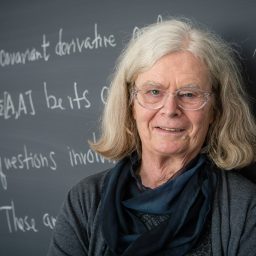
    Featured photograph: In 1987 Karen Keskulla Uhlenbeck moved to the University of Texas at Austin to take up the Sid W. Richardson Foundation Regents’ Chair in mathematics where she worked until 2014. Currently, Uhlenbeck is a Visiting Senior Research Scholar at Princeton University as well as Visitor in the School of Mathematics at the Institute for Advanced Study (IAS). Photo: Andrea Kane/Institute for Advanced Study

  • Happy birthday mister Einstein, happy Pi Day to you!

    Happy birthday mister Einstein, happy Pi Day to you!


    Π Day is the day on which we commemorate Albert Einstein’s (1879-1955) birthday. Also, people celebrate the existence of $ \pi $ as today is 3/14, forming the first three digits (at least) of the number $ \pi $ in the American date format. Some Western European critics—on Twitter, for example—have stated one oughtn’t as ‘we, here’ simply do not use the American date format. Of course, nearly the whole rest of the world do not use the American date format—hence, ‘American’—but it hasn’t stopped cheerful people from all over that same rest of the world to celebrate and put mathematics into the limelight once a year.


    Larry Shaw (1939-2017), the founder of Pi Day, at the Exploratorium in San Francisco

    In 1987 or 1988, a physicist named Larry Shaw (1939-2017), while working at the Exploratorium, museum for science, art, and human perception, came up with the idea of celebrating the mathematical constants on March 14th. What started out as eating pie with just his colleagues, the event became public the next year. At 1:59pm, a time notation predominantly used in the US and the Commonwealth, forming (at least) the fourth, fifth, and sixth digits, a parade would be held with each visitor holding a digit of pi while eating pie and singing happy birthday to Albert Einstein. Larry was pleased to see the younger visitors loving the museum’s festivities, which, furthermore, include pi poetry readings, pi-kus (haikus about pi) and pi limericks, a pizza-dough tossing lesson, and eating it.

    Hidden pis

    (Grow up, it’s not even spelt right.) One of the most fascinating things about pi is that it tends to come up in places where you would least expect it. For instance, Albert Einstein and pi have a relationship. His general theory of relativity pivots around the following field equations:

    \[ R_{\mu\nu}-\frac{1}{2}Rg_{\mu\nu}=8\pi GT_{\mu\nu}. \]

    We won’t get into the details, but it’s pretty delightful that a theory describing one of the most fundamental forces in our universe, called gravity, would need the ever so humble pi.

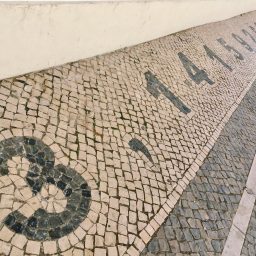
    A long string of digits has been incorporated into the calçada portuguesa thanks to mathematics teacher and current chair of Faro’s city council Rogério Bacalhau. Credits: @kjrunia, licensed under CC BY 4.0.

    And this one is even cooler. Mathematicians wondered what you would get when you sum the following series of terms to infinity:

    \[ \frac{1}{1^2}+\frac{1}{2^2}+\frac{1}{3^2}+\frac{1}{4^2}+\dots \]

    The genius mathematician Leonhard Euler solved this Basel problem and found that the sum would converge to $ \pi^2/6 $. Even when a series tends to infinity, the ever so humble pi appears.

    Speaking of ‘humble pi’, recently, a great book with this very title has come out by my favourite stand-up mathematician and YouTuber Matt Parker. I recommend it. It’s great. In this video, he is trying to approximate pi by using classical mechanics. Do have a look! Over the years, he made a whole bunch of cool and funny videos calculating pi. If you find yourself trapped in the algorithmic funnel that its inventors called YouTube, you’re welcome.

    Screenshot of Matt Parker’s YouTube video in which he is calculating pi using a balancing beam.

    One of the most fascinating places where pi pops up is where billiard balls bounce against each other and the cushion on the inner rail of a billiard table. Gregory Galperin at the Department of Mathematics of the Eastern Illinois University wrote a paper demonstrating how pi could be obtained in a jaw-droppingly awesome way.

    The New York Times published a blog post about it in 2014 but not before the YouTube channel Numberphile—another favourite—had professor Ed Copeland explain it already in 2012.

    Recently, however, the YouTube channel 3Blue1Brown published a video about it too. (Yes, the channel is also a favourite and I realise that I am using the word in a contradictory manner.)

    It features a gorgeous simulation and is somehow very pleasing to the ears. Also, Grant Sanderson, the mathematician behind the voice and videos, does a great job of visually deciphering the language of the universe. Do have a look. He then gives the answer as to ‘but how’ and ‘why at all’ in a second video.

    If you haven’t seen it, do support your chin firmly with your hand while letting the video play out as it may gravitate towards the centre of Earth, radially.

    A screenshot of 3Blue1Brown’s video on calculating pi using collisions.

    Photo of Larry Shaw: credits: Ronhip, licensed under CC BY-SA 3.0.
    Photo of digits of pi in the Portuguese streets: credits: @kjrunia, licensed under CC BY 4.0.

  • Happy New Year: Earth is Amazing

    Happy New Year: Earth is Amazing


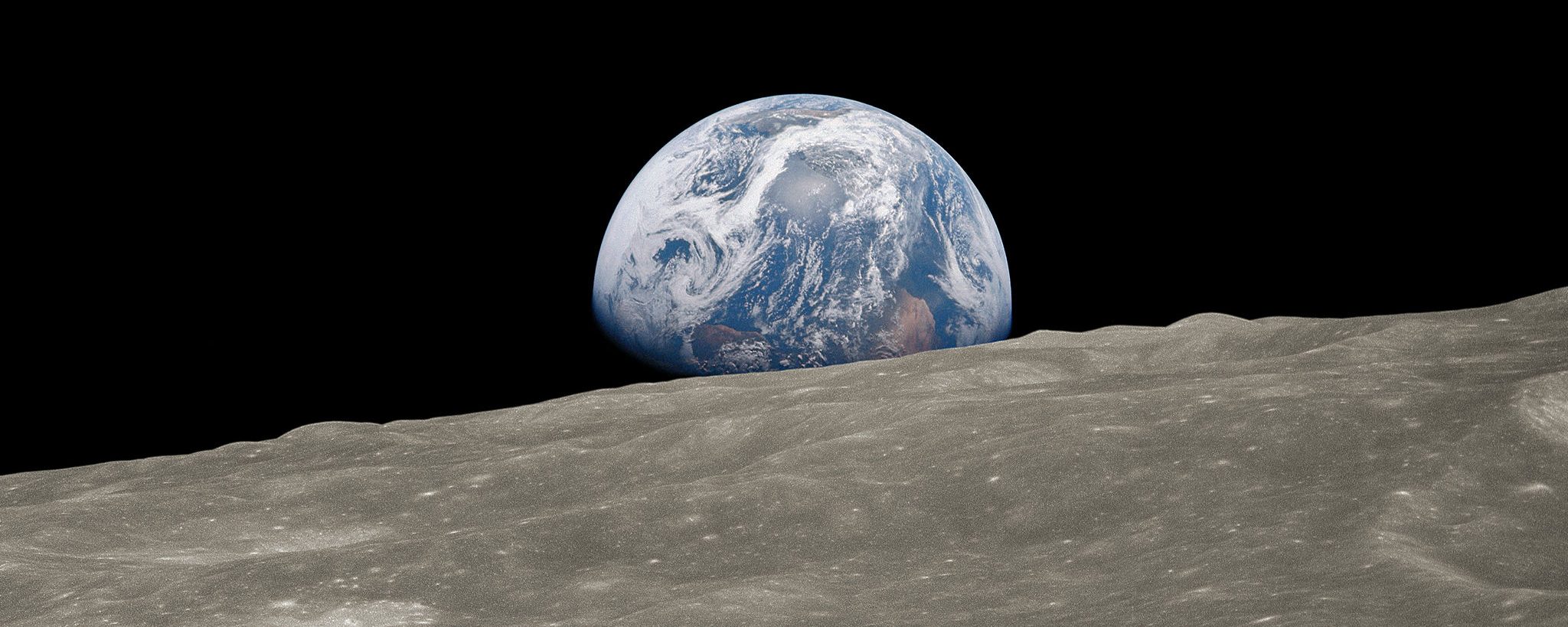
    NASA recently published a 4K version of an audiovisual amalgam of the iconic Earthrise photo made by Apollo 8’s astronaut William Sanders on the 24th of December 1968, a 3D mapping of lunar photography, and the voice-recording of the crew onboard the spacecraft.


    It allows us to witness in real time the events unfolding leading up to the moment it was captured. We can hear Anders’ crew-mate Borman joking: ‘Hey, don’t take that, it’s not scheduled.’ We are glad Anders was not the type to take everything literally.

    In an interview with The Guardian, Anders noted his experience had even changed his religious views, in fact, undercutting them.

    Well, while we are not concerned with whether it changes one’s existential views on life and the universe or not, we do hope you enjoy witnessing their voice-recorded awe and amazement for this precious little blue ball and its smaller grey companion whizzing around the big white ball for a whole new year.

    We wish you a successful, loving, and all-along-the-line gorgeous new trip in the vast emptiness of the fabric of the cosmos.

    Featured image: NASAApollo 8 Crew, Bill Anders; Processing and License: Jim Weigang

  • Boxing day: Marie and Pierre Curie announce the discovery of radium

    Boxing day: Marie and Pierre Curie announce the discovery of radium


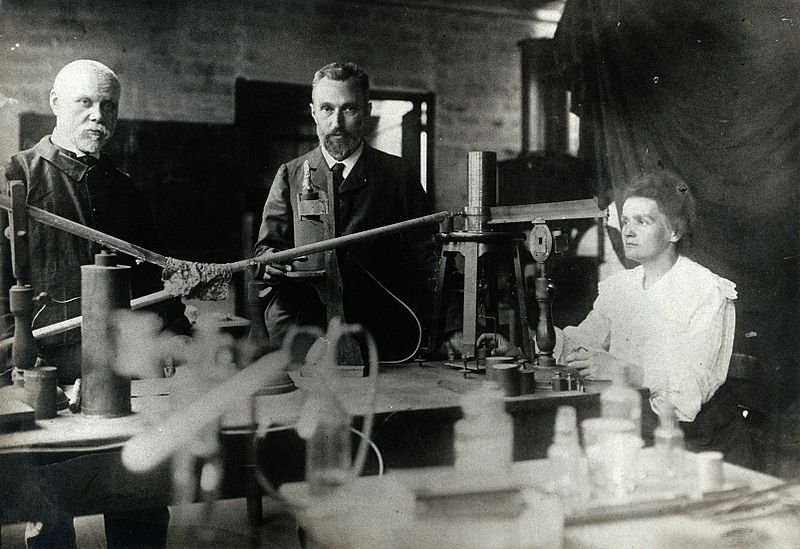
    Today, that is, on the 26th of December, Marie Curie, her husband Pierre, and Gustavé Bemont announced in the Comptes rendus de l’Académie des Sciences in 1898 that they discovered a new element which they proposed to name radium.


    Nowadays, an isotope of radium is of medical use against metastatic bone cancer, relying on the isotope’s release of helium nuclei (so-called α-decay) which destroy cells within a relatively small volume of tissue.

    An English translation of the original article is available online. The original can be read here (pp. 1215-1217):

    Featured image: Marie and Pierre Curie, and Gustavé Bemont in their laboratory in Paris, 1901. Welcome Images, CC-BY 4.0

  • The Arts in Physics: a short film of freezing soap bubbles

    The Arts in Physics: a short film of freezing soap bubbles


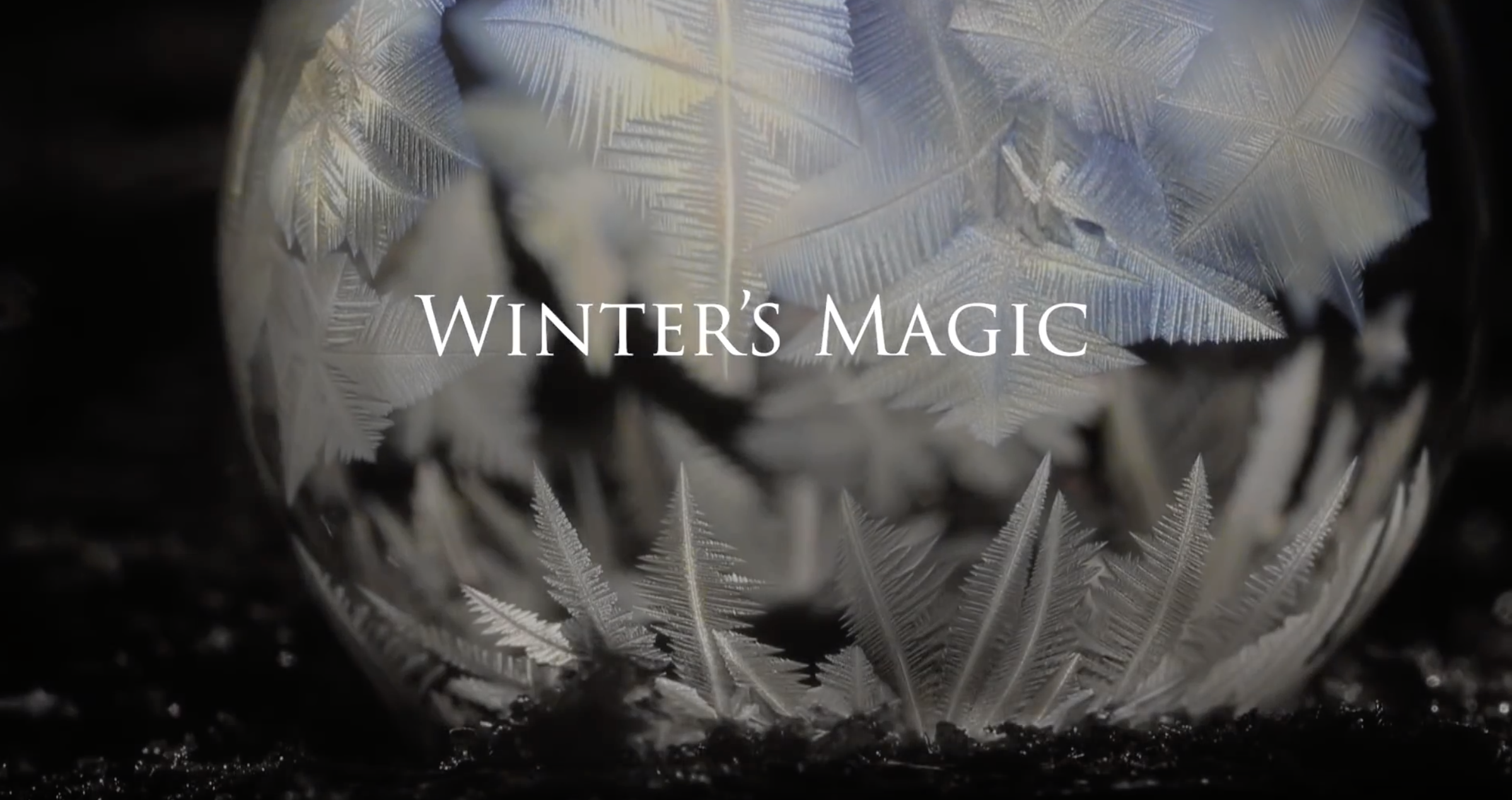
    It’s mesmerising. As soap bubbles freeze—an incredibly delicate process—the camera of Don Komarechka recorded each little detail beautifully. According to the video description, it took about 400 attempts to produce the short film you’re seeing here. Originally licensed to the BBC for their Forces of Nature documentary series, two years after the fact, we are happy to see it out in the open. Physics and art brought together wonderfully. Merry Christmas!