Tag: electrons

  • The double-slit experiment

    The double-slit experiment


    Over three hundred years ago, grumpy old men with 17th-century wigs or 18th-century black-ribboned man ponytails were divided into two camps. They were squabbling over what type of phenomenon light is. ‘Light is waves’, said Huygens, Hooke, Euler and friends. ‘No no, light is particles’, said Newton, Laplace and colleagues. Fast forward to 1990 and even my physics teacher in high school confesses he still wasn’t sure about the correct answer.

    His confusion is understandable. Even though he could have known the correct way of thinking about it, the reason for these murky waters can be traced back to the now famous set of double-slit experiments.

    So, join me in tumbling through the slits of science, into the mad world of quantum physics, where one thing was proven be in two places at once. Or was it?


    NEW: Listen to the audio |


    (not really meant as podcast since referrals are made to figures in the article)


    The set-up

    Suppose you had a shotgun capable of spraying a cloud of numerous tiny lead pellets in one shot. If you’d aim it at a screen containing two thin slits, so only some might get through, what shooting pattern should you expect to appear on a screen behind it?

    Figure 1. A screen with two slits
    Figure 1. A screen with two slits

    I’m quite confident your answer will correlate strongly with the situation as depicted in Figure 2.

    Figure 2. The screen with the double slits and a screen behind it with the typical impact pattern of pellets or particles
    Figure 2. The screen with the double slits and a screen behind it with the typical impact pattern of pellets or particles

    This is exactly what you would expect if the things you’re using to shoot with are tiny pellets or tiny particles. No surprise here.

    Now imagine, we’d slowly submerge the screen with the two slits half-way into a pond. Water waves are slowly rolling towards the first screen as depicted in Figure 3.

    Figure 3. Both screens are now partly submerged in water. Water waves are approaching the first screen.
    Figure 3. Both screens are now partly submerged in water. Water waves are approaching the first screen.

    What would these waves look like after they’ve gone through the slits? When seen from above, it would look like Figure 4.

    Figure 4. As the waves go through the two slits, they transform into two circularly spreading waves like two stones in a pond.
    Figure 4. As the waves go through the two slits, they transform into two circularly spreading waves like two stones in a pond.

    The two slits transform the waves into two circularly spreading waves. Like two stones thrown into a pond. You can see how the waves will intersect with each other. You might expect some interaction to occur at these crossroads and you would be right.

    In fact, let’s have a look at a real pond. In the GIF of Figure 5, you can clearly see how these two circular waves interfere with each other. If two crests meet, they amplify each other’s amplitude, whereas two troughs meeting, they amplify each other’s trough-ness (also amplitude but in the other direction). And where a crest meets a trough, they cancel each other out!

    Figure 5. Two circular waves in an actual pond.
    Figure 5. Two circular waves in an actual pond.

    Now have a look at the animation of Figure 6 and observe especially what the second screen receives: patches where the waves hit the screen are white and patches where there are no waves at all are black.

    Figure 6. The white areas are where the (amplified) waves hit the second screen, the black areas are the parts where no waves are present due to mutual cancellation
    Figure 6. The white areas are where the (amplified) waves hit the second screen, the black areas are the parts where no waves are present due to mutual cancellation

    So, now we know what happens if waves would be thrown at the two slits. Contrary to what you see when you would shoot pellets towards the screen, you would see what’s depicted in Figure 7.

    Figure 7. The double-slit set-up with the typical pattern on the second screen when waves have gone through

    So, now we have two options. If whatever we’re shooting at the slits is particles, we get what’s on the left in Figure 8. If we’re aiming waves at the slits, we get what is on the right in Figure 8.

    Figure 8. If particles went through the slits, you get to see the pattern on the left. If it’s waves, you get the pattern on the right.

    Young’s interference experiment

    Thomas Young was a polymath and physician. In the 1790s, he wrote a thesis on the physical and mathematical properties of sound. In 1800, he presented the Royal Society, the UK’s national academy of sciences, his theory that light is a wave too. He was met with great skepticism as the likes of Newton and Laplace were proponents of the light-is-particles theory. 

    Young then showed how they were wrong. A notable fact is that he didn’t actually use two slits. He had a bundle of sunlight pass through a pinhole so as to obtain a very tiny bundle of sunlight. He then placed a ‘slip of card’ in front of the pinhole, essentially splitting the small bundle in two even smaller bundles which then interfere with each other. The resulting light pattern would have looked like the one shown in Figure 9.

    Figure 9. The pattern which Young produced by splitting sunlight

    If light were particles, you would have seen an entirely different pattern. This result, however, completely corresponds to the wave theory of light. Young concluded therefore that light is indeed a wave phenomenon. He called this the most important of his achievements.

    This marked the beginning of the acceptance of the wave theory of light (yay for Huygens and friends) and a departure from the particle theory of light (nay for Newton and fr… well, colleagues, at least).

    Or particles after all?

    Figure 10. Individual electrons

    Of course, Max Planck, Albert Einstein, and a few other colleagues would later show that light is particles after all. In a previous post, The formula that got Albert Einstein the Nobel Prize and should stop us getting sunburn all the time, we discussed Einstein’s finding which won him the Nobel Prize.

    In short, Max Planck and Albert Einstein showed that certain behaviour of light could only be explained if it consisted of small packets of energy, quanta as they were labelled.

    But apart from that, experimenters found another peculiarity. In the 1960s, electrons were generally expected to behave like particles – like pellets or ball bearings. So, instead of light, they fired one electron at a time towards a splitter and have a screen behind that capture the electron. What they initially saw was to be expected. A few (11) loose dots on the screen as shown in Figure 10. However, as the individual electrons kept being fired, one after the other, an astonishing pattern started to emerge – the kind you would expect to see in the case of interfering waves! Wait, what?

    Are they waves after all? But they were individual electrons! How?

    Needless to say, experimenters did the same thing with individual photons, the quanta of light Max Planck and Einstein were talking about. Extremely low-intensity light was produced up to the point where single photons were shot at the screen. The same result. They seem to behave like particles at first but then this wave pattern emerges.

    Two places at once?

    Theorists then theorised that the only explanation was that a single electron and a single photon somehow went through the two slits at the same time, enabling some kind of self-interference so that this wave pattern would emerge while also preserving a particle pattern at the same time.

    To test this theory, people put particle detectors at the two slits in order to see if the single electron or the single photon indeed flew through both slits at the same time.

    The result was again astonishing: the wave pattern disappeared and what they got was instead the pattern you’d expect to see if the particles were actual particles – the pattern was like the pattern in Figure 2. At the same time, they never detected the particle at both detectors. They were ever only detected by one detector – as if they were particles.

    As soon as they removed the detectors, however, the wave pattern emerged again.

    And even if they placed just one detector at one slit, the wave pattern disappeared again and the particle pattern showed up.

    It was as if the electron and the photon knew when they were being watched and then decided to behave differently.

    This is called the measurement problem. In the next post, we will discuss this at greater depth.

    People now started talking about the wave-particle duality of elementary particles. Are particles truly particles or waves? They’re both, people now said. Sometimes they’re waves, sometimes they’re particles.

    Fields

    Of course, nowadays, the reigning theoretical paradigm is quantum field theory – mathematical field descriptions to capture the behaviour of ‘particles’ such as the electron, the photon, and a whole zoo of elementary constituents of our reality. The most successful quantum field theory to date is called the Standard Model of particle physics. In a previous post, Why, exactly, do glass and liquids refract light?, we dive a little bit into quantum field theory.

    In short, the question of whether light is particles or waves has been answered: it’s fields. The same goes for electrons. And all the other elementary ‘particles’. It’s all fields.

    As long as no interaction with the outside world such as detectors take place, a photon or electron are part of the wave functions of their respective electromagnetic and electron fields, governed by the Schrödinger equation. They are very much like waves. However, as soon as they interact with something, such as a detector, what is detected is a particle, merely a slice of a photon’s or electron’s entire wave function.

    I promise we will unpack these two last paragraphs in a later post. We expounded on that a little bit already in This is not an atom.

    But, please, tell me now, are they in two places?

    No, not even technically. Linguistically then? Also, no. That statement is likely the result of mixing-up or lack for a better way of providing both metaphorical and physical descriptions of what is going on – it also reveals the still-present, outdated notion of what photons and electrons were supposed to be. If electrons were in two places at once, you still imagine them being small, little pellets, two copies of which fly through both slits, somehow interfering with each other. And that’s just not so.

    The correct expression is that electrons and photons and the likes don’t have a definite location: their existence is simply spread out in space according to the wave function, the time-evolution of which in turn obeys the Schrödinger equation. Again, do give This is not an atom a read where this is explained in more detail.

    Pretty mind-bending stuff, right? Good. Welcome to the club. Great minds before you have had to take their time to wrap their heads around the double-slit experiment. Now you’re one of them.


    Featured image by Free-Photos

    Sunlight diffraction pattern by Aleksandr Berdnikov under CC BY-SA 4.0

    Single electron build-up series. Results of a double-slit-experiment performed by Dr. Tonomura showing the build-up of an interference pattern of single electrons. Numbers of electrons are 11 (a), 200 (b), 6000 (c), 40000 (d), 140000 (e). By Belsazar under CC BY-SA 3.0.

  • Is microwave oven radiation unhealthy?

    Is microwave oven radiation unhealthy?


    Some say that the radiation inside a microwave oven is bad for our health. And that it’s bad for our food. It’s uncertain from where these contentions originate exactly. Even though the introduction of the microwave oven(beginfootnote)They were called ‘electronic ovens’.(endfootnote) in our homes took place in the 1960s, among some, they never got rid of their unhealthy reputation entirely. In this article, we will have a look at what its radiation is and how that influences food and vitamins. We will then proceed to answer the question: Is microwave oven radiation unhealthy?

    The word ‘radiation’

    Pripyat, near Chernobyl, Ukraine. When we hear 'radiation', we may associate it with the Chernobyl disaster. That is absolutely not at all what microwave oven radiation is.
    Pripyat, near Chernobyl, Ukraine. When we hear ‘radiation’, we may associate it with the Chernobyl disaster. That is absolutely not at all what microwave oven radiation is.

    In physics, ‘radiation’ is the emission or transmission of energy in the form of waves or ‘particles’. Not all radiation is a health hazard to our species as we have evolved to be immune in most cases. Radiation emitted by nuclear reactors is dangerous. However, it may not surprise you that we have evolved to withstand the radiation of tea lights.

    While society generally might not care about what physics says ‘radiation’ means, this is what we’re going to be using throughout this article.

    Radiation is not always dangerous. There are more things in everyday life than you might think which are forms of radiation.

    Bananas, also those growing in the wild, naturally possess radioactivity. Our species can handle this. It's infinitely more dangerous for other reasons. Don't litter, folks.
    Bananas, also those growing in the wild, naturally possess radioactivity. Our species can handle the radiation. It’s infinitely more dangerous for other reasons. Don’t litter, folks.

    Some examples of sources of radiation: bananas (which are naturally radioactive), magnets, candle sticks, central heating, club and stage lights, any light source for that matter, including your bathroom light, human bodies, microwave ovens, the Sun, the uranium and plutonium rods of a nuclear plant, and furthermore, anything you can see with your eyes either emits or reflects radiation, right here, right now.

    Just look straight into the eyes of your partner, or friend with merits, lying next to you the next morning: whether you want to or not, they have been literally gushing their radiation all over your body, right here, and are still, right now, the whole time. And not in any spiritual or venereal sense, no no, you have been and are being exposed to actual spurts of electromagnetic radiation discharging from their bodies(beginfootnote)Infrared, mostly. Note that our bodies are also radioactive. We emit ‘particle’ radiation too. On average, about 5000 of our atomic nuclei decay every second (5000 Bq) and emit radioactive radiation.(endfootnote), at energy levels literally more than a hundred thousand times higher than microwave oven radiation.

    In fact, in all the examples above, it’s the same type of radiation as microwave oven radiation, called electromagnetic radiation. The difference is that the examples are more than a hundred thousand times more energetic than microwave oven radiation. Except for a big chunk of the Sun’s radiation, and uranium and plutonium rods. Those entail dangerous forms of ionising radiation, and involve more than just the electromagnetic kind.

    Ionising radiation

    The dangerous form of radiation is called ionising radiation. This is the type of radiation many people think of when they hear the word ‘radiation’. Microwave oven radiation isn’t that.

    If incoming radiation has so much energy that it strips one or more electrons away from their nucleus, we call this ionising radiation. An atom which has lost one or more electrons, we consider to be ionised, and so, we now call it an ion.

    Why is this dangerous? Well, our bodies are made of large strings and knots of intertwined atoms. Our skin, organs, cells, DNA—it’s all made up of trillions of atoms. Those atoms are only able to form these large chains and knots because their electrons keep them together this way.

    Thus, if ionising radiation strips away those electrons from their nucleus, then our molecules, cells, DNA—it all falls apart. And especially damage to our DNA is dangerous as this could develop into cancerous growth. Fortunately, our body has evolved to possess certain superpowers, if you will, enabling it to repair damaged cells and even DNA to an astonishing degree.

    Sadly, there are limits. A sufficient blast of ionising radiation may cause damage beyond our bodies’ repair capabilities and thereby may be the cause for cancer.

    Ionising radiation breaks down atoms, thus molecules, thus organic cells. When our body’s repair mechanism is overwhelmed by the amount of ionisation, this may eventually lead to cancer and organ failure. Microwave oven radiation, however, is not ionising at all. Far from it. It is simply not energetic enough. Not by a stretch.

    Examples of ionising radiation are:

    • subatomic particle radiation: such as protons, neutrons, separate or combined to an atomic nucleus(beginfootnote)Also known as alpha particles.(endfootnote) as well as electrons and positrons(beginfootnote)Also known as beta particles.(endfootnote) flying about, aimed at your general direction;
    • high-energy electromagnetic radiation: cosmic rays, gamma rays(beginfootnote)This is what Dr Bruce Banner was exposed to, turning him into what we call a Hulk. But please, don’t try this yourself. Most likely, you’ll die. At best, you might end up looking like former KGB agent Emil Blonsky or General Thaddeus Ross. If you’re unfamiliar with their tragic fates: Universal Misery.(endfootnote), X-rays(beginfootnote)In hospitals, you will receive much less the amount of X-ray radiation than would be dangerous. Your body is capable of repairing any damage, in this case. It still means that one must be careful, hence, only highly-qualified medical personnel should administer X-ray doses.(endfootnote), the higher-energy UV-light.

    Electromagnetic radiation

    Microwave oven radiation is electromagnetic radiation. What is the latter then? In physics, we have the most successful of theories called quantum electrodynamics (QED), which arose in the 1930s. Do watch these amazing, very accessible videos of the genius and Nobel laureate Richard Feynman, who brought major contributions to QED. It’s the first theory within a larger physical framework called quantum field theory (QFT). In short, without QED, we wouldn’t have had electromagnetism-based technology such as microprocessors—which means we wouldn’t have had TVs, computers, mobile phones, and internet. To understand the theory is to make a few mental steps. In Why, exactly, do glass and liquids refract light?, we’ve mentioned QFT already. We paraphrase the essence down below.

    Space throughout the entire observable Universe is filled with three-dimensional fields. In fact, fields are a property of space. Space without fields does not exist. With space come fields.

    There are many fields. Two of these fields are the electromagnetic field and the electron field.

    We perceive oscillations at specific frequencies in the electromagnetic field as photons, ‘particles’ of light, if you will, sometimes visible light but most of the time it’s invisible light.

    We perceive oscillations at specific frequencies in the electron field as electrons. If we measure them—interact with them using an electric probe in the lab for instance—we perceive them as ‘particles’. Usually, we speak about them as ‘particles’, even though they’re not.

    Electrons influence the electromagnetic field. The latter influences electrons in return. Photons are oscillating parts of the electromagnetic field, and so, electrons influence photons, while photons influence electrons. However, electrons are only influenced by photons when the latter have specific energy values, not just any energy value.

    Photons, or, the electromagnetic field disturbances caused by a microwave oven, which we call ‘radiation’, do not have the correct energy value to ionise the atoms in our body.

    Luckily, photons emitted by the person lying next to you don’t have the correct energy value to destroy our atoms either, nor do the regular lights in our home, even though they carry a hundred thousand times more energy than those of a microwave oven.

    All this is perfectly calculable. Because maths and physics.

    A schematic depiction of two fields spanning throughout the entire observable universe. Here, they look like two-dimensional planes hovering over one another with a little bit of empty space between them but in reality they are three-dimensional fields pervading all of space. They are completely intertwined with each other, three-dimensionally. Electrons are specific oscillations in the electron field and are here depicted as darker yellow blobs in the yellow-coloured electron field. Photons, light, or electromagnetic radiation (they are all the same thing) are likewise depicted as darker green blobs in the green-coloured electromagnetic field. The lighter-green blobs represent the influence in the electromagnetic field caused by electrons.
    A schematic depiction of two fields pervading through the entire observable universe. Here, they look like two-dimensional planes hovering over one another with a little bit of empty space between them but in reality they are three-dimensional fields pervading all of space. They are completely intertwined with each other, three-dimensionally. Electrons are specific oscillations in the electron field and are here depicted as darker yellow blobs in the yellow-coloured electron field. Photons, light, or electromagnetic radiation (they are all the same thing) are likewise depicted as darker green blobs in the green-coloured electromagnetic field. The lighter-green blobs represent the influence in the electromagnetic field caused by electrons.

    How do we know?

    Max Planck, a German theoretical physicist (1858-1947), found a way to calculate the energy values for photons. Einstein subsequently used Planck’s formula to come up with another formula allowing us to calculate if atoms would become ionised by certain forms of radiation. In The formula that got Albert Einstein the Nobel Prize and should stop us getting sunburn all the time, we discuss Einstein’s groundbreaking work in quantum mechanics which would later develop to become quantum electrodynamics (QED). Warning: mathematical equations are given in that article.

    This cheery-looking fellow was a physicist, a genius, and a Nobel laureate. He was one of the founders of quantum mechanics. His name was Max Planck. This is a photograph from 1933.
    This cheery-looking fellow was a physicist, a genius, and a Nobel laureate. He was one of the founders of quantum mechanics. His name was Max Planck. This is a photograph from 1933.

    And so, after many more contributions by really clever people, the fascinating branch of science arose through which we are now able to harness the power of electromagnetic radiation, including that of the microwave oven as well as, incidentally, radio signals, TV signals, Wi-Fi, and mobile phone signals.

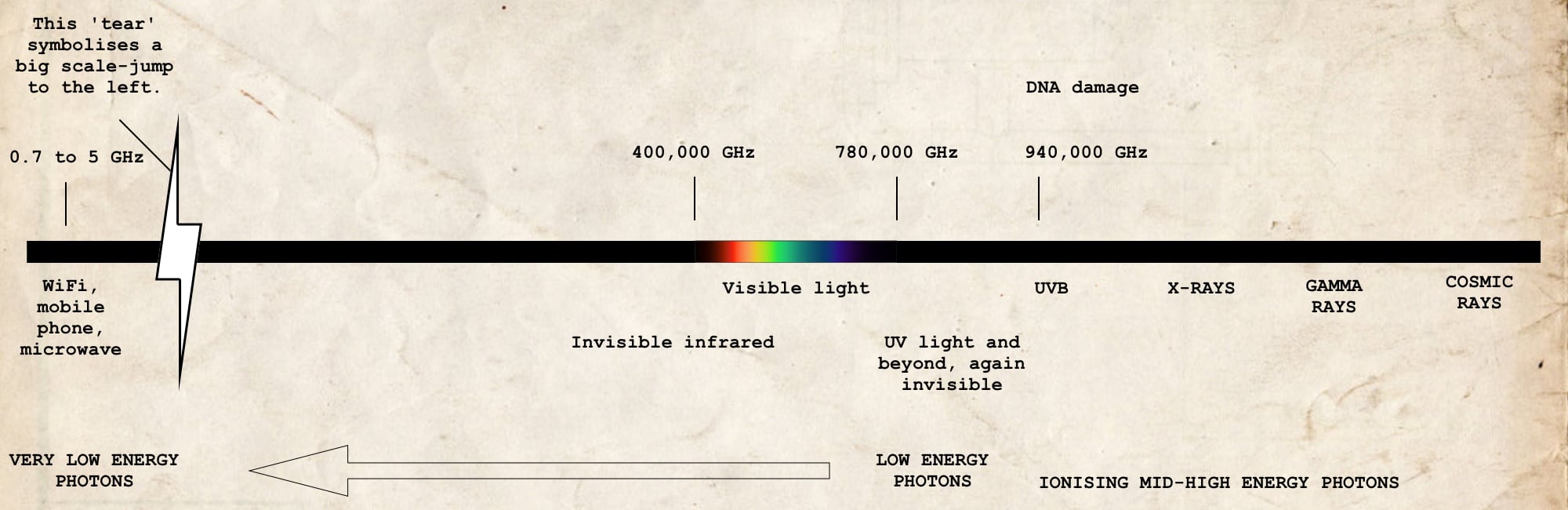
    If you want to know where in the ‘spectrum of danger’ microwave oven radiation lies, have a look at this diagram. Hint: if radiation in a microwave oven were dangerous, then the lights in your toilet would liquidate you instantly to a warm, sliding, sneakers-covering pulp of mashed guts, lung pudding, and brain leftovers. Also, Planck, Einstein, and others, would be turning over in their graves.

    Heat

    Knowing this, the natural thing to ask is, what about all the heat? If microwave oven radiation is really that low-energy, how does it manage to cook my food boiling hot? The answer is friction.

    Remember that time when you bent a piece of steel wire back and forth quickly for a while? And that the bend eventually became very hot? That’s because you had been moving many molecules back and forth quickly enough to have them heat up the wire due to friction. You don’t need life-threatening amounts of energy—merely the energy of your arms—to make something really, really hot. Microwave radiation does that mainly with the water molecules in food.

    Under the influence of the electromagnetic field inside the microwave, the slightly polarised water molecules rotate back and forth about 2 400 000 000 times per second. Friction with their surroundings cause heat.

    It’s like rubbing your hands together the same number of times per second, which entails friction and causes heat. This is why it’s easier to heat up solid food in the microwave oven than liquids, such as a cup of water: in the latter, water molecules experience less friction than in the first.

    The radiation does nothing to the composition of the atoms. It merely causes molecules to move. Just as a flame does. Or a conventional oven. Making molecules move, that’s all there is to it.

    This also means that you shouldn’t put your hand in an operating microwave oven. Your molecules will start moving too, just like in a conventional oven or when you would put your hands into a flame on the hob. Though, admittedly, in a microwave oven that would mostly only be your water molecules, while in a conventional oven or on the hob, all of your molecules are affected.

    Vitamins

    Does microwave oven radiation destroy vitamins? As stated before, the radiation isn’t ionising, so it does not destroy vitamins. Heat does, however. Just as flames and conventional ovens heat up food and through that heat destroy vitamins, so does radiation. Not because of the radiation but because of simple heat.

    If microwave oven radiation did destroy vitamins, then the light hanging over your dinner table should obliterate the entire dish in an instant. That would be overdoing the concept of having a quick meal, somewhat.

    Here’s a silver lining. The longer food is exposed to heat, the more vitamins are destroyed. So, if there would be a means to heat food as quickly as possible, less vitamins would be destroyed. It might just be that, depending on all kinds of settings and situations, heating food quickly inside an efficient microwave oven spares more vitamins than a slow burn on the stove.

    We see a gas stove. Flames are engulfing the bottom of a pot. Vitamins are destroyed by heat, not microwave oven radiation.
    Vitamins are destroyed by heat, not microwave oven radiation. Beyond a certain temperature, a certain number of vitamins per second are starting to be destroyed. The longer it takes to heat up food after that, the more vitamins are broken down.

    Moreover, cooking food in a pot in its liquids and then throwing away the liquids equals throwing away the dissolved vitamins in those liquids. This happens a lot while cooking on a conventional hob. In a microwave oven, however, everything stays on the same plate. So, even if vitamins have dissolved in the food’s liquid, you’d still have them on your plate.

    Lastly, while microwave ovens don’t emit radiation that is carcinogenic, food itself may very well be, especially when it’s burnt. So, particularly when cooking on the flames and in a conventional oven: don’t burn your food. You know this. Don’t burn it to a crisp and then eat it.

    Incidentally, microwave oven radiation is very unlikely to burn food on a plate(beginfootnote)Which is why many don’t like it since, more often than not, a little bit of that browned-burnt-y flavour does taste good.(endfootnote).

    Is microwave oven radiation unhealthy?

    Courtesy of quantum physics, microwave oven radiation is not unhealthy and by itself, it doesn’t destroy vitamins (heat does). There is also no residual effect that might be dangerous: it’s like switching the light on and off, only a hundred thousand times less energetic than light. One might mix things up with the residual effect of a nuclear bomb or a nuclear disaster. This is due to the billions of heavy atomic nuclei having been hurled into the environment which in turn emit ionising radiation for thousands of years. Microwave ovens don’t hurl atomic nuclei into your food. That would have been deadly, indeed.

    Any text online, in books or magazines, stating otherwise is basically fighting against the quantum mechanical facts of the Universe. And a grumpy Einstein. In which case, other forces and motivations must have been at play in stating these uninformed propositions.

    So, if someone is telling you microwave ovens are unhealthy, ask them for the exact quantum mechanical equations supporting their claim. Sorry but it is what it is, and it is simply this Universe. If quantum mechanics weren’t correct, they’d have never been able to read their uninformed online source, anyway. Computers wouldn’t work. Their mobile phone would be nothing more than a fancy brick. Internet would never have existed. They would never be able to spread false rumours online about microwave ovens if physics were incorrect. Heck, they themselves wouldn’t even exist.

    We see a shirtless man in a canoe. Don't do this without sunscreen. This is dangerous. Not microwave oven radiation.
    Don’t do this without sunscreen. This is dangerous, not microwave oven radiation.

    By the same science, however, do watch out for the Sun’s UV-light this summer. And avoid at all cost, cosmic rays, gamma rays, and particle beams(beginfootnote)Unless exposure takes place briefly, as conducted by awesome and life-saving medical professionals.(endfootnote), so, whatever you do, do not stroll outside your international space station without a protective suit. And don’t eat yellowcake. Ever. Instead, radiate some green beans in a microwave oven. And eat a radioactive banana. Much healthier.


    Photo of Pripyat, near Chernobyl, Ukraine by Денис Резник from Pixabay.

  • Why, exactly, do glass and liquids refract light?

    Why, exactly, do glass and liquids refract light?


    Summer has arrived, and you have been served a gorgeous-looking cocktail. Condensation droplets on the glass reveal you are set for a much needed particularly refreshing indulgence. However, just as you were about to soak up the colourful fluid of blissful gratification, your shockingly intelligent child asks why the straw seems to be broken inside your drink. And if not about that, then it’s about why this bear’s head is in the wrong place. Sure, the answer is light refraction, but why, exactly, do glass and liquids refract light?

    People looking at a bear in his habitat in the zoo. The side is transparent, so people can see the bear standing in the water from the side, partially submerged. Due to the light refraction caused by the water and the glass, the bear's head is located at a different place than his submerged body. Dramatically displaced.

    We will provide you with the answer. However, before we begin, we need to ask, TL;DR? Rather not see formulas? Scroll down to the last section, the Quick summary. More curious? Then by all means, read on. I promise, not a single calculation will be done. And if you do read on, you will know actual physics. Shockingly more than most.

    For your convenience, here’s a little table of contents:
    A few incorrect explanations
    Why are they incorrect?
    Step 1. Not particles, not waves: it’s all fields
    Step 2. Maxwell’s field equations
    Step 3. Draw the vectors
    Step 4. The electric field inside of materials
    Quick summary: why, exactly, do glass and liquids refract light?


    A few incorrect explanations

    What would you answer? Here are just a few bad examples which other people (but not you) tend to tell their offspring.

    1. Light takes the fastest route. As its speed differs per material, it needs to change direction. Or: light takes the path of the least amount of action. Same reasoning.
    2. When light enters the glass and the liquid, it bounces back and forth between the molecules and atoms of the material. Due to their crystalline or liquid arrangement, the overall direction of light changes. Hence, light is refracted.
    3. Light consists of particles, so-called photons, which get absorbed by the atoms of the material, causing their electrons to temporarily increase their orbital radius around the nucleus. The instant they fall back to their original orbit, they emit another photon in a direction which depends on and is consistent with the type of atom, i.e. material. The overall result is that the beam of particles has changed direction. Hence, light is refracted.
    4. Huygens’ Principle. Light is a wave. Every point on its wavefront can be a source for a circular wavelet. Draw them, connect the dots and you’ll see: light gets refracted.

    Why are they incorrect?

    1. Okay, this is not incorrect, however, while light does that, it doesn’t explain what really happens. It’s an answer to a different kind of question. So, to be ‘that person’ here, in terms of answer-to-the-question-asked, it’s incorrect after all.
    2. By this logic, light should appear much more spread out due to the probabilistic nature of the supposed bouncing back and forth between chaotically moving or vibrating molecules and atoms. The specific direction of bouncing light is not guaranteed to be as consistent as we nevertheless observe in the real world. The resulting image should be a blur. It is not.
    3. Here too, light should appear much more spread out. The direction of the re-released photon is not guaranteed to be in the direction we observe in the real word. A photon could be re-emitted in any direction, regardless of the type of atom. The frequency of the photon correlates with the atomic configuration, not its direction. Moreover, ‘getting absorbed’ and ‘re-emitted’ are not well defined. What does that even mean?
    4. This is a sophisticated one. At first glance, it does produce an angle for the outbound light beam. However, Huygens’ Principle only corresponds to observations if you cherry pick from multiple possibilities. See Figure 1 for a brief explanation.
    (a) The vertical lines represent the crests of the light wave. The blue area is the glass or liquid. As light only bends in these materials at an angle, the diagram shows a beam of light approaching the surface of the material at an angle. Huygens proposed that at every instance 'wavelets' (drawn here as segments of dotted circles) can be thought emanating at every point in space, growing over time. Connecting the wavefronts of those wavelets predicts the course of the next wave (crest). As the bottom of the incoming crests hit the surface first, those wavelets will have had time to grow larger before the top of the incoming crests hit the surface. (b) Over time, multiple wavelets can be thought to have developed. (c) Where the wavelets intersect each other wave crests can be drawn. The result seems to be the predicted new progression of the light beam inside of the material. (d) However, over time, multiple intersections will have developed. By Huygens' logic, multiple wave crests could be drawn. This, however, would result in a diffuse light wave, spreading out its light instead of a distinct bending of the one beam. Stating that a situation as sketched in (c) will occur is selectively choosing a preferred scenario while (d) shows multiple would occur. Hence, Huygens' principle seems right at first but ultimately breaks down over time.
    (a) The vertical lines represent the crests of the light wave. The blue area is the glass or liquid. As light only bends in these materials at an angle, the diagram shows a beam of light approaching the surface of the material at an angle. Huygens proposed that at every instance ‘wavelets’ (drawn here as segments of dotted circles) can be thought emanating from the wavefront at every point in space, growing over time. Connecting the wavefronts of those wavelets predicts the course of the next wave (crest). As the bottom of the incoming crests hit the surface first, those wavelets will have had time to grow larger before the top of the incoming crests hit the surface. (b) Over time, multiple wavelets can be thought to have developed. (c) Where the wavelets intersect each other wave crests can be drawn. The result seems to be the predicted new progression of the light beam inside of the material. (d) However, over time, multiple intersections will have developed. By Huygens’ logic, multiple wave crests could be drawn. This, however, would result in a diffuse light wave, spreading out its light instead of a distinct bending of the one beam. Stating that a situation as sketched in (c) will occur is selectively choosing a preferred scenario while (d) shows multiple would occur. Hence, Huygens’ principle seems right at first but ultimately breaks down over time.

    Step 1. Not particles, not waves: it’s all fields

    So, what does make light refract then? We need to take a few mental steps. Here is the first one, which you’ll just have to get used to.

    Space throughout the entire observable Universe is filled with fields. In fact, fields are a property of space. Space without fields does not exist. With space come fields. Points in most fields not only have a value, they also have a direction. They are called vector fields. Some are called scalar fields; their points have no direction, they only have values. There are more types of fields, such as tensor fields and fermionic fields. This is quantum field theory (QFT), the most successful and accurate theory to date. Has been for well over ninety years (including a renaissance in the 1970s).

    Next question is, what concrete fields are we talking about? You probably heard of or read about the Higgs field(beginfootnote)It just so happens this is not a vector field; its points have no direction, just values, and so, it is a scalar field.(endfootnote). In 2012, the Large Hadron Collider at CERN produced an oscillation in the Higgs field or rather an excitation. That excitation is what we call the Higgs particle. The energy produced inside the LHC was more than enough to cause an excitation of the Higgs field, which we perceive as a particle(beginfootnote)The Higgs particle itself was indirectly observed as its lifespan is too short. It decays quickly into other particles, or excitations, in other fields. Those, however, live long enough for the detectors to observe.(endfootnote). The field was proven to be a real thing. Two Nobel Prizes were awarded to François Englert and Peter Higgs for having proposed the existence of the Higgs field forty-eight years earlier. It proved how humans with their shockingly tiny brains were able to probe the depths of the subatomic world, a thousand times smaller than the atomic nucleus, and the entire observable Universe at the same time. By using maths and, forty-eight years later, by building ingenious experiments.

    There are more fields. There is an electron field. Most of the time, the field has value zero. But when the values of a tiny part of that field oscillate at a distinct frequency, we call that an electron.

    There is also an electromagnetic field. A stream of billions of local oscillations of a range of frequencies is what we call a beam of visible light. It’s practical to sometimes talk about it as it being particles (called photons) as well as it being waves (electromagnetic radiation). It depends on what you’re calculating.

    You could say there is also a proton field, although there are more fundamental fields than this, for instance the quark and gluon fields (protons aren’t elementary particles, they consist of quarks and gluons). However, for the purpose of this post, we will work with the simpler notion of a proton field. A fairly local oscillation is a proton, which we usually perceive as a particle.

    There are many more fields but to discuss them all would justify a separate article. Or several books. And a couple of years of study.

    So, what is light, what are electrons, what are protons or quarks? Are they both particle and wave? No, that’s an old and misleading question. Are they sometimes particles, sometimes waves then? No, also not that.

    ‘Particles’ aren’t actual particles like tiny silver ball bearings or something like that. They are best described as a mathematical function, which we call the wave function (denoted by the symbol Ψ). When measured they are fairly local oscillations or excitations at specific frequencies in fields pervading through all of space, almost behaving like particles. Sometimes, it’s practical to mathematically model them as either particles or waves, depending on the situation. However, it’s meaningless to state they are either or both at the same time. It’s more accurate to just treat them as mathematical wave functions instead of anything elseA personal conviction is currently that the wave function is all there is. Elementary ‘particles’ are wave functions. Nothing more, nothing less. Favouring ‘tangible objects’ over ‘mere mathematical descriptions’, which, nevertheless have been proven to be incredibly accurate after billions and billions of experimental runs, is really just exposing our limited understand of quantum physics as confined by everyday, large-scale experiences such as playing with base-, basket- and footballs. There is no reason, however, to assume the latter are a measure to gauge the subatomic foundation of our Universe. In my view, that should be the wave function. — KJ.

    Figure 2. Three fields of space are drawn stacked. In reality, they are three-dimensional and not stacked and separated as depicted here. Instead, they are occupying the same space, completely blended with each other.
    Figure 2. Three fields of space are drawn stacked. They are two-dimensional here, but in reality they are three-dimensional and fill the same three-dimensional space, completely immersed in and blended with each other. The problem is that drawing mixed and blended three-dimensional stuff is hard on a two-dimensional screen. In this diagram, no ‘particles’ are present at the moment. There are no oscillating excitations in the fields. In other words, the field values are zero, there are no particles, but the fields are still there. Filling space. (Just to be entirely precise, in reality, the fields do always oscillate a little bit as predicted by Heisenberg’s uncertainty principle.)

    Step 2. Maxwell’s field equations

    James Clerk Maxwell was, besides Scottish, a scientist in the field of mathematical physics. Having studied the previous work of Faraday, Gauss, and Ampère, he showed that an electric field and a magnetic field were the same thing, just different aspects of it. That thing is what we now call the aforementioned, space-filling electromagnetic field. He also showed that light was an electromagnetic phenomenon. A disturbance in the field.

    Engraving of James Clerk Maxwell by G. J. Stodart from a photograph by Fergus of Greenock. Frontpiece in James Maxwell, The Scientific Papers of James Clerk Maxwell. Ed: W. D. Niven. New York: Dover, 1890. Public domain.

    He formulated a set of four differential equations. This set bears his name. We will only ‘use’ two of the four:

    \begin{align}
    \mathbf{\nabla} \cdot \mathbf{E} &= \frac{\rho}{\varepsilon_0}, \\
    \mathbf{\nabla} \times \mathbf{E} &= -\frac{\partial \mathbf{B}}{\partial t}.
    \end{align}

    I say, ‘use’, but don’t worry, we’re not going to do any complicated calculations.

    Equation (1) is called Gauss’s law and shows how the electric field (which is one aspect of the electromagnetic field), denoted by E, is influenced by a charge $\rho$, such as the negative charge of an electron or the positive charge of a proton. The symbol $\varepsilon_0$ denotes a constant, which differs depending on the material. The subscript 0 denotes it’s the constant of the vacuum of space. This physical constant $\varepsilon_0$ has different names such as vacuum permittivity, permittivity of free space or the electric constant. In this article, we will use different values for this constant, however. We will use

    \[ \varepsilon_\text{air} \text{ and } \varepsilon_\text{mat}. \]

    ‘Mat’ is short for ‘material’ which could be glass or liquid, for example. The precise numerical values we won’t use, because that’s not important for understanding why light bends. These two epsilons will turn out to play a pivotal role in the bending of light by materials, however. Do read on, I’d say.

    In Figure 3, the three fields in space are again depicted. This time, you can see the elevated values as blobs in the proton field. They are protons. They are surrounded by electron blobs as is depicted in the electron field. Both ‘particles’ influence the electromagnetic field, or, rather, the electric subfield thereof. Note that the blobs in the latter do not constitute ‘particles’, merely influences in the electric field.

    Figure 3. Protons and electrons, together constituting atoms, influence the electromagnetic field.
    Figure 3. Protons and electrons, together constituting atoms, influence the electromagnetic field.

    Step 3. Draw the vectors

    Have a look at Figure 4. The orange arrow or vector denotes the direction of the light inside whatever material we have, such as glass or a liquid. Maxwell showed that light, being an oscillation in the electromagnetic field, has an oscillatory component in the electric subfield of the electromagnetic field. And that electric field is orientated perpendicular to the direction of light. This is represented by the green vector.

    Figure 4. Light inside of the material falls at an angle onto the surface of the material. It has an electric field oscillation perpendicular to its direction.
    Figure 4. Light inside of the material falls at an angle onto the surface of the material. It has an electric field oscillation perpendicular to its direction.

    It is important to note that the electric field vector has two fundamental components, namely a component vector parallel to the surface, denoted by the symbol $\parallel$, and a component vector perpendicular to the surface, denoted by the symbol $\perp$. This is depicted in Figure 5.

    Figure 5. The electric field inside the material, caused by the light, has two vector components: parallel and perpendicular to the surface.
    Figure 5. The electric field inside the material, caused by the light, has two vector components: parallel and perpendicular to the surface.

    Exactly at the surface, the transition from the material to air, the electric field of the material and the electric field of the air will have to ‘slide’ to an equal value (or else we would have a tear in our universe). This means that

    \begin{align}
    \varepsilon_\text{air}(\mathbf{\nabla} \cdot \mathbf{E}_\text{air}) &= \varepsilon_\text{mat}(\mathbf{\nabla} \cdot \mathbf{E}_\text{mat}), \\
    \mathbf{\nabla} \times \mathbf{E}_\text{air} &= \mathbf{\nabla} \times \mathbf{E}_\text{mat}.
    \end{align}

    If we do a little bit of calculus, we come to the following equations:

    \begin{align}
    \mathbf{E}_{\text{mat}\parallel} &= \mathbf{E}_{\text{air}\parallel} \\
    \varepsilon_\text{mat}\mathbf{E}_{\text{mat}\perp} &= \varepsilon_\text{air}\mathbf{E}_{\text{air}\perp}.
    \end{align}

    So, the vector components of both air and the material parallel to the surface are equal. However, the vector components perpendicular to the surface are not. This is the crux:

    \[ \varepsilon_\text{mat} \neq \varepsilon_\text{air}. \]

    In fact,

    \[ \varepsilon_\text{mat} > \varepsilon_\text{air}. \]

    This means that the perpendicular vector component of air has to be larger than that of the material in order to satisfy equation (6). This is depicted in Figure 6.

    Figure 6. Because the epsilon (electric constant) of the material is larger than that of air, the perpendicular component vector of air has to be larger due to satisfy the equation. Here, a new resultant vector of the electric field in air has been drawn superimposed on the old electric field vector to emphasise the difference.
    Figure 6. Because the epsilon (electric constant) of the material is larger than that of air, the perpendicular component vector of air has to be larger due to satisfy the equation. Here, a new resultant vector of the electric field in air has been drawn superimposed on the old electric field vector to emphasise the difference.

    The only thing left to do, is to draw the new direction of the light in the air. As we know that the direction of the electric field is perpendicular to the direction of light, courtesy to Maxwell and colleagues, we can easily construct the new course of the light outside in the open air as is depicted in Figure 7.

    Figure 7. The new direction of light in air is refracted relative to the original angle inside of the material, just as vector calculus predicted.
    Figure 7. The new direction of light in air is refracted relative to the original angle inside of the material as predicted by vector calculus, just as observed in reality.

    Step 4. The electric field inside of materials

    The question is now: what causes the electric constant of materials to be so different?

    Figure 8 shows a schematic depiction of what light, being the cause for disturbances in the electric field itself, does to electrically charged ‘particles’ inside a material in terms of quantum field perturbations. Note how the alignment of charges and thus the oscillations in the electromagnetic field have changed in such a way that the electric subfield as a whole, inside of the material, has to have changed values as well. These changes are encapsulated in the electric constant, $\varepsilon_\text{mat}$.

    Light changes a material’s electromagnetic configuration, which then influences the trajectory of that same light.

    Figure 8. Light changes the electromagnetic configuration inside a material, which then influences the trajectory of that same light.
    Figure 8. Light changes the electromagnetic configuration inside a material, which then influences the trajectory of that same light.

    Quick summary: why, exactly, do glass and liquids refract light?

    The Universe, i.e. space itself(beginfootnote)With ‘space’, we don’t mean ‘outer space’ but rather the thing we move in, the volume, the expanse, the invisible yet essential thing allowing us to move back-and-forth, up-and-down, left-and-right.(endfootnote), contains an omnipresent electromagnetic field. Mathematically, we can divide this field up into two components: its electric (sub)field and its magnetic (sub)field.

    Electrons in glass and liquids as well as light are influenced by the electric field. At the same time, they influence that same electric field. When light hits the material, it changes the electric field inside the material. This makes electrons bring about opposite electric field changes in turn. The net electric field inside the glass changes the light’s direction of propagation in a perfectly predictable way. Courtesy of vector calculus.

    Or, if you prefer:

    Light pushes on electrons via the electric field. Electrons push back a bit via the same field. Light says, ‘Okay, okay, relax!’, and takes a slightly different route.