Tag: Max Planck

  • Why is glass transparent?

    Why is glass transparent?


    Imagine transparent materials didn’t exist. What would cars look like? How would you be able to look at the cold Winter Moon from your bedroom window without getting cold yourself? Would air be opaque too? What about the lenses in our eyes? And if all materials consist of molecules, how is it that the molecules of glass are transparent while others aren’t? This last question was asked by the oldest(beginfootnote)If I’m not mistaken, thirteen at the time I’m writing this.(endfootnote) son of one of my best friends last week.

    Firstly, I’ll try to give an answer as short as possible. If you’d like to know more, you can read on. Be warned, however: the article is quite possibly a bit long. It’s just that the answer to this seemingly easy question asks for quite some background knowledge. On the other hand, with a brilliant question like this one—let’s just say, you’re asking for it.

    Short answer

    Sometimes the composition of a molecule is such that its electrons will hardly respond to passing photons. For all intents and purposes, they will leave them be. At most, they will change their course a little. To our eyes, the material is then transparent.

    If electrons do react to incoming photons, they might reflect them or absorb all of their energy, making the photons disappear. Sometimes they just vibrate a little bit and make the entire atoms vibrate a little bit too (phonon), but nothing much else happens. The material just increases temperature for a minuscule amount. Sometimes the electrons vibrate so much that they’ll radiate that energy very soon after, causing new photons to be created, which then move on to the rest of the universe. To us, that material is then opaque; the photons radiated from the material end up in our eyes.

    So, this was the short version. If you’d like to know more, do read on!

    Molecules, atoms, elementary particles

    Perhaps you know this but just to be sure: all solids, liquids, and gasses consist of molecules. Here you see a photo of a bunch of so-called pentacene molecules made by Canadian scientists[1]. These molecules aren’t present in glass, however, it does give an impression of what molecules can look like.

    caterpillar-like pentacene molecules

    Every caterpillar-like thingy is a molecule. When they stick close enough together, they form a solid. If they are capable of sliding past each other, it’s a liquid. And if they’re capable of jiggling a lot more away from each other, it’s a gas.

    It’s possible to look more closely. Those molecules consist of atoms. Do have a look at this cool photo of one such molecule which Swiss physicists and one physicist at Utrecht University were able to snap in 2009[2].

    a pentacene molecule, consisting of five benzene rings

    You might be able to distinguish five hexagonal shapes with protrusions. At every corner and every protrusion, an atom is present. You don’t see the individual atoms – they’re too small for that. However, you can see the structure formed by the chain of atoms, thereby shaping the molecule into existence.

    Back to glass. The window in your bedroom is composed of different types of molecules. There are a lot of silicon dioxide molecules, sodium carbonate molecules, calcium oxide molecules, magnesium oxide molecules, and some aluminium oxide molecules. Here you see a drawing of one such silicon dioxide molecule.

    a molecule of silicon dioxide

    Do they look like that for real? No, absolutely not. It’s just a conceptual model. In science, a model is meant to be a tool and never an exact copy of reality. And yet, we use models as they are quite helpful for imagining what we’re working with and for doing calculations on them. You have to keep in mind, though, it’s not what it really looks like.

    From (the model of) the silicon dioxide molecule you can see that it is comprised of three atoms: one silicon atom (grey) and two oxygen atoms(beginfootnote)‘Oxygen’ and ‘oxide’ stem from the ancient-Greek words for ‘sharp’ (ὀξύς, oxús), and ‘birth’ (γένος, génos), and the Latin word for ‘acid’, which is acidus. Lastly, the word ‘di’ stems from the ancient-Greek δίς (dís), meaning ‘twice’. As the molecule consists of two oxygen atoms, the official chemical name of the molecule is thus silicon dioxide.(endfootnote) (red). You may also wonder what these two little bars on each side are supposed to be. They symbolise the electrons which are shared by all the atoms amongst each other. Atoms can stick together when they share electrons with each other. In other words, it refers to how strong the atomic bond is. More bars equals a stronger bond.

    Every atom consists of yet smaller parts. Apart from one(beginfootnote)the hydrogen atom(endfootnote), atoms are made up of three types of particles: electrons, protons, and neutrons. At the core of the atom are all the protons and neutrons. The electrons kind of swirl around them in a cloud-like type of existence. As electrons don’t themselves consist of smaller things, they are said to be elementary(beginfootnote)‘Elementary’ stems from the Latin word elementum, carrying a meaning like ‘first principle’. There is nothing that goes further down than what is elementary. Elements always form the basis for other things.(endfootnote) particles. Here you see a model of an atom.

    a model of an atom

    The core (or ‘nucleus’) with all the protons and neutrons is so small that it’s usually drawn as a point or a little ball. However, if you were to zoom in, you’d see a lump of protons and neutrons. Around it there is the cloud-like electron or multiple electrons. (If you’d like to know exactly why a cloud is the model for one or more electrons, you can read This is not an atom.)

    It’s quite possible that an electron is further removed from the nucleus than shown here. If an electron receives energy, it’ll jump further away from the nucleus. After a very short period, the electron might jump back to its old position. If it does so, its energy leaves the atom again in the form of light. One of the ways in which the electron receives energy is light.

    Light

    What is light? Is it a wave, does it consist of particles? For a long time, physicists had no idea what light was exactly. Since the seventeenth century, great debates went on between physicists supporting Sir Isaac Newton and physicists supporting Christiaan Huygens. I fear a little that some science teachers at high schools still think it’s a big mystery. One of my science teachers in high school told us he was still on the fence whether it’s particles or waves. Unfortunately for him, since slightly less than a hundred years ago, we know.

    Isaac Newton (left): light = particles (tiny balls). Christiaan Huygens (right): light = waves. The correct quantum mechanical answer is: light = a disturbance in the Universe-pervading electromagnetic field. Depending on what is practical, one uses the mathematics of classical waves or the mathematics of photons (wave packets, not balls!) to work with. Physics students learn to use both approaches.

    What I’m about to tell you is not something you’ll likely learn in high school. I’m not sure why but it may have to do with textbook authors finding the mathematics too complicated. So, what you’re about to read is more or less what you’ll learn at university as a physics student, only without the mathematics.

    The problem with the question ‘wave or particle’ is that it suggests there’s only one choice. This is incorrect. The question should be: What is light? The answer is: a field(beginfootnote)In mathematics and physics, we call this a gauge field. It’s quite abstract mathematics. However, no matter how abstract, it has proven to be highly applicable in practice. Mobile phones would not have existed without these abstract mathematics.(endfootnote), one of the many Universe-pervading fields present, in this case the electromagnetic field. And to be even more precise: light is a disturbance of this electromagnetic field. One can describe this disturbance as either a wave or a particle, depending on what is more practical for the matter at hand.

    Besides, in modern physics the meaning of the word ‘particle’ differs from what you’d normally expect. In physics a particle is actually a packet, a wave packet. It’s not a pellet, it’s not a tiny ball or even a point. It’s a tiny packet of information which we mathematically describe as a tiny wave (a disturbance).

    Richard Feynman was an important, Nobel Prize-winning physicist who made enormous contributions to quantum electrodynamics.

    According to one of the best theories we have of our Universe to date, so-called quantum electrodynamics(beginfootnote)‘Quantum’ is Latin for ‘how much’. Physicists have been using the word as a synonym for ‘particle’. Plural is quanta. ‘Dynamics’ stems from the ancient-Greek δυναμικός, dunamikós, ‘powerful’ en refers to the theory describing forces and change of forces.(endfootnote) (QED), the Universe is pervaded by a mostly invisible – yet sometimes visible! – electromagnetic field. In most cases, that field does nothing at all. You can’t smell it, you can’t touch it, you can’t see it.

    However, when the electromagnetic field is being disturbed at a specific place in the Universe – e.g. on the inside of the LED lamp in your lavatory – then that disturbance will propagate in all directions, from that specific spot in the Universe towards the very rest of the Universe – i.e. the space of your lavatory. This disturbance you can see! I’m not sure how your pets might call this disturbance, however, humans call it light.

    Albert Einstein
    Albert Einstein

    If your eyes were able to zoom in immensely, you would see that light actually consists of billions and billions and billions of tiny disturbances. Light is a bundle of tiny disturbances in the omnipresent electromagnetic field. Those tiny disturbances used to be called ‘light quanta’ by Albert Einstein and others. However, since 1928, we call them photons(beginfootnote)This stems from the ancient-Greek φῶς, phôs, which ironically means ‘light’.(endfootnote). In popular books and magazines and even by physicists they are called ‘particles’. Again, they’re not pellets or tiny balls or anything. The word ‘particle’ refers to them being very tiny but it doesn’t say anything about what they look like. As model, tiny pellets or points are sometimes used, however, it’s not what they are. Photons are, just like electrons, elementary, however.

    In high school and at university, to do calculations on light, the wave model of light is used rather often. The great mathematician and physicist James Clerk Maxwell was one of the founders of the mathematical framework of the wave model of light. He and others before him are responsible for us still talking about ‘light waves’ instead of photons. The classical electromagnetic theory of Maxwell works so well that it’s compulsory for physics students to study this wonderful theory. So, it’s not at all wrong to speak of light waves.

    James Clerk Maxwell
    James Clerk Maxwell

    In the twentieth century, however, physicists found that quantum electrodynamics was able to predict and describe more phenomena than Maxwell’s classical electromagnetic theory, so the first kind of replaced the latter. Put differently, Maxwell’s theory is still highly useful in industrial applications, however, with QED, you can do what Maxwell’s theory can do plus a lot more.

    This is the way it usually goes in physics. The law of universal gravitation of Sir Isaac Newton works brilliantly. You can even apply it to Mars landings. However, the theory of gravity by Albert Einstein, so-called general relativity, can do what Newton’s theory does and a lot more, more precisely. So, general relativity has kind of replaced Newton’s law of universal gravitation. And yet, the latter is compulsory in high school and at university. It’s not wrong. It’s very useful, even! However, it does have its limitations. That’s why we first learn about Newton’s gravity and only later do physics students have to learn about Einstein’s gravity. Without Einstein’s general relativity, Google Maps and GPS-systems inside cars would not have worked properly.

    Hence, physics students learn everything about Maxwell’s wave theory and only later do they learn about quantum electrodynamics. And without quantum electrodynamics you would not have had computer processors, there would have been no internet, no mobile phones, no touchscreens.

    Light and energy

    The great physicist Max Planck came up with the idea that every photon has a specific energy level. He also showed that with every energy level comes a particular light colour. Bright blue light carries more energy than deep-dark red light. Sometimes light (photons) has (have) so much energy that it has (they have) become invisible to our human eyes. High-energy ultraviolet(beginfootnote)‘Ultra’ is Latin for ‘beyond’. So, ultraviolet means beyond violet.(endfootnote) light (UV light) is invisible to us. However, if your eyes were much more sensitive than they are now, you would see a very bright ‘more violet than violet-coloured’ light. Conversely, light can have very little energy. So little even, we won’t be able to see it anymore. Hence, infrared(beginfootnote)‘Infra’ is Latin for ‘below’. So, infrared is ‘below’ or ‘less than’ red.(endfootnote) light is invisible to us. However, if our eyes were slightly more sensitive, we would see ‘less red than red-coloured’ light.

    This cheery looking fellow was a physicist and a genius. His name was Max Planck. A photograph from 1933.
    This cheery looking fellow was a physicist and a genius. His name was Max Planck. A photograph from 1933.

    WiFi and 4/5G are light too. The photons have very little energy compared to the photons in your lavatory. If our eyes had been thousands of times more sensitive than they are now, you would have seen that the antennas of the WiFi router and the mobile phones are basically lamps radiating ‘less than less than less than (thousands of times ‘less than’) red-coloured’ light.

    The electromagnetic field pervading our Universe can thus be disturbed at various energy levels. Depending on that, light looks differently. It has varying colours or is invisible – which it is most of the time. Our eyes aren’t the best instruments to look around with. Of all possible energy levels the electromagnetic field can be at, we can only discern just a few. That energy portion is what we call visible light.

    Another word for disturbances of the electromagnetic field is electromagnetic radiation. Depending on the energy level of the radiation, we have different terms for it, such as ‘radioactive radiation’ or ‘gamma radiation’. However, all these things – the lavatory light, the WiFi, 4/5G for the mobile phone, the head lights of the car, the radio waves from the neighbour, the Bluetooth speaker in the kitchen, the x-ray images at the dentist, the microwave – are all light, are all electromagnetic radiation, are all disturbances of the one and the same electromagnetic field. The only difference is the energy level of that disturbance.

    The correct order going from very little to deadly amounts of energy is the following: radio, WiFi, microwave(beginfootnote)If you want to know whether microwave radiation is deadly or not, do give my article Is microwave oven radiation unhealthy? a read.(endfootnote), 4/5G >> infrared light (TV remote) >> visible light (lavatory light, club lights) >> UV light (take care, apply sunscreen) >> x-rays (only operated by professional medical workers) >> gamma radiation (deadly, except for Bruce Banner) >> cosmic radiation (deadly, except for Captain Marvel).

    As most electrons inside of walls of houses won’t respond much to electromagnetic disturbances (photons) at the energy level of WiFi (very little energy), to WiFi photons, the walls are almost transparent. This is why you can receive WiFi straight through the walls. If your eyes were sensitive enough, you would be able to see the light coming from the router, straight through the walls. Those same electrons, however, do react to photons at the much higher energy level corresponding to visible light. This is why those photons do not fly through the wall. And this is why we find walls to be quite the opaque type objects. Nevertheless, the electrons do not respond again to photons at the even higher – much higher – energy levels of x-rays. This is exactly why walls are perfectly transparent to Superman.

    Depending on the composition of the molecules and atoms do electrons more or less react to the presence of photons at varying energy levels. If electrons of the material do not respond to photons at the energy level corresponding to visible light, then the material is transparent to us.

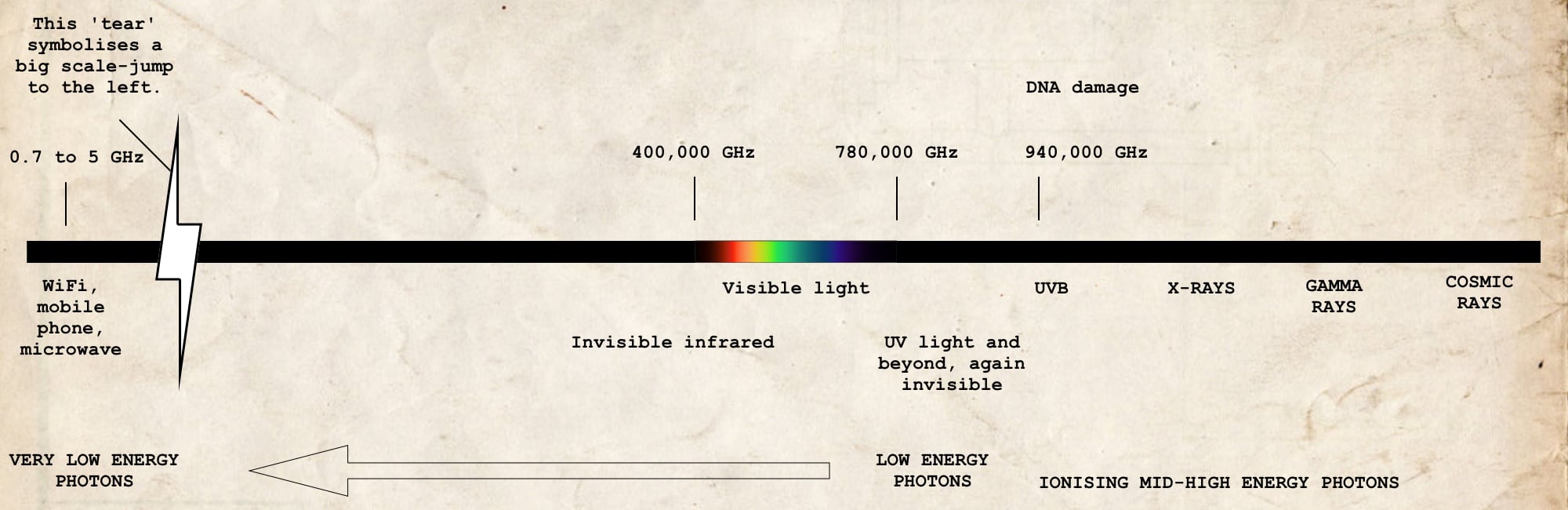
    Below you see a diagram of the full spectrum(beginfootnote)‘Spectrum’ is Latin for ‘appearance’. So, if you speak of the spectrum of something, such as electromagnetism, then you’re referring to all of its appearances.(endfootnote) of electromagnetic radiation (click to enlarge). As you can see, only a small portion is visible to us.

    A diagram of electromagnetic radiation. Far right, we see the dangerous types of radiation: cosmic rays, x-rays, gamma rays, UV-light. In the middle, we see visible light. Far left, we see the lowest energy photons: WiFi, mobile phones, microwave ovens.
    A diagram (not to scale) of electromagnetic radiation, or photons, if you will. The mentioned values are the frequencies of the photons, expressed in gigahertz (GHz). The higher the frequency, the higher the energy of the photon.

    GHz refers to the frequency of the photon and is a measure for the photon’s energy level. The higher the frequency, the higher the energy level. Ultraviolet radiation is where it’s starting to become dangerous to us. This is where our cells become damaged (‘DNA damage’). As long as you’re not exposed to the Sun for too long and x-ray photography is done in very short amounts of time, it’s going to be fine. But be careful. Again, gamma radiation and cosmic radiation are deadly. I understand, it doesn’t feel comfortable at all, but please, please do listen to your parents when you’re going out for a space walk. Put on that spacesuit.

    Impressionable electrons

    In the previous century, physicists such as Albert Einstein discovered that electrons can be influenced by incoming photons(beginfootnote)This is what he received the Nobel Prize for. You can read more about that in my article The formula that got Albert Einstein the Nobel Prize and should stop us getting sunburn all the time.(endfootnote). It very much depends on the way the electrons are captured inside the molecules – which depends on the type of atoms – at which energy level photons they will start reacting.

    In the case of glass, the electrons do feel electromagnetic disturbances slightly. This is why they do start to jiggle differently just a notch. That jiggling causes changes in the part of the electromagnetic field that is inside of the glass. And these changes will influence the photons (disturbances in that same electromagnetic field) in such a way that they’ll change course slightly.

    There's a bear swimming in a pool in a zoo. The pool is visible from the side through a large window. Due to refraction, the head of the bear above the surface seems to be located at a different place than the rest of its submerged body. The bear seems beheaded and yet, it lives.

    This is why the image behind glass can seem to be slightly warped. The same happens when light goes from air to water (as water, too, contains electrons which react to incoming photons). The electrons don’t do too much so that photons can just pass through, however, they do enough so that the photons do change course slightly. Or a lot as you can see by the water in the photo above. In my article Why, exactly, do glass and liquids refract light? we take a deep dive into this phenomenon.

    Why is glass transparent?

    And so, glass is transparent as the electrons in glass molecules aren’t capable of reacting very much to incoming electromagnetic disturbances (photons). Just a little. So, they do bend the original trajectory of the photons slightly.

    There are materials containing electrons responding to all energy levels except those corresponding to blue light, for example. This means that blue light can just pass through while the rest is being absorbed. To us, this material seems to be a blue filter.

    It’s also possible to produce materials carrying electrons which react to all photons in the visible part of the spectrum. They do this so strongly that photons will be reflected completely. We call that a mirror.

    closeup photo of primate looking in a mirror

    Note that we’re talking mostly about photons we can see. To us most glass is transparent. However, we can also produce glass which seems transparent as it lets visible light pass through, while they are much less transparent to birds at the same time.

    We are incapable of seeing UV light. Birds can, however. So, if glass is produced in such a way that they will let visible light pass through but not UV light, they seem less transparent to birds, preventing them to bump into it.

    So, the answer to the question, ‘And if all materials consist of molecules, how is it that the molecules of glass are transparent while others aren’t?’, should rather be: ‘Transparent to whom? To birds? Or to humans?’

    References

    [1] Dinca, L. E. et al. (2015) “Pentacene on Ni(111): Room-Temperature Molecular Packing and Temperature-Activated Conversion to Graphene,” Nanoscale, 7(7), pp. 3263–3269. doi: 10.1039/C4NR07057G.

    [2] Gross, L. et al. (2009) “The Chemical Structure of a Molecule Resolved by Atomic Force Microscopy,” Science, 325(5944), pp. 1110–1114. doi: 10.1126/science.1176210.

  • The double-slit experiment

    The double-slit experiment


    Over three hundred years ago, grumpy old men with 17th-century wigs or 18th-century black-ribboned man ponytails were divided into two camps. They were squabbling over what type of phenomenon light is. ‘Light is waves’, said Huygens, Hooke, Euler and friends. ‘No no, light is particles’, said Newton, Laplace and colleagues. Fast forward to 1990 and even my physics teacher in high school confesses he still wasn’t sure about the correct answer.

    His confusion is understandable. Even though he could have known the correct way of thinking about it, the reason for these murky waters can be traced back to the now famous set of double-slit experiments.

    So, join me in tumbling through the slits of science, into the mad world of quantum physics, where one thing was proven be in two places at once. Or was it?


    NEW: Listen to the audio |


    (not really meant as podcast since referrals are made to figures in the article)


    The set-up

    Suppose you had a shotgun capable of spraying a cloud of numerous tiny lead pellets in one shot. If you’d aim it at a screen containing two thin slits, so only some might get through, what shooting pattern should you expect to appear on a screen behind it?

    Figure 1. A screen with two slits
    Figure 1. A screen with two slits

    I’m quite confident your answer will correlate strongly with the situation as depicted in Figure 2.

    Figure 2. The screen with the double slits and a screen behind it with the typical impact pattern of pellets or particles
    Figure 2. The screen with the double slits and a screen behind it with the typical impact pattern of pellets or particles

    This is exactly what you would expect if the things you’re using to shoot with are tiny pellets or tiny particles. No surprise here.

    Now imagine, we’d slowly submerge the screen with the two slits half-way into a pond. Water waves are slowly rolling towards the first screen as depicted in Figure 3.

    Figure 3. Both screens are now partly submerged in water. Water waves are approaching the first screen.
    Figure 3. Both screens are now partly submerged in water. Water waves are approaching the first screen.

    What would these waves look like after they’ve gone through the slits? When seen from above, it would look like Figure 4.

    Figure 4. As the waves go through the two slits, they transform into two circularly spreading waves like two stones in a pond.
    Figure 4. As the waves go through the two slits, they transform into two circularly spreading waves like two stones in a pond.

    The two slits transform the waves into two circularly spreading waves. Like two stones thrown into a pond. You can see how the waves will intersect with each other. You might expect some interaction to occur at these crossroads and you would be right.

    In fact, let’s have a look at a real pond. In the GIF of Figure 5, you can clearly see how these two circular waves interfere with each other. If two crests meet, they amplify each other’s amplitude, whereas two troughs meeting, they amplify each other’s trough-ness (also amplitude but in the other direction). And where a crest meets a trough, they cancel each other out!

    Figure 5. Two circular waves in an actual pond.
    Figure 5. Two circular waves in an actual pond.

    Now have a look at the animation of Figure 6 and observe especially what the second screen receives: patches where the waves hit the screen are white and patches where there are no waves at all are black.

    Figure 6. The white areas are where the (amplified) waves hit the second screen, the black areas are the parts where no waves are present due to mutual cancellation
    Figure 6. The white areas are where the (amplified) waves hit the second screen, the black areas are the parts where no waves are present due to mutual cancellation

    So, now we know what happens if waves would be thrown at the two slits. Contrary to what you see when you would shoot pellets towards the screen, you would see what’s depicted in Figure 7.

    Figure 7. The double-slit set-up with the typical pattern on the second screen when waves have gone through

    So, now we have two options. If whatever we’re shooting at the slits is particles, we get what’s on the left in Figure 8. If we’re aiming waves at the slits, we get what is on the right in Figure 8.

    Figure 8. If particles went through the slits, you get to see the pattern on the left. If it’s waves, you get the pattern on the right.

    Young’s interference experiment

    Thomas Young was a polymath and physician. In the 1790s, he wrote a thesis on the physical and mathematical properties of sound. In 1800, he presented the Royal Society, the UK’s national academy of sciences, his theory that light is a wave too. He was met with great skepticism as the likes of Newton and Laplace were proponents of the light-is-particles theory. 

    Young then showed how they were wrong. A notable fact is that he didn’t actually use two slits. He had a bundle of sunlight pass through a pinhole so as to obtain a very tiny bundle of sunlight. He then placed a ‘slip of card’ in front of the pinhole, essentially splitting the small bundle in two even smaller bundles which then interfere with each other. The resulting light pattern would have looked like the one shown in Figure 9.

    Figure 9. The pattern which Young produced by splitting sunlight

    If light were particles, you would have seen an entirely different pattern. This result, however, completely corresponds to the wave theory of light. Young concluded therefore that light is indeed a wave phenomenon. He called this the most important of his achievements.

    This marked the beginning of the acceptance of the wave theory of light (yay for Huygens and friends) and a departure from the particle theory of light (nay for Newton and fr… well, colleagues, at least).

    Or particles after all?

    Figure 10. Individual electrons

    Of course, Max Planck, Albert Einstein, and a few other colleagues would later show that light is particles after all. In a previous post, The formula that got Albert Einstein the Nobel Prize and should stop us getting sunburn all the time, we discussed Einstein’s finding which won him the Nobel Prize.

    In short, Max Planck and Albert Einstein showed that certain behaviour of light could only be explained if it consisted of small packets of energy, quanta as they were labelled.

    But apart from that, experimenters found another peculiarity. In the 1960s, electrons were generally expected to behave like particles – like pellets or ball bearings. So, instead of light, they fired one electron at a time towards a splitter and have a screen behind that capture the electron. What they initially saw was to be expected. A few (11) loose dots on the screen as shown in Figure 10. However, as the individual electrons kept being fired, one after the other, an astonishing pattern started to emerge – the kind you would expect to see in the case of interfering waves! Wait, what?

    Are they waves after all? But they were individual electrons! How?

    Needless to say, experimenters did the same thing with individual photons, the quanta of light Max Planck and Einstein were talking about. Extremely low-intensity light was produced up to the point where single photons were shot at the screen. The same result. They seem to behave like particles at first but then this wave pattern emerges.

    Two places at once?

    Theorists then theorised that the only explanation was that a single electron and a single photon somehow went through the two slits at the same time, enabling some kind of self-interference so that this wave pattern would emerge while also preserving a particle pattern at the same time.

    To test this theory, people put particle detectors at the two slits in order to see if the single electron or the single photon indeed flew through both slits at the same time.

    The result was again astonishing: the wave pattern disappeared and what they got was instead the pattern you’d expect to see if the particles were actual particles – the pattern was like the pattern in Figure 2. At the same time, they never detected the particle at both detectors. They were ever only detected by one detector – as if they were particles.

    As soon as they removed the detectors, however, the wave pattern emerged again.

    And even if they placed just one detector at one slit, the wave pattern disappeared again and the particle pattern showed up.

    It was as if the electron and the photon knew when they were being watched and then decided to behave differently.

    This is called the measurement problem. In the next post, we will discuss this at greater depth.

    People now started talking about the wave-particle duality of elementary particles. Are particles truly particles or waves? They’re both, people now said. Sometimes they’re waves, sometimes they’re particles.

    Fields

    Of course, nowadays, the reigning theoretical paradigm is quantum field theory – mathematical field descriptions to capture the behaviour of ‘particles’ such as the electron, the photon, and a whole zoo of elementary constituents of our reality. The most successful quantum field theory to date is called the Standard Model of particle physics. In a previous post, Why, exactly, do glass and liquids refract light?, we dive a little bit into quantum field theory.

    In short, the question of whether light is particles or waves has been answered: it’s fields. The same goes for electrons. And all the other elementary ‘particles’. It’s all fields.

    As long as no interaction with the outside world such as detectors take place, a photon or electron are part of the wave functions of their respective electromagnetic and electron fields, governed by the Schrödinger equation. They are very much like waves. However, as soon as they interact with something, such as a detector, what is detected is a particle, merely a slice of a photon’s or electron’s entire wave function.

    I promise we will unpack these two last paragraphs in a later post. We expounded on that a little bit already in This is not an atom.

    But, please, tell me now, are they in two places?

    No, not even technically. Linguistically then? Also, no. That statement is likely the result of mixing-up or lack for a better way of providing both metaphorical and physical descriptions of what is going on – it also reveals the still-present, outdated notion of what photons and electrons were supposed to be. If electrons were in two places at once, you still imagine them being small, little pellets, two copies of which fly through both slits, somehow interfering with each other. And that’s just not so.

    The correct expression is that electrons and photons and the likes don’t have a definite location: their existence is simply spread out in space according to the wave function, the time-evolution of which in turn obeys the Schrödinger equation. Again, do give This is not an atom a read where this is explained in more detail.

    Pretty mind-bending stuff, right? Good. Welcome to the club. Great minds before you have had to take their time to wrap their heads around the double-slit experiment. Now you’re one of them.


    Featured image by Free-Photos

    Sunlight diffraction pattern by Aleksandr Berdnikov under CC BY-SA 4.0

    Single electron build-up series. Results of a double-slit-experiment performed by Dr. Tonomura showing the build-up of an interference pattern of single electrons. Numbers of electrons are 11 (a), 200 (b), 6000 (c), 40000 (d), 140000 (e). By Belsazar under CC BY-SA 3.0.

  • Is microwave oven radiation unhealthy?

    Is microwave oven radiation unhealthy?


    Some say that the radiation inside a microwave oven is bad for our health. And that it’s bad for our food. It’s uncertain from where these contentions originate exactly. Even though the introduction of the microwave oven(beginfootnote)They were called ‘electronic ovens’.(endfootnote) in our homes took place in the 1960s, among some, they never got rid of their unhealthy reputation entirely. In this article, we will have a look at what its radiation is and how that influences food and vitamins. We will then proceed to answer the question: Is microwave oven radiation unhealthy?

    The word ‘radiation’

    Pripyat, near Chernobyl, Ukraine. When we hear 'radiation', we may associate it with the Chernobyl disaster. That is absolutely not at all what microwave oven radiation is.
    Pripyat, near Chernobyl, Ukraine. When we hear ‘radiation’, we may associate it with the Chernobyl disaster. That is absolutely not at all what microwave oven radiation is.

    In physics, ‘radiation’ is the emission or transmission of energy in the form of waves or ‘particles’. Not all radiation is a health hazard to our species as we have evolved to be immune in most cases. Radiation emitted by nuclear reactors is dangerous. However, it may not surprise you that we have evolved to withstand the radiation of tea lights.

    While society generally might not care about what physics says ‘radiation’ means, this is what we’re going to be using throughout this article.

    Radiation is not always dangerous. There are more things in everyday life than you might think which are forms of radiation.

    Bananas, also those growing in the wild, naturally possess radioactivity. Our species can handle this. It's infinitely more dangerous for other reasons. Don't litter, folks.
    Bananas, also those growing in the wild, naturally possess radioactivity. Our species can handle the radiation. It’s infinitely more dangerous for other reasons. Don’t litter, folks.

    Some examples of sources of radiation: bananas (which are naturally radioactive), magnets, candle sticks, central heating, club and stage lights, any light source for that matter, including your bathroom light, human bodies, microwave ovens, the Sun, the uranium and plutonium rods of a nuclear plant, and furthermore, anything you can see with your eyes either emits or reflects radiation, right here, right now.

    Just look straight into the eyes of your partner, or friend with merits, lying next to you the next morning: whether you want to or not, they have been literally gushing their radiation all over your body, right here, and are still, right now, the whole time. And not in any spiritual or venereal sense, no no, you have been and are being exposed to actual spurts of electromagnetic radiation discharging from their bodies(beginfootnote)Infrared, mostly. Note that our bodies are also radioactive. We emit ‘particle’ radiation too. On average, about 5000 of our atomic nuclei decay every second (5000 Bq) and emit radioactive radiation.(endfootnote), at energy levels literally more than a hundred thousand times higher than microwave oven radiation.

    In fact, in all the examples above, it’s the same type of radiation as microwave oven radiation, called electromagnetic radiation. The difference is that the examples are more than a hundred thousand times more energetic than microwave oven radiation. Except for a big chunk of the Sun’s radiation, and uranium and plutonium rods. Those entail dangerous forms of ionising radiation, and involve more than just the electromagnetic kind.

    Ionising radiation

    The dangerous form of radiation is called ionising radiation. This is the type of radiation many people think of when they hear the word ‘radiation’. Microwave oven radiation isn’t that.

    If incoming radiation has so much energy that it strips one or more electrons away from their nucleus, we call this ionising radiation. An atom which has lost one or more electrons, we consider to be ionised, and so, we now call it an ion.

    Why is this dangerous? Well, our bodies are made of large strings and knots of intertwined atoms. Our skin, organs, cells, DNA—it’s all made up of trillions of atoms. Those atoms are only able to form these large chains and knots because their electrons keep them together this way.

    Thus, if ionising radiation strips away those electrons from their nucleus, then our molecules, cells, DNA—it all falls apart. And especially damage to our DNA is dangerous as this could develop into cancerous growth. Fortunately, our body has evolved to possess certain superpowers, if you will, enabling it to repair damaged cells and even DNA to an astonishing degree.

    Sadly, there are limits. A sufficient blast of ionising radiation may cause damage beyond our bodies’ repair capabilities and thereby may be the cause for cancer.

    Ionising radiation breaks down atoms, thus molecules, thus organic cells. When our body’s repair mechanism is overwhelmed by the amount of ionisation, this may eventually lead to cancer and organ failure. Microwave oven radiation, however, is not ionising at all. Far from it. It is simply not energetic enough. Not by a stretch.

    Examples of ionising radiation are:

    • subatomic particle radiation: such as protons, neutrons, separate or combined to an atomic nucleus(beginfootnote)Also known as alpha particles.(endfootnote) as well as electrons and positrons(beginfootnote)Also known as beta particles.(endfootnote) flying about, aimed at your general direction;
    • high-energy electromagnetic radiation: cosmic rays, gamma rays(beginfootnote)This is what Dr Bruce Banner was exposed to, turning him into what we call a Hulk. But please, don’t try this yourself. Most likely, you’ll die. At best, you might end up looking like former KGB agent Emil Blonsky or General Thaddeus Ross. If you’re unfamiliar with their tragic fates: Universal Misery.(endfootnote), X-rays(beginfootnote)In hospitals, you will receive much less the amount of X-ray radiation than would be dangerous. Your body is capable of repairing any damage, in this case. It still means that one must be careful, hence, only highly-qualified medical personnel should administer X-ray doses.(endfootnote), the higher-energy UV-light.

    Electromagnetic radiation

    Microwave oven radiation is electromagnetic radiation. What is the latter then? In physics, we have the most successful of theories called quantum electrodynamics (QED), which arose in the 1930s. Do watch these amazing, very accessible videos of the genius and Nobel laureate Richard Feynman, who brought major contributions to QED. It’s the first theory within a larger physical framework called quantum field theory (QFT). In short, without QED, we wouldn’t have had electromagnetism-based technology such as microprocessors—which means we wouldn’t have had TVs, computers, mobile phones, and internet. To understand the theory is to make a few mental steps. In Why, exactly, do glass and liquids refract light?, we’ve mentioned QFT already. We paraphrase the essence down below.

    Space throughout the entire observable Universe is filled with three-dimensional fields. In fact, fields are a property of space. Space without fields does not exist. With space come fields.

    There are many fields. Two of these fields are the electromagnetic field and the electron field.

    We perceive oscillations at specific frequencies in the electromagnetic field as photons, ‘particles’ of light, if you will, sometimes visible light but most of the time it’s invisible light.

    We perceive oscillations at specific frequencies in the electron field as electrons. If we measure them—interact with them using an electric probe in the lab for instance—we perceive them as ‘particles’. Usually, we speak about them as ‘particles’, even though they’re not.

    Electrons influence the electromagnetic field. The latter influences electrons in return. Photons are oscillating parts of the electromagnetic field, and so, electrons influence photons, while photons influence electrons. However, electrons are only influenced by photons when the latter have specific energy values, not just any energy value.

    Photons, or, the electromagnetic field disturbances caused by a microwave oven, which we call ‘radiation’, do not have the correct energy value to ionise the atoms in our body.

    Luckily, photons emitted by the person lying next to you don’t have the correct energy value to destroy our atoms either, nor do the regular lights in our home, even though they carry a hundred thousand times more energy than those of a microwave oven.

    All this is perfectly calculable. Because maths and physics.

    A schematic depiction of two fields spanning throughout the entire observable universe. Here, they look like two-dimensional planes hovering over one another with a little bit of empty space between them but in reality they are three-dimensional fields pervading all of space. They are completely intertwined with each other, three-dimensionally. Electrons are specific oscillations in the electron field and are here depicted as darker yellow blobs in the yellow-coloured electron field. Photons, light, or electromagnetic radiation (they are all the same thing) are likewise depicted as darker green blobs in the green-coloured electromagnetic field. The lighter-green blobs represent the influence in the electromagnetic field caused by electrons.
    A schematic depiction of two fields pervading through the entire observable universe. Here, they look like two-dimensional planes hovering over one another with a little bit of empty space between them but in reality they are three-dimensional fields pervading all of space. They are completely intertwined with each other, three-dimensionally. Electrons are specific oscillations in the electron field and are here depicted as darker yellow blobs in the yellow-coloured electron field. Photons, light, or electromagnetic radiation (they are all the same thing) are likewise depicted as darker green blobs in the green-coloured electromagnetic field. The lighter-green blobs represent the influence in the electromagnetic field caused by electrons.

    How do we know?

    Max Planck, a German theoretical physicist (1858-1947), found a way to calculate the energy values for photons. Einstein subsequently used Planck’s formula to come up with another formula allowing us to calculate if atoms would become ionised by certain forms of radiation. In The formula that got Albert Einstein the Nobel Prize and should stop us getting sunburn all the time, we discuss Einstein’s groundbreaking work in quantum mechanics which would later develop to become quantum electrodynamics (QED). Warning: mathematical equations are given in that article.

    This cheery-looking fellow was a physicist, a genius, and a Nobel laureate. He was one of the founders of quantum mechanics. His name was Max Planck. This is a photograph from 1933.
    This cheery-looking fellow was a physicist, a genius, and a Nobel laureate. He was one of the founders of quantum mechanics. His name was Max Planck. This is a photograph from 1933.

    And so, after many more contributions by really clever people, the fascinating branch of science arose through which we are now able to harness the power of electromagnetic radiation, including that of the microwave oven as well as, incidentally, radio signals, TV signals, Wi-Fi, and mobile phone signals.

    If you want to know where in the ‘spectrum of danger’ microwave oven radiation lies, have a look at this diagram. Hint: if radiation in a microwave oven were dangerous, then the lights in your toilet would liquidate you instantly to a warm, sliding, sneakers-covering pulp of mashed guts, lung pudding, and brain leftovers. Also, Planck, Einstein, and others, would be turning over in their graves.

    Heat

    Knowing this, the natural thing to ask is, what about all the heat? If microwave oven radiation is really that low-energy, how does it manage to cook my food boiling hot? The answer is friction.

    Remember that time when you bent a piece of steel wire back and forth quickly for a while? And that the bend eventually became very hot? That’s because you had been moving many molecules back and forth quickly enough to have them heat up the wire due to friction. You don’t need life-threatening amounts of energy—merely the energy of your arms—to make something really, really hot. Microwave radiation does that mainly with the water molecules in food.

    Under the influence of the electromagnetic field inside the microwave, the slightly polarised water molecules rotate back and forth about 2 400 000 000 times per second. Friction with their surroundings cause heat.

    It’s like rubbing your hands together the same number of times per second, which entails friction and causes heat. This is why it’s easier to heat up solid food in the microwave oven than liquids, such as a cup of water: in the latter, water molecules experience less friction than in the first.

    The radiation does nothing to the composition of the atoms. It merely causes molecules to move. Just as a flame does. Or a conventional oven. Making molecules move, that’s all there is to it.

    This also means that you shouldn’t put your hand in an operating microwave oven. Your molecules will start moving too, just like in a conventional oven or when you would put your hands into a flame on the hob. Though, admittedly, in a microwave oven that would mostly only be your water molecules, while in a conventional oven or on the hob, all of your molecules are affected.

    Vitamins

    Does microwave oven radiation destroy vitamins? As stated before, the radiation isn’t ionising, so it does not destroy vitamins. Heat does, however. Just as flames and conventional ovens heat up food and through that heat destroy vitamins, so does radiation. Not because of the radiation but because of simple heat.

    If microwave oven radiation did destroy vitamins, then the light hanging over your dinner table should obliterate the entire dish in an instant. That would be overdoing the concept of having a quick meal, somewhat.

    Here’s a silver lining. The longer food is exposed to heat, the more vitamins are destroyed. So, if there would be a means to heat food as quickly as possible, less vitamins would be destroyed. It might just be that, depending on all kinds of settings and situations, heating food quickly inside an efficient microwave oven spares more vitamins than a slow burn on the stove.

    We see a gas stove. Flames are engulfing the bottom of a pot. Vitamins are destroyed by heat, not microwave oven radiation.
    Vitamins are destroyed by heat, not microwave oven radiation. Beyond a certain temperature, a certain number of vitamins per second are starting to be destroyed. The longer it takes to heat up food after that, the more vitamins are broken down.

    Moreover, cooking food in a pot in its liquids and then throwing away the liquids equals throwing away the dissolved vitamins in those liquids. This happens a lot while cooking on a conventional hob. In a microwave oven, however, everything stays on the same plate. So, even if vitamins have dissolved in the food’s liquid, you’d still have them on your plate.

    Lastly, while microwave ovens don’t emit radiation that is carcinogenic, food itself may very well be, especially when it’s burnt. So, particularly when cooking on the flames and in a conventional oven: don’t burn your food. You know this. Don’t burn it to a crisp and then eat it.

    Incidentally, microwave oven radiation is very unlikely to burn food on a plate(beginfootnote)Which is why many don’t like it since, more often than not, a little bit of that browned-burnt-y flavour does taste good.(endfootnote).

    Is microwave oven radiation unhealthy?

    Courtesy of quantum physics, microwave oven radiation is not unhealthy and by itself, it doesn’t destroy vitamins (heat does). There is also no residual effect that might be dangerous: it’s like switching the light on and off, only a hundred thousand times less energetic than light. One might mix things up with the residual effect of a nuclear bomb or a nuclear disaster. This is due to the billions of heavy atomic nuclei having been hurled into the environment which in turn emit ionising radiation for thousands of years. Microwave ovens don’t hurl atomic nuclei into your food. That would have been deadly, indeed.

    Any text online, in books or magazines, stating otherwise is basically fighting against the quantum mechanical facts of the Universe. And a grumpy Einstein. In which case, other forces and motivations must have been at play in stating these uninformed propositions.

    So, if someone is telling you microwave ovens are unhealthy, ask them for the exact quantum mechanical equations supporting their claim. Sorry but it is what it is, and it is simply this Universe. If quantum mechanics weren’t correct, they’d have never been able to read their uninformed online source, anyway. Computers wouldn’t work. Their mobile phone would be nothing more than a fancy brick. Internet would never have existed. They would never be able to spread false rumours online about microwave ovens if physics were incorrect. Heck, they themselves wouldn’t even exist.

    We see a shirtless man in a canoe. Don't do this without sunscreen. This is dangerous. Not microwave oven radiation.
    Don’t do this without sunscreen. This is dangerous, not microwave oven radiation.

    By the same science, however, do watch out for the Sun’s UV-light this summer. And avoid at all cost, cosmic rays, gamma rays, and particle beams(beginfootnote)Unless exposure takes place briefly, as conducted by awesome and life-saving medical professionals.(endfootnote), so, whatever you do, do not stroll outside your international space station without a protective suit. And don’t eat yellowcake. Ever. Instead, radiate some green beans in a microwave oven. And eat a radioactive banana. Much healthier.


    Photo of Pripyat, near Chernobyl, Ukraine by Денис Резник from Pixabay.