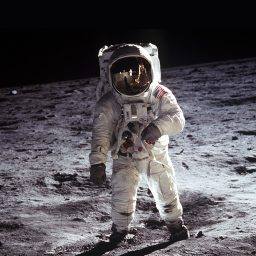
Today, fifty years ago, on the Sunday of 20 July 1969, at 20:17 UTC, aeronautical engineer, test pilot, and astronaut Neil Armstrong reported to the Mission Control’s CAPCOM(beginfootnote)capsule communicator(endfootnote) Charles Duke, and transmitted already historic words.
NEIL: ‘Houston, Tranquility Base here. The Eagle has landed.’
CAPCOM: ‘Roger, Twan— Tranquility, we copy you on the ground. You got a bunch of guys about to turn blue. We’re breathing again. Thanks a lot.’
Of course, ‘Twan'(beginfootnote)’Twan’ is (at least) a Dutch version of the French name ‘Toine’, usually given to males.(endfootnote) was a mistake but who cared because humanity had just achieved the greatest accomplishment thinkable.
This was and continued to be the stuff that dreams were made of. Many decisions to become a scientist and engineer were due to the hardly over-estimable inspiration the landing on the Moon brought to many of us and the next generations. We can only hope that a sufficient percentage of humanity will be allowed by society to continue to perform scientific research and explorations(beginfootnote)And that scientific data won’t be confused with opinions and/or regarded as part of the larger scheme of deception from a hidden agenda of those who really control the world. ??(endfootnote).
Here is a clip of the landing, courtesy of NASA: ‘It’s a 16mm film clip showing the final forty seconds of descent. It begins when Charlie Duke calls out sixty seconds of fuel remaining, and with the Little West Crater at the bottom of the window. The time-lapse video runs faster than real-time. Audio runs at normal, real-time speed, however.’
If you have time (three hours and two minutes), by all means, watch NASA’s restored Apollo 11 Moonwalk.
Science
While it was indeed an unprecedented achievement of courage, skill, and applied maths and science, the astronauts also carried out several scientific experiments, yielding some very interesting data on our solar system. Dr. Becky Smethurst, astrophysicist and research fellow at the University of Oxford, highlights the following five things we didn’t know before we went to the Moon, in a video on their YouTube channel:
the distance to the Moon,
the structure inside the Moon,
what the solar wind is made of,
what the Moon is made of,
how the Moon was formed.
We highly recommend subscribing to their channel with ever informative and entertaining nuggets of knowledge you both knew and didn’t know you wanted to know about that little agitation called Universe. Happy lunar anniversary! To everyone.
Screenshot of Dr. Becky’s video. Click to open their YouTube clip.
Featured image: Buzz Aldrin, made by Neil Armstrong. Courtesy of NASA.
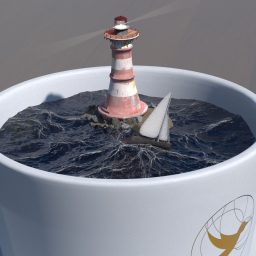
The Moon orbits the earth and its gravity is causing the tides. But why don’t swimming pools have tides? Or a cup of coffee? Human bodies consist of water, mostly. Aren’t they tidally influenced by the Moon? If you’re asking all these beautiful questions, then what you thought is causing the tides is probably wrong, and here’s why.
Remember, back in high school, when the science or physics teacher had all the air sucked out of a large, transparent tube which contained a feather and a little steel ball or something like that? And that she asked you to predict which would drop to the bottom first if she would turn the tube upside down?
Of course, both objects turned out to fall to the bottom at the exact same speed. We learnt it did not matter if the steel ball had more mass than the feather. Earth’s gravity works the same on both. In fact, anything which is being ‘pulled down’ by our planet’s gravity gets to be pulled down at the same rate, no matter how much mass these things have (provided we ignore any form of friction).
Lunar gravity
Even though the Moon’s gravity is smaller than Earth’s, the principle is the same. Irrespective of an object’s mass, it falls straight to the lunar surface at precisely the same rate as any other thing. On 2 August 1971, NASA Commander David Scott demonstrated that a feather and a hammer hit the Moon’s soil simultaneously.
The Moon’s gravity is strong enough to have a noticeable effect on Earth, as we all know. Indeed, it is the reason why our oceans have tides. However, if gravity, whether on our planet or on the Moon, acts the same way on every object irrespective of their mass, how come our bathtub does not experience tides, for instance? Yes, it has less mass, but by Cmdr David Scott’s experiment, that shouldn’t matter. And if the Moon’s gravity is capable of pulling on vast bodies of water such as oceans causing them to rise literally meters high, why does our rubber duck not start levitating up in the air as soon as the Moon rushes past our homes?
The answer sounds both obvious and contradictory: because the force of the Moon’s gravity is negligibly small, except when it is not.
The wrong picture
Let’s have a look at the simplified drawing of Figure 1. Just to make things a little less complicated, we imagine our planet to be covered by water entirely. There are no continents for now.
Figure 1. Earth’s tides and the Moon. (Not to scale!)
First misconception. Even though, intuitively, it may seem to be the case, the bulge at point A is not because the Moon’s gravity is tugging at it, contrary to popular belief.
And in many texts, you might encounter the following incorrect explanation for the bulge at point B. ‘The Moon’s pull is smaller at point B than at point A, so, point B stays more or less where it is, while point A gets pulled more towards the Moon. Everything in between A and B gets stretched like chewing gum. So, from the perspective of someone standing (on land) at point B, the water rises there as well.’
This is also mostly incorrect. It is true, the Moon’s gravitational pull is smaller at B than it is at A. But that is not what is causing the bulge at point B. Not in the direct way as stated here, that is.
Many a little makes a mickle
Why don’t we have a look at points C and D in two different, little patches of water in Figure 2? The Moon’s force of gravity acts on these points at a certain angle as is represented by the blue arrows, or vectors. At the same time, the entire earth experiences a slight force towards the Moon as is modelled by the red vector.
Figure 2. The force of the Moon’s gravity acting on points C and D and the entire earth
So, point C and D undergo two simultaneous forces as is explicitly shown in Figure 3. Note that the blue and red vectors have different directions. Our high school physics or maths teacher then taught us that two or more forces acting on the same point can be modelled as one resultant force.
Now we need to take two important steps: 1. Newton taught us that a force is an acceleration, so, from now on we will regard the arrows in Figure 3 as being accelerations. 2. To determine the acceleration of the patches of water at points C and D relative to Earth’s surface, we subtract the red vector from the blue vector. What’s left is the green vector, the resultant.
Figure 3. The resultant forces are represented by the green vector
In Figure 3, it is shown how the combination of the two gross forces blue and red yield a net force as represented by the green vectors. Do note, the net forces are what is called apparent forces. Think of a car suddenly accelerating. Relative to the ground, your head is standing still for an instant of time. However, from within the car, your head seems like it is being pushed back by some invisible force. Tides are thus being caused by so-called tidal forces, which are apparent forces.
So, if we do the same for many other points, you get many green vectors as they are shown in Figure 4. And guess what, all the green (now black) arrows point in a way that look a lot like bulges in the water.
Figure 4. An array of net forces (the green arrows are here the black arrows)
This shows that what actually happens is that every minuscule patch of water gets influenced by a tiny bit of net force in the direction of the places where the bulges will emerge, pushing every other patch in front of it towards the bulges, thereby creating the bulges in the first place.
Now, in the drawing, all arrows are relatively massive, so we can actually see them. In reality, however, the net forces are tiny. Microscopically tiny.
And this is the key to solving the paradox. Even though a net force, resulting from the Moon’s gravitational influences, is utterly insignificant on a single patch of the water, the amount of ocean on Earth is quite the opposite of negligible, rendering the sum of all net forces on every cubic patch within the oceanic liquid highly significant, and in some cases, depending on the shape of the land, dangerously significant.
Conclusion
The Moon’s influence on tiny things is tiny. It does not noticeably influence your cup of coffee, your body, your bathtub, ponds, and lakes. Any tidal height difference in a cup of coffee could be thinner than a bacterium, the significance of which is immediately squashed by the mere presence of, well, a bacterium in your coffee, practising its back crawl. If your coffee starts to display any tidal effects, prepare for the Apocalypse and/or escaped dinosaurs. Either case, something is really wrong then.
Even a lake the size of Lake Michigan will only rise a couple of centimetres—easily negated by its murmuring surface on a sunny day in May. So, you can imagine, your body does not feel a thing. The pressure needed for delivering oxygen to your brains alone squashes out every single tidal influence by the Moon, which would have been smaller than a hair’s thickness anyway. If you feel less capable of rational thought, you now know it’s not the Moon. But do check your blood pressure.
However, in the case of an ocean, a body with many, many, many tiny, watery parts which can roll, slip and slide freely on top of one another, there will be bulges about where the Moon whizzes. However, the swelling occurs by virtue of pushing not pulling, directly.
In short, a quindecillion minuscule little net forces on every cubic piece of the ocean cause an upward push so the two bulges emerge. Lakes, ponds, bathtubs, human bodies, and coffee mugs do not come close to even a little bit of that amount.
EDIT: the original article omitted to mention how tidal force is an apparent force, resulting in a fundamental misinterpretation of Figures 3 and 4. This has been corrected.
We did not consider the rotation of the earth, the Coriolis effect, the presence of the sun, the presence of land, etc., just to keep it simple. This changes the situation somewhat, but does not change the gist of it all.
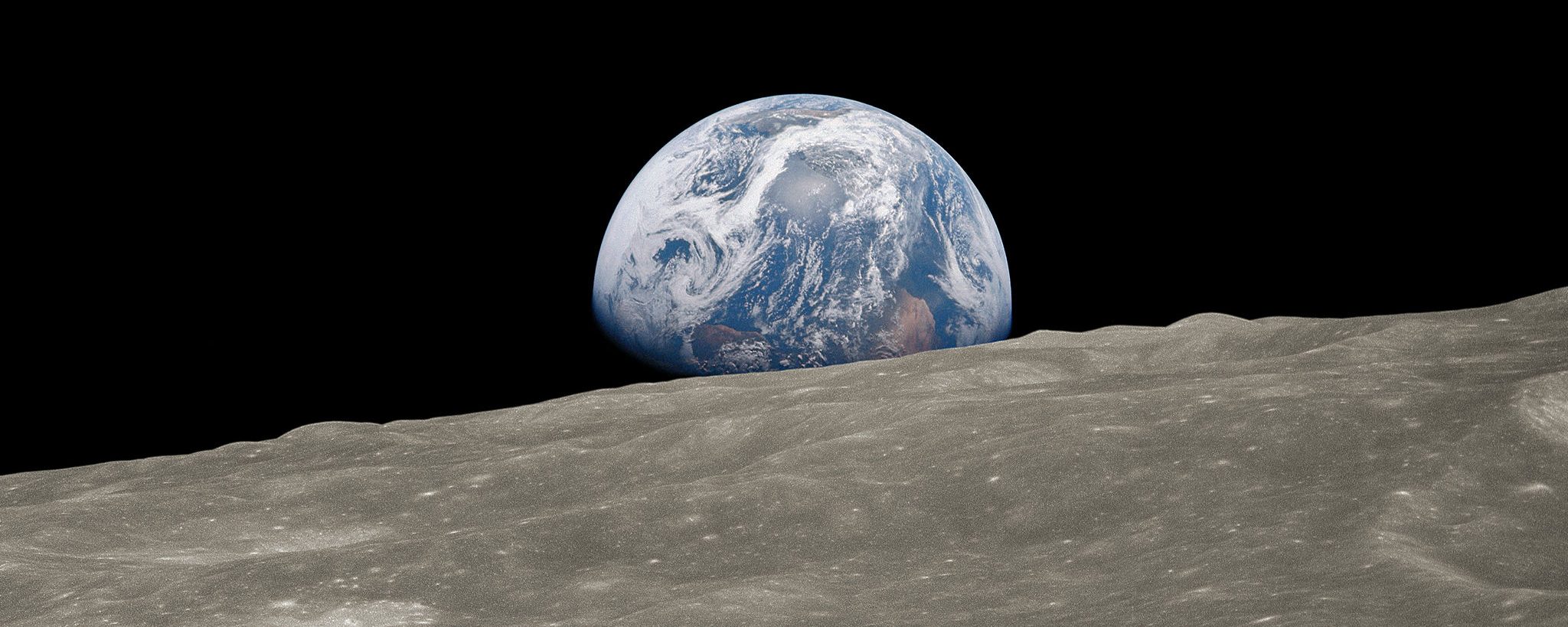
NASA recently published a 4K version of an audiovisual amalgam of the iconic Earthrise photo made by Apollo 8’s astronaut William Sanders on the 24th of December 1968, a 3D mapping of lunar photography, and the voice-recording of the crew onboard the spacecraft.
It allows us to witness in real time the events unfolding leading up to the moment it was captured. We can hear Anders’ crew-mate Borman joking: ‘Hey, don’t take that, it’s not scheduled.’ We are glad Anders was not the type to take everything literally.
In an interview with The Guardian, Anders noted his experience had even changed his religious views, in fact, undercutting them.
Well, while we are not concerned with whether it changes one’s existential views on life and the universe or not, we do hope you enjoy witnessing their voice-recorded awe and amazement for this precious little blue ball and its smaller grey companion whizzing around the big white ball for a whole new year.
We wish you a successful, loving, and all-along-the-line gorgeous new trip in the vast emptiness of the fabric of the cosmos.