We will focus on a few simple problems where we will manipulate the equations for relativistic energy and momentum.
This could be seen as a second-year university-level post.
Einstein had shown that the Lorentz transformations were the correct way to switch between the coordinate systems of different frames of reference [1]. He also taught us that Newton’s laws weren’t at all proper relativistic laws. For instance, Newtonian momentum $ \mathbf{p} = m \mathbf{v} $, and energy $ E = mv^2 / 2 $ were not at all accurate at speeds approaching that of light.
Instead, we have all come to learn that the relativistic momentum is written as
\begin{equation} \label{eq:relativistic momentum} \mathbf{p} = \frac{m \mathbf{v}}{\sqrt{1 – \dfrac{v^2}{c^2}}}. \end{equation}
And that the correct relativistic expression for total energy is
\begin{equation} \label{eq:relativistic energy} E_{\text{tot}} = \frac{mc^2}{\sqrt{1 – \dfrac{v^2}{c^2}}}. \end{equation}
We will solve the following problem set:
- Prove, for a particle travelling at $ c $, that the magnitude of the relativistic energy is given by $ E = pc $.
- Show that the energy-momentum relation for a particle with any mass $ m $ travelling at any speed $ v $ is correct and do mind it is not the famous $ E = mc^2 $ we are referring to. Use the correct one, if you please.
- Given that the mass of a proton is $ m_p $, calculate its exact speed when its relativistic translational kinetic energy (which is the relativistic total energy minus its relativistic mass energy) is four times its relativistic mass energy.
Problem I
Since $ E $ is expressed in terms of $ p $, we need to rewrite Eq. $ \eqref{eq:relativistic momentum} $ by solving for $ m $:
\[ m = \frac{p \sqrt{1 – \dfrac{v^2}{c^2}}}{v}. \]
Note, we do not use the vector quantities, just the magnitudes. We can now proceed to substitute this into Eq. $ \eqref{eq:relativistic energy} $:
\[ E_{\text{tot}} = \frac{\left(\dfrac{p \sqrt{1 – \dfrac{v^2}{c^2}}}{v}\right)c^2}{\sqrt{1-\dfrac{v^2}{c^2}}}. \]
This reduces to
\begin{align}
E_{\text{tot}} &= \frac{pc^2 \sqrt{1 – \dfrac{v^2}{c^2}}}{v \sqrt{1 – \dfrac{v^2}{c^2}}}, \\
\therefore E_{\text{tot}} &= \frac{pc^2}{v}. \label{eq:E=pc^2/v}
\end{align}
As we are dealing with a particle travelling at speed $ c $, we know $ v = c $, rendering Eq. $ \eqref{eq:E=pc^2/v} $ to
\begin{align}
E_{\text{tot}} &= \frac{pc^2}{c}, \\
\therefore E_{\text{tot}} &= pc.
\end{align}
Problem II
The energy-momentum relation is
\[ E^2_{\text{tot}} = p^2c^2 + m^2c^4. \]
Substituting Eqs. $ \eqref{eq:relativistic momentum} $ and $ \eqref{eq:relativistic energy} $, yields
\[ \left(\frac{mc^2}{\sqrt{1 – \dfrac{v^2}{c^2}}}\right)^2 = \left(\frac{m \mathbf{v}}{\sqrt{1 – \dfrac{v^2}{c^2}}}\right)^2c^2 + m^2c^4, \]
which we can continue to work out as follows:
\begin{align*}\left(\frac{mc^2}{\sqrt{1 – \dfrac{v^2}{c^2}}}\right)^2 – \left(\frac{m \mathbf{v}}{\sqrt{1 – \dfrac{v^2}{c^2}}}\right)^2c^2 – m^2c^4 &= 0, \\
\frac{m^2c^4}{1 – \dfrac{v^2}{c^2}} – \frac{m^2v^2c^2}{1 – \dfrac{v^2}{c^2}} – m^2c^4 &= 0, \\
\left(1-\dfrac{v^2}{c^2}\right)\left(\frac{m^2c^4}{1-\dfrac{v^2}{c^2}}\right) \qquad &\qquad \\ – \left(1-\dfrac{v^2}{c^2}\right)\left(\frac{m^2v^2c^2}{1-\dfrac{v^2}{c^2}}\right) &\qquad \\ – \left(1-\dfrac{v^2}{c^2}\right)m^2c^4 &= 0, \\
m^2c^4 – m^2v^2c^2 – m^2c^4 + \frac{m^2v^2c^4}{c^2} &= 0, \\
m^2c^4 – m^2c^4 – m^2v^2c^2 + m^2v^2c^2 &= 0, \\
0 – 0 &= 0.
\end{align*}
Hence, for every value of $ m $, $ p $, and thus $ v $, the relation holds.
Problem III

The relativistic (total) energy is
\[ E_{\text{tot}} = E_{\text{trans}} + E_{\text{mass}}. \]
If the relativistic translational kinetic energy is four times the relativistic mass energy, then we can write
\[ E_{\text{trans}} = 4E_{\text{mass}}. \]
In our case, this then yields for the relativistic (total) energy:
\[ E_{\text{tot}} = 4E_{\text{mass}} + E_{\text{mass}} = 5E_{text{mass}}. \]
To calculate the proton’s speed, we then write
\begin{align*}
\frac{m_pc^2}{\sqrt{1 – \dfrac{v^2}{c^2}}} &= 5E_{\text{mass}} = 5m_pc^2, \\
\frac{1}{\sqrt{1 – \dfrac{v^2}{c^2}}} &= 5, \\
\sqrt{1-v^2/c^2} &= \frac{1}{5}, \\
1-\frac{v^2}{c^2} &= \frac{1}{25}, \\
\frac{v^2}{c^2} &= \frac{24}{25}, \\
v^2 &= \frac{24c^2}{25}, \\
\therefore v &= \sqrt{\frac{24c}{25}} = \frac{2\sqrt{6}c}{5},
\end{align*}
which is about $ 0.98c $ rounded to two decimals, which means that the proton zips at about 98% of the speed of light through the fabric of the cosmos.
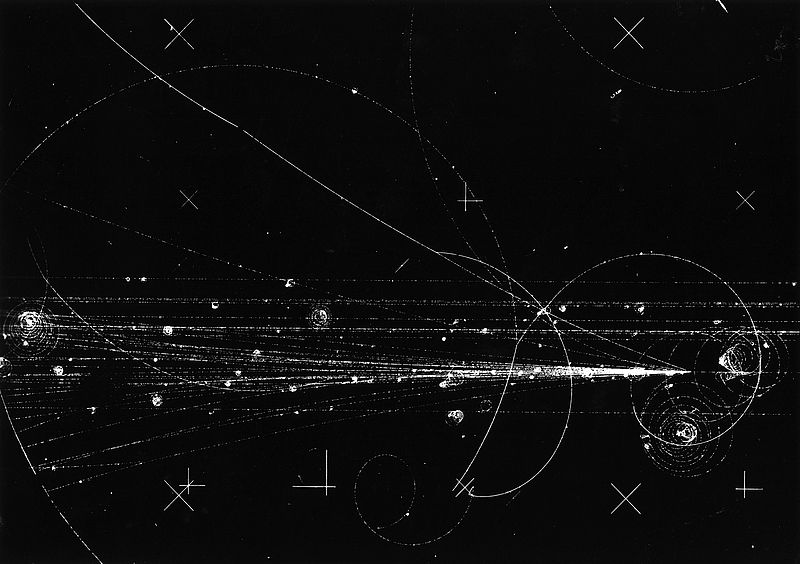
Image Hydrogen bubble chamber Fermilab: Proton with 300 GeV energy producing 26 charged particles in the 30 inch hydrogen bubble chamber at Fermilab. Source: Wikimedia Commons
[1] Einstein, A. (1905) ‘Zur Elektrodynamik bewegter Körper’, Annalen der Physik, 322(10), pp. 891–921. doi: 10.1002/andp.19053221004.
This is a repost. Slight errors in the parsing of LaTeX in the original article of 24 December 2018 have been corrected.
.jpg)