Tag: quantum mechanics

  • Why is glass transparent?

    Why is glass transparent?


    Imagine transparent materials didn’t exist. What would cars look like? How would you be able to look at the cold Winter Moon from your bedroom window without getting cold yourself? Would air be opaque too? What about the lenses in our eyes? And if all materials consist of molecules, how is it that the molecules of glass are transparent while others aren’t? This last question was asked by the oldest(beginfootnote)If I’m not mistaken, thirteen at the time I’m writing this.(endfootnote) son of one of my best friends last week.

    Firstly, I’ll try to give an answer as short as possible. If you’d like to know more, you can read on. Be warned, however: the article is quite possibly a bit long. It’s just that the answer to this seemingly easy question asks for quite some background knowledge. On the other hand, with a brilliant question like this one—let’s just say, you’re asking for it.

    Short answer

    Sometimes the composition of a molecule is such that its electrons will hardly respond to passing photons. For all intents and purposes, they will leave them be. At most, they will change their course a little. To our eyes, the material is then transparent.

    If electrons do react to incoming photons, they might reflect them or absorb all of their energy, making the photons disappear. Sometimes they just vibrate a little bit and make the entire atoms vibrate a little bit too (phonon), but nothing much else happens. The material just increases temperature for a minuscule amount. Sometimes the electrons vibrate so much that they’ll radiate that energy very soon after, causing new photons to be created, which then move on to the rest of the universe. To us, that material is then opaque; the photons radiated from the material end up in our eyes.

    So, this was the short version. If you’d like to know more, do read on!

    Molecules, atoms, elementary particles

    Perhaps you know this but just to be sure: all solids, liquids, and gasses consist of molecules. Here you see a photo of a bunch of so-called pentacene molecules made by Canadian scientists[1]. These molecules aren’t present in glass, however, it does give an impression of what molecules can look like.

    caterpillar-like pentacene molecules

    Every caterpillar-like thingy is a molecule. When they stick close enough together, they form a solid. If they are capable of sliding past each other, it’s a liquid. And if they’re capable of jiggling a lot more away from each other, it’s a gas.

    It’s possible to look more closely. Those molecules consist of atoms. Do have a look at this cool photo of one such molecule which Swiss physicists and one physicist at Utrecht University were able to snap in 2009[2].

    a pentacene molecule, consisting of five benzene rings

    You might be able to distinguish five hexagonal shapes with protrusions. At every corner and every protrusion, an atom is present. You don’t see the individual atoms – they’re too small for that. However, you can see the structure formed by the chain of atoms, thereby shaping the molecule into existence.

    Back to glass. The window in your bedroom is composed of different types of molecules. There are a lot of silicon dioxide molecules, sodium carbonate molecules, calcium oxide molecules, magnesium oxide molecules, and some aluminium oxide molecules. Here you see a drawing of one such silicon dioxide molecule.

    a molecule of silicon dioxide

    Do they look like that for real? No, absolutely not. It’s just a conceptual model. In science, a model is meant to be a tool and never an exact copy of reality. And yet, we use models as they are quite helpful for imagining what we’re working with and for doing calculations on them. You have to keep in mind, though, it’s not what it really looks like.

    From (the model of) the silicon dioxide molecule you can see that it is comprised of three atoms: one silicon atom (grey) and two oxygen atoms(beginfootnote)‘Oxygen’ and ‘oxide’ stem from the ancient-Greek words for ‘sharp’ (ὀξύς, oxús), and ‘birth’ (γένος, génos), and the Latin word for ‘acid’, which is acidus. Lastly, the word ‘di’ stems from the ancient-Greek δίς (dís), meaning ‘twice’. As the molecule consists of two oxygen atoms, the official chemical name of the molecule is thus silicon dioxide.(endfootnote) (red). You may also wonder what these two little bars on each side are supposed to be. They symbolise the electrons which are shared by all the atoms amongst each other. Atoms can stick together when they share electrons with each other. In other words, it refers to how strong the atomic bond is. More bars equals a stronger bond.

    Every atom consists of yet smaller parts. Apart from one(beginfootnote)the hydrogen atom(endfootnote), atoms are made up of three types of particles: electrons, protons, and neutrons. At the core of the atom are all the protons and neutrons. The electrons kind of swirl around them in a cloud-like type of existence. As electrons don’t themselves consist of smaller things, they are said to be elementary(beginfootnote)‘Elementary’ stems from the Latin word elementum, carrying a meaning like ‘first principle’. There is nothing that goes further down than what is elementary. Elements always form the basis for other things.(endfootnote) particles. Here you see a model of an atom.

    a model of an atom

    The core (or ‘nucleus’) with all the protons and neutrons is so small that it’s usually drawn as a point or a little ball. However, if you were to zoom in, you’d see a lump of protons and neutrons. Around it there is the cloud-like electron or multiple electrons. (If you’d like to know exactly why a cloud is the model for one or more electrons, you can read This is not an atom.)

    It’s quite possible that an electron is further removed from the nucleus than shown here. If an electron receives energy, it’ll jump further away from the nucleus. After a very short period, the electron might jump back to its old position. If it does so, its energy leaves the atom again in the form of light. One of the ways in which the electron receives energy is light.

    Light

    What is light? Is it a wave, does it consist of particles? For a long time, physicists had no idea what light was exactly. Since the seventeenth century, great debates went on between physicists supporting Sir Isaac Newton and physicists supporting Christiaan Huygens. I fear a little that some science teachers at high schools still think it’s a big mystery. One of my science teachers in high school told us he was still on the fence whether it’s particles or waves. Unfortunately for him, since slightly less than a hundred years ago, we know.

    Isaac Newton (left): light = particles (tiny balls). Christiaan Huygens (right): light = waves. The correct quantum mechanical answer is: light = a disturbance in the Universe-pervading electromagnetic field. Depending on what is practical, one uses the mathematics of classical waves or the mathematics of photons (wave packets, not balls!) to work with. Physics students learn to use both approaches.

    What I’m about to tell you is not something you’ll likely learn in high school. I’m not sure why but it may have to do with textbook authors finding the mathematics too complicated. So, what you’re about to read is more or less what you’ll learn at university as a physics student, only without the mathematics.

    The problem with the question ‘wave or particle’ is that it suggests there’s only one choice. This is incorrect. The question should be: What is light? The answer is: a field(beginfootnote)In mathematics and physics, we call this a gauge field. It’s quite abstract mathematics. However, no matter how abstract, it has proven to be highly applicable in practice. Mobile phones would not have existed without these abstract mathematics.(endfootnote), one of the many Universe-pervading fields present, in this case the electromagnetic field. And to be even more precise: light is a disturbance of this electromagnetic field. One can describe this disturbance as either a wave or a particle, depending on what is more practical for the matter at hand.

    Besides, in modern physics the meaning of the word ‘particle’ differs from what you’d normally expect. In physics a particle is actually a packet, a wave packet. It’s not a pellet, it’s not a tiny ball or even a point. It’s a tiny packet of information which we mathematically describe as a tiny wave (a disturbance).

    Richard Feynman was an important, Nobel Prize-winning physicist who made enormous contributions to quantum electrodynamics.

    According to one of the best theories we have of our Universe to date, so-called quantum electrodynamics(beginfootnote)‘Quantum’ is Latin for ‘how much’. Physicists have been using the word as a synonym for ‘particle’. Plural is quanta. ‘Dynamics’ stems from the ancient-Greek δυναμικός, dunamikós, ‘powerful’ en refers to the theory describing forces and change of forces.(endfootnote) (QED), the Universe is pervaded by a mostly invisible – yet sometimes visible! – electromagnetic field. In most cases, that field does nothing at all. You can’t smell it, you can’t touch it, you can’t see it.

    However, when the electromagnetic field is being disturbed at a specific place in the Universe – e.g. on the inside of the LED lamp in your lavatory – then that disturbance will propagate in all directions, from that specific spot in the Universe towards the very rest of the Universe – i.e. the space of your lavatory. This disturbance you can see! I’m not sure how your pets might call this disturbance, however, humans call it light.

    Albert Einstein
    Albert Einstein

    If your eyes were able to zoom in immensely, you would see that light actually consists of billions and billions and billions of tiny disturbances. Light is a bundle of tiny disturbances in the omnipresent electromagnetic field. Those tiny disturbances used to be called ‘light quanta’ by Albert Einstein and others. However, since 1928, we call them photons(beginfootnote)This stems from the ancient-Greek φῶς, phôs, which ironically means ‘light’.(endfootnote). In popular books and magazines and even by physicists they are called ‘particles’. Again, they’re not pellets or tiny balls or anything. The word ‘particle’ refers to them being very tiny but it doesn’t say anything about what they look like. As model, tiny pellets or points are sometimes used, however, it’s not what they are. Photons are, just like electrons, elementary, however.

    In high school and at university, to do calculations on light, the wave model of light is used rather often. The great mathematician and physicist James Clerk Maxwell was one of the founders of the mathematical framework of the wave model of light. He and others before him are responsible for us still talking about ‘light waves’ instead of photons. The classical electromagnetic theory of Maxwell works so well that it’s compulsory for physics students to study this wonderful theory. So, it’s not at all wrong to speak of light waves.

    James Clerk Maxwell
    James Clerk Maxwell

    In the twentieth century, however, physicists found that quantum electrodynamics was able to predict and describe more phenomena than Maxwell’s classical electromagnetic theory, so the first kind of replaced the latter. Put differently, Maxwell’s theory is still highly useful in industrial applications, however, with QED, you can do what Maxwell’s theory can do plus a lot more.

    This is the way it usually goes in physics. The law of universal gravitation of Sir Isaac Newton works brilliantly. You can even apply it to Mars landings. However, the theory of gravity by Albert Einstein, so-called general relativity, can do what Newton’s theory does and a lot more, more precisely. So, general relativity has kind of replaced Newton’s law of universal gravitation. And yet, the latter is compulsory in high school and at university. It’s not wrong. It’s very useful, even! However, it does have its limitations. That’s why we first learn about Newton’s gravity and only later do physics students have to learn about Einstein’s gravity. Without Einstein’s general relativity, Google Maps and GPS-systems inside cars would not have worked properly.

    Hence, physics students learn everything about Maxwell’s wave theory and only later do they learn about quantum electrodynamics. And without quantum electrodynamics you would not have had computer processors, there would have been no internet, no mobile phones, no touchscreens.

    Light and energy

    The great physicist Max Planck came up with the idea that every photon has a specific energy level. He also showed that with every energy level comes a particular light colour. Bright blue light carries more energy than deep-dark red light. Sometimes light (photons) has (have) so much energy that it has (they have) become invisible to our human eyes. High-energy ultraviolet(beginfootnote)‘Ultra’ is Latin for ‘beyond’. So, ultraviolet means beyond violet.(endfootnote) light (UV light) is invisible to us. However, if your eyes were much more sensitive than they are now, you would see a very bright ‘more violet than violet-coloured’ light. Conversely, light can have very little energy. So little even, we won’t be able to see it anymore. Hence, infrared(beginfootnote)‘Infra’ is Latin for ‘below’. So, infrared is ‘below’ or ‘less than’ red.(endfootnote) light is invisible to us. However, if our eyes were slightly more sensitive, we would see ‘less red than red-coloured’ light.

    This cheery looking fellow was a physicist and a genius. His name was Max Planck. A photograph from 1933.
    This cheery looking fellow was a physicist and a genius. His name was Max Planck. A photograph from 1933.

    WiFi and 4/5G are light too. The photons have very little energy compared to the photons in your lavatory. If our eyes had been thousands of times more sensitive than they are now, you would have seen that the antennas of the WiFi router and the mobile phones are basically lamps radiating ‘less than less than less than (thousands of times ‘less than’) red-coloured’ light.

    The electromagnetic field pervading our Universe can thus be disturbed at various energy levels. Depending on that, light looks differently. It has varying colours or is invisible – which it is most of the time. Our eyes aren’t the best instruments to look around with. Of all possible energy levels the electromagnetic field can be at, we can only discern just a few. That energy portion is what we call visible light.

    Another word for disturbances of the electromagnetic field is electromagnetic radiation. Depending on the energy level of the radiation, we have different terms for it, such as ‘radioactive radiation’ or ‘gamma radiation’. However, all these things – the lavatory light, the WiFi, 4/5G for the mobile phone, the head lights of the car, the radio waves from the neighbour, the Bluetooth speaker in the kitchen, the x-ray images at the dentist, the microwave – are all light, are all electromagnetic radiation, are all disturbances of the one and the same electromagnetic field. The only difference is the energy level of that disturbance.

    The correct order going from very little to deadly amounts of energy is the following: radio, WiFi, microwave(beginfootnote)If you want to know whether microwave radiation is deadly or not, do give my article Is microwave oven radiation unhealthy? a read.(endfootnote), 4/5G >> infrared light (TV remote) >> visible light (lavatory light, club lights) >> UV light (take care, apply sunscreen) >> x-rays (only operated by professional medical workers) >> gamma radiation (deadly, except for Bruce Banner) >> cosmic radiation (deadly, except for Captain Marvel).

    As most electrons inside of walls of houses won’t respond much to electromagnetic disturbances (photons) at the energy level of WiFi (very little energy), to WiFi photons, the walls are almost transparent. This is why you can receive WiFi straight through the walls. If your eyes were sensitive enough, you would be able to see the light coming from the router, straight through the walls. Those same electrons, however, do react to photons at the much higher energy level corresponding to visible light. This is why those photons do not fly through the wall. And this is why we find walls to be quite the opaque type objects. Nevertheless, the electrons do not respond again to photons at the even higher – much higher – energy levels of x-rays. This is exactly why walls are perfectly transparent to Superman.

    Depending on the composition of the molecules and atoms do electrons more or less react to the presence of photons at varying energy levels. If electrons of the material do not respond to photons at the energy level corresponding to visible light, then the material is transparent to us.

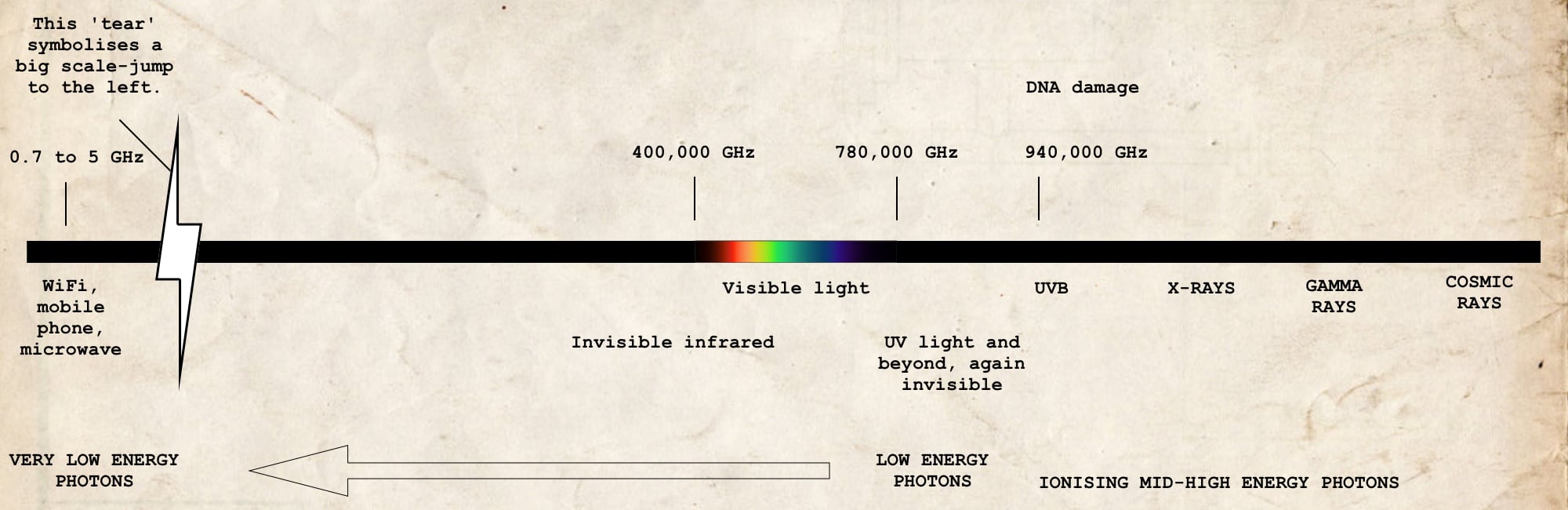
    Below you see a diagram of the full spectrum(beginfootnote)‘Spectrum’ is Latin for ‘appearance’. So, if you speak of the spectrum of something, such as electromagnetism, then you’re referring to all of its appearances.(endfootnote) of electromagnetic radiation (click to enlarge). As you can see, only a small portion is visible to us.

    A diagram of electromagnetic radiation. Far right, we see the dangerous types of radiation: cosmic rays, x-rays, gamma rays, UV-light. In the middle, we see visible light. Far left, we see the lowest energy photons: WiFi, mobile phones, microwave ovens.
    A diagram (not to scale) of electromagnetic radiation, or photons, if you will. The mentioned values are the frequencies of the photons, expressed in gigahertz (GHz). The higher the frequency, the higher the energy of the photon.

    GHz refers to the frequency of the photon and is a measure for the photon’s energy level. The higher the frequency, the higher the energy level. Ultraviolet radiation is where it’s starting to become dangerous to us. This is where our cells become damaged (‘DNA damage’). As long as you’re not exposed to the Sun for too long and x-ray photography is done in very short amounts of time, it’s going to be fine. But be careful. Again, gamma radiation and cosmic radiation are deadly. I understand, it doesn’t feel comfortable at all, but please, please do listen to your parents when you’re going out for a space walk. Put on that spacesuit.

    Impressionable electrons

    In the previous century, physicists such as Albert Einstein discovered that electrons can be influenced by incoming photons(beginfootnote)This is what he received the Nobel Prize for. You can read more about that in my article The formula that got Albert Einstein the Nobel Prize and should stop us getting sunburn all the time.(endfootnote). It very much depends on the way the electrons are captured inside the molecules – which depends on the type of atoms – at which energy level photons they will start reacting.

    In the case of glass, the electrons do feel electromagnetic disturbances slightly. This is why they do start to jiggle differently just a notch. That jiggling causes changes in the part of the electromagnetic field that is inside of the glass. And these changes will influence the photons (disturbances in that same electromagnetic field) in such a way that they’ll change course slightly.

    There's a bear swimming in a pool in a zoo. The pool is visible from the side through a large window. Due to refraction, the head of the bear above the surface seems to be located at a different place than the rest of its submerged body. The bear seems beheaded and yet, it lives.

    This is why the image behind glass can seem to be slightly warped. The same happens when light goes from air to water (as water, too, contains electrons which react to incoming photons). The electrons don’t do too much so that photons can just pass through, however, they do enough so that the photons do change course slightly. Or a lot as you can see by the water in the photo above. In my article Why, exactly, do glass and liquids refract light? we take a deep dive into this phenomenon.

    Why is glass transparent?

    And so, glass is transparent as the electrons in glass molecules aren’t capable of reacting very much to incoming electromagnetic disturbances (photons). Just a little. So, they do bend the original trajectory of the photons slightly.

    There are materials containing electrons responding to all energy levels except those corresponding to blue light, for example. This means that blue light can just pass through while the rest is being absorbed. To us, this material seems to be a blue filter.

    It’s also possible to produce materials carrying electrons which react to all photons in the visible part of the spectrum. They do this so strongly that photons will be reflected completely. We call that a mirror.

    closeup photo of primate looking in a mirror

    Note that we’re talking mostly about photons we can see. To us most glass is transparent. However, we can also produce glass which seems transparent as it lets visible light pass through, while they are much less transparent to birds at the same time.

    We are incapable of seeing UV light. Birds can, however. So, if glass is produced in such a way that they will let visible light pass through but not UV light, they seem less transparent to birds, preventing them to bump into it.

    So, the answer to the question, ‘And if all materials consist of molecules, how is it that the molecules of glass are transparent while others aren’t?’, should rather be: ‘Transparent to whom? To birds? Or to humans?’

    References

    [1] Dinca, L. E. et al. (2015) “Pentacene on Ni(111): Room-Temperature Molecular Packing and Temperature-Activated Conversion to Graphene,” Nanoscale, 7(7), pp. 3263–3269. doi: 10.1039/C4NR07057G.

    [2] Gross, L. et al. (2009) “The Chemical Structure of a Molecule Resolved by Atomic Force Microscopy,” Science, 325(5944), pp. 1110–1114. doi: 10.1126/science.1176210.

  • Quantum mechanics in ten ideas for people on the move

    Quantum mechanics in ten ideas for people on the move


    The last few posts on quantum mechanics have been quite extensive and at times rather deep for those who are on the move. So, here are ten important ideas about particles and wave functions for when you’re en route in slightly more normal English.


    1: Subatomic particles

    To describe objects in our everyday world, such as rocks, buildings, and cars, Newton’s laws suffice. To describe subatomic, elementary particles, such as electrons, protons, neutrons, and photons, however, there is a whole different type of physics: quantum mechanics.

    2: Wave functions

    The most complete description of an elementary particle is called the wave function. Actually, the word ‘particles’ seems to incorrectly refer to tiny points, balls or spheres or something, which they are absolutely not. They aren’t waves either. ‘Particles’ are wave functions with wave-like properties (emphasis on ‘like’). Upon interaction with other particles and/or measurement, they exhibit particle-like behaviour, however. The wave function contains all physically possible states a ‘particle’ can be in at the moment we measure its state. The wave function can be seen as a mathematical description of the probabilities of the states that the particle will snap into as soon as you measure it. It’s often visualised as a ‘cloud’ even though that’s not what it actually looks like. It’s just a visual metaphor for a mathematical object that actually lives in complex space as it is complex valued.

    I usually just draw vague spherical thingies.
    I usually just draw vague spherical thingies.

    3: Quantum state

    Once measured, particles show one specific quantum state out of a whole range of possible quantum states prior measurement. Position is the most intuitive to understand example of a quantum state. Momentum is another (momentum is a measure of the amount of motion of a particle). Then there are states such as polarity, spin, and a bunch of others. The wave function encapsulates all these possible states and yields a probability-value for actually measuring a particular state. In other words, even before you measure it, the wave function allows you to calculate the chances of encountering this particular quantum state.

    4: Measurement problem

    As long you don’t measure a particle, and as long as it doesn’t interact with other particles, the particle is not in a specific quantum state yet. Instead, its wave function just describes all these possible states as though they are mathematically added on top of each other. This ‘adding of quantum states’ is what is meant when physicists talk about superposition. The term is from the mathematics of waves and linear algebra in general, not quantum mechanics in particular. While the situation is often portrayed as particles being in multiple states all at once (such as being in two positions at the same time), it’s more accurate to say that the particle does not have a specific state at all. There’s just the wave function with all the probabilities of future quantum states. As soon as you perform a measurement, the particle snaps out of its wave function full of possibilities into a single possibility. In other words, what you see is not what it was. What you observe is just a sliver of its total prior existence. How this happens, nobody knows. It’s called the measurement problem. There’s a Nobel Prize waiting for you.

    This extraordinary experiment yielded a photo of the closest approximation of the wave function of an electron in a hydrogen atom we have to date. It was made by the Polish physicist Aneta Sylwia Stodolna et al. (Source: Stodolna AS et al. (2013) “Hydrogen Atoms Under Magnification: Direct Observation of the Nodal Structure of Stark States,” Physical review letters, 110(21), pp. 213001–213001.)
    This extraordinary experiment yielded a photo of the closest approximation of the wave function of an electron in a hydrogen atom we have to date. It was made by the Polish physicist Aneta Sylwia Stodolna et al. (Source: Stodolna AS et al. (2013) “Hydrogen Atoms Under Magnification: Direct Observation of the Nodal Structure of Stark States,” Physical review letters, 110(21), pp. 213001–213001.)

    5: Schrödinger equation

    Wave functions obey the Schrödinger equation. You could say that what Newton’s second law is for objects in our everyday world, is what the Schrödinger equation is for the subatomic world. It gives us the ability to predict how the wave function evolves in time. This is a completely classical equation; it is 100% deterministic. Where the wave function captures a range of probabilities, the Schrödinger equation tells us how this range of probabilities changes over time perfectly predictably so. In other words, it doesn’t predict the exact state of a particle once measured, but it does accurately predict the probability-value of an exact state once measured at any given time.

    6: Uncertainty

    There is a fundamental informational trade-off between certain possible states such as between position and momentum, energy and time, and time and frequency. The origin for this does not lie in quantum mechanics. It’s due to the way they are related to each other. Mathematically, these variables are called Fourier transform pairs or conjugate variables. To calculate one from the other, you have to execute a mathematical procedure called a Fourier transform. The trade-off is that Fourier transforming a variable whose range of possible values is smaller leads to the other variable having a larger range of possible values. And if a range of possible values becomes larger, then the exact outcome of measurement is less certain (the probability of a specific state after measurement becomes more uncertain). Heisenberg showed that this uncertainty principle also applies to the wave function in quantum mechanics, hence, there the principle is called Heisenberg’s uncertainty principle.

    Fourier showed that if a sound is fairly well-defined in time (bottom), it has to be comprised of multiple frequenties (illustrated as multiple waves at multiple frequencies). That's the fundamental uncertainty principle with waves.
    Fourier showed that if a sound is fairly well-defined in time (bottom), it has to be comprised of multiple frequenties (illustrated as multiple waves at multiple frequencies). That’s the fundamental uncertainty principle with waves.

    7: Certainty

    That same principle predicts that, while very valid at the scale of subatomic particles, this uncertainty becomes utterly meaningless at our large-scale world of everyday objects. A bowling ball whose range of possible positions is very limited (locked in a very tight enclosure with little to no leeway), will never portray any uncertainty values pertaining to its motion (momentum), for instance. By Heisenberg’s uncertainty principle, upon measurement, it might show to have the speed of $3.283 \times 10^{-35} \text{ m/s}.$ This means that after 965.9 billion years it will have travelled the distance of the width of a proton. So, no, uncertainty effects play no role in our everyday world, unless you are doing experiments with a running time of seventy times the age of our current Universe. In that case, you will have to deal with the uncertainty of the width of a proton(beginfootnote)When people state or think that everyday objects (our bodies, brains, tennis balls, animals) can exhibit quantum effects such as being at multiple places at the same time, I suspect this is because they have no well-defined idea how small subatomic particles really are and no inkling as to how large the everyday world is in those terms. Also, they didn’t do the calculations.(endfootnote). We do note that extraordinarily sensitive larger-scale equipment such as the the mirrors at the LIGO and Virgo experiments are capable of measuring quantum effects, however, this isn’t really unexpected nor is it the same as saying a human body is in a quantum superposition. Measuring quantum effects is one thing, brains supposedly being in two places on Earth (‘based on principles from quantum mechanics’) is a whole other thing.

    Missing the pins has nothing to do with practical nor theoretical quantum effects. You're just not that good.
    Missing the pins has nothing to do with practical nor theoretical quantum effects. You’re just not that good.

    8: Quantum entanglement

    When two or more particles can only be described by one wave function – not as separate wave functions – those particles are said to be quantum entangled, either partly or completely. A measurement performed on one particle immediately determines the measurement outcome on the other entangled particle, irrespective of the spatial distance between them. This is why this phenomenon is said to be non-local. How this happens, is unknown. This effect dissipates to zero when entangled particles interact with yet other particles. At the large scale of our everyday world, the number of particles inside an object to be interacted with is so great, quantum entanglement completely fades away. In very special conditions, however, such as in our labs, entanglement can be sustained for quite some time.

    This isn't what quantum entanglement looks like. It's just a picture.
    This isn’t what quantum entanglement looks like. It’s just a picture.

    9: Quantum Field Theory

    Over the years, the mathematical and physical theory of (quantum) wave mechanics has been extended to describe quantum fields as the fundamental building blocks of our Universe. The Universe is made of quantum fields. The most complete description of fields are wave functions. This is called Quantum Field Theory (QFT). The most successful version of QFT is called the Standard Model of quantum physics. ‘Particles’ are here some kind of disturbance in their field: an electron is a disturbance in the electron field. The particle’s description is here part of the wave function of its entire field. The challenge is now to extend this quantum field theory into its next form, encapsulating something called quantum gravity. What we don’t know yet, for example, is how to have space and time in extreme regions such as black holes, naturally appear out of a quantum theory.

    My very sketchy way of showing quantum fields. Proton field is not really a thing. It's just a shortcut for several quark fields. Besides, fields aren't two-dimensional, they're obviously three-dimensional.
    My very sketchy way of showing quantum fields. Proton field is not really a thing. It’s just a shortcut for several quark fields. Besides, fields aren’t two-dimensional, they’re obviously three-dimensional.

    10: Applications

    While the famous physicist and Nobel Prize winner Richard Feynman is known for having said, ‘I think I can safely say that nobody understands quantum mechanics’, this is sometimes incorrectly taken to be a reason to state that, therefore, physicists don’t know what they’re talking about. Feynman alluded to the fact that there is much we don’t know about the foundations of quantum mechanics. There is still much employment in solving hard problems such as quantum gravity, the measurement problem, the strong CP problem, the interpretation of quantum mechanics, non-locality, and so forth.

    On the other hand, we now have WiFi, internet, touchscreens, lasers, MRI scanners, LEDs, flash memory, solid state disks, the old crunchy hard disks, transistors, and CPUs or integrated chips (ICs) in general.

    I think I can safely say that the fact that you’ve plucked this article out of the air to have it displayed on your (touch)screen is at least an indication of the level at which ‘nobody understands quantum mechanics’.

    Nevertheless, we’re far from done. There is still much to discover in this Universe with a bit of maths and physics.

  • Heisenberg’s uncertainty principle

    Heisenberg’s uncertainty principle


    It’s perhaps not as famous as Einstein’s formula but in this day and age many people may still have heard at least once of the phrase ‘Heisenberg’s uncertainty principle’. It plays an important role in quantum mechanics. You may have heard that every time you observe or measure matter, due to the crudeness or inherent inaccuracy of the measurement device, you will inevitably disturb your own observation. This would then preclude you from gaining accurate knowledge with satisfying certainty. In fact, in general, Heisenberg’s uncertainty principle states that nothing can be certain. At the risk of sounding vague and vanilla, all of these statements are completely and utterly wrong. Let’s look at what it really says, shall we?

    Figure 1. Werner Heisenberg in Göttingen in 1924.

    Fourier transform pairs

    Trade-offs. Who doesn’t hate them? Remember when your parents told you that you could have this but then not have that or maybe just a bit of this but then less or fewer of that? Unsurprisingly, at least three famous philosophers have written a few words on this, each in their own way lamenting on the existence of trade-offs and how to deal with them. One chose to become all rebellious about it and wrote: ‘I want it all, I want it all, and I want it now!’ (May, 1988). The other two, however, chose to be more pragmatic about it as they postulated that ‘you can’t always get what you want’ (Jagger & Richards, 1968). Obviously, they knew that, sometimes, life brings you Fourier transform pairs. The more well-known example is of course Heisenberg’s uncertainty principle.

    If you limit a particle’s range of possible positions in space $(\Delta x)$, you increase its range of possible momenta(beginfootnote)Momentum is the product of mass $m$ and velocity $v,$ so $p=mv.$ It’s a measure for the amount of motion of an object.(endfootnote) along the $x$-direction $(\Delta p_x),$ and vice versa.

    This is formalised as follows:

    $$\Delta x \Delta p_x \geq \frac{\hbar}{2}.$$

    Just to be absolutely clear: the delta-symbol $\Delta$ is a range of a certain quantity. Usually, a $\Delta$ is defined as the difference between two values. Suppose, you measure point $A$ of your garden fence to be $0.1$ metre away from your wall and point $B$ to be $0.7$ metre away from your wall, then the $\Delta$ of the distances, i.e. the length between points $A$ and $B,$ is $0.7-0.1=0.6$ metre.

    In Heisenberg’s principle, it is stated that the product of the range of possible positions $\Delta x$ and the range of possible momenta $\Delta p_x$ is greater than or equal to some number. Mind you, it’s a tiny number. The symbol $\hbar$ stands for the Planck constant divided by $2 \pi,$ and the result gets cut in half yet again.

    This means that whenever one is getting bigger, $\Delta p_x$ for instance, the other is getting smaller, which is then $\Delta x.$ And vice versa.

    Click here if you’d like to do a bit of maths. It’s very easy.

    Just to get an intuitive insight in this relation, suppose $\frac{\hbar}{2}=1,$ and so, suppose, $\Delta x \Delta p_x = 1.$ Furthermore, suppose $\Delta x = 0.5.$ What value does $\Delta p_x$ has to be to satisfy this equation? Exactly, $\Delta p_x$ has to be $2,$ because $0.5 \times 2 = 1,$ or else the equation is false.

    Now, lets make $\Delta x$ smaller. In other words, we’re going to try to pinpoint the location with much more precision. So, let’s say, $\Delta x = 0.001.$ What value does $\Delta p_x$ has to become to satisfy this equation? You guessed right, $\Delta p_x$ has to become even larger: $\Delta p_x = 1000,$ because $0.001 \times 1000 = 1.$ If you were to reverse the situation – decreasing the size of $\Delta p_x$ – then, in turn, $\Delta x$ would have to become larger.

    In reality, $\frac{\hbar}{2}$ is much smaller than 1. It is, in fact, about $5.273 \times 10^{-35} \text{J/s}.$ That’s thirty-four zeros behind the decimal point and then ending in 5273. It’s incredibly small. Don’t worry about this. We’ll get back to that later.

    Hopefully, now you see the relation between $\Delta x$ and $\Delta p_x$ as put forward by Heisenberg’s formulation. They complement each other. Whenever a range of possible values becomes larger, in other words, the $\Delta$ or range of value-options is larger – its actual value becomes more uncertain, hence the use of the word ‘uncertainty’ in Heisenberg’s uncertainty principle(beginfootnote)In fact, it’s statistics. The $\Delta$-sign could just as well be a $\delta$-sign, so $\delta x \delta p_x \geq \frac{\hbar}{2},$ which signifies its statistical character more accurately. After all, the wave function is about probabilities.(endfootnote).


    But why is this? While this principle plays a central role in quantum mechanics, it’s actually not fundamentally a quantum-mechanical law. This principle exists more generally in many instances in physics, and, even more generally, in mathematics.

    In mathematics, the variables position and momentum are said to be a Fourier transform pair. Put in yet other mathematical jargon, position and momentum are said to be conjugate variables.

    Sound

    A well-known, non-quantum-mechanical example of the uncertainty principle is determining the pitch of a sound. How ‘high’ a note is, depends on the frequency.

    The most familiar way we depict sound waves is a simple sine wave. It represents the simplest of sounds possible. Also, it’s the most boring of sounds possible.

    The $x$-axis represents time. The $y$-axis represents the amplitude of the sound or the loudness, the intensity of it. As you can see, the sound wave repeats itself over time; the pattern is cyclic. One whole cycle is when the plot has completed going up, going down, going further down, and going up again. The time it takes to complete one cycle is designated by the symbol $T,$ called the period(beginfootnote)It is also possible to measure the time-distance between two peaks or two troughs.(endfootnote). So, this particular sound wave is said to be periodic.

    Figure 3. A time-amplitude plot of a boring old sinusoidal sound wave. (Click to enlarge.)

    The shorter the period ­– the quicker the cycles are – the higher the tone. Another way of saying, is that the higher the frequency, the higher the tone. The mathematical relationship between period $T$ and frequency $f$ is the following expression:

    $$f = \frac{1}{T}.$$

    If the period gets shorter, i.e. the value of $T$ becomes smaller, then the value of $f$ becomes larger, which means higher, which means a higher tone.

    Seeing as the time period $T = 2 \pi$ seconds, the frequency diagram looks like a spike at $\frac{1}{2 \pi}$ Hz. In this frequency-diagram, the $x$-axis is the frequency and the $y$-axis is still the amplitude.

    Figure 4. A frequency-amplitude plot of the sound wave of Figure 3. It shows the exact frequency at which that sound wave exists.

    So, there are now two ways in which we can describe the sound wave: either by frequency (Figure 4) or by change over time (Figure 3).

    Notice that the sound wave plotted as a function of time (Figure 3) has no beginning nor end. For all we know, that plot could just go on forever, to an infinite amount of time, in both directions. Suppose, we would ask the question at what time exactly does the sound exist? The answer is: always. There is no particular, specific time at which it exists.

    In other words, we could write that $\Delta t = \infty.$

    Notice, however, that the frequency plot looks very finite: just one stroke. One well-defined, finite stroke. If we were to ask the question what frequency exactly does the sound have? The answer is: there is a particular, specific, exact frequency at which it exists and it is $\frac{1}{2 \pi}$ Hz ​
    $( \approx 0.16).$

    Fourier analysis

    In reality, no sound is going to be infinitely long. Pluck a guitar string and it will fade out as the energy dissipates slowly. Also, at some point it started ­– meaning, before that, it didn’t exist. In other words, in reality, a sound wave usually exists in a finite range of time.

    Let’s limit our sound wave to a range in time, so it looks more like the sound of a ‘blip’ and less like an infinite tone of boredom. Again, the $x$-axis represents time and the $y$-axis represents the amplitude.

    Figure 5. A time-amplitude plot of a so-called wavelet, a short sound burst. Contrary to the sound wave in Figure 3, it’s not infinitely long. It’s now also more difficult to assess its frequency.

    As you can see, the sound now exists in a more defined range of time – roughly 1.5 seconds. In other words, $\Delta t \approx 1.5$ seconds. That’s a whole lot smaller than the old $\Delta t = \infty.$

    Now, we ask ourselves, what is its frequency? The difficulty now is that it’s hard to pinpoint an exact period $T$. The evolution of the plot is quite different from our infinitely long sine wave. Yes, we can identify kind of those cycles we’re looking for, however, no cycle has the same shape, so, technically, we’re dealing with multiple cycles at once. And guess what, its frequency-amplitude plot looks like this.

    Figure 6. The frequency-amplitude plot of the wavelet in Figure 5. It’s far from being a specific, exact frequency. At varying degrees, it’s actually a few frequencies at the same time.

    As you can see, it has become difficult to pinpoint the exact frequency of our wavelet. It exists at a variety of frequencies and amplitudes.

    So, while the ‘time window’ of the sound wave has become more exact, the frequency has now become ‘less certain’.

    The brilliant mathematician Joseph Fourier discovered that a wavelet such as in Figure 5 can actually be constructed by adding many infinite waves at many frequencies. Put differently, Fourier analysis shows that our wavelet is the culmination of a superposition of many waves at many frequencies.

    Figure 7. The wavelet at the bottom is constructed by many infinite waves at many different frequencies superposed onto each other. This automatically means that the wavelet’s exact frequency is fundamentally harder to determine than the frequency of the sound wave in Figure 3.

    Now you see why the frequency-amplitude plot has changed from a very specific value in Figure 4 to the wider set of frequencies in Figure 6. In the latter case, the wavelet ‘contains’ multiple waves at multiple frequencies, so when you Fourier transform its time-amplitude plot to its frequency-amplitude plot, the frequency has become ‘uncertain’.

    The relation between time $\Delta t$ and frequency $\Delta f$ in ordinary classical physics is fundamentally complementary. No quantum mechanics needed.

    In mathematical jargon, time and frequency are so-called Fourier transform pairs or conjugate variables.

    The term ‘Uncertainty principle’ pertains to the general phenomenon that Fourier transforms (such as between time and frequency) entail a fundamental, mathematical trade-off between types of information carried by the two transformed variables. Heisenberg then showed that this principle also holds in quantum mechanics. And so, the uncertainty principle in quantum mechanics is called Heisenberg’s uncertainty principle.

    The De Broglie relation

    Time to go back to quantum mechanics. Remember that a particle’s best description is a wave function? A wave function is the mathematical expression of a particle containing all possible states it can assume once we measure it.

    Instead of a time-amplitude plot, let’s represent a particle by a space-amplitude plot. To make it a little bit easier, let’s take the wave function of a particle of which the amplitude only varies along one dimension of space, $x.$

    Here is a representation of a particle’s wave function along one dimension of space (along a ‘straight line’). The $x$-axis represents a position in space. The $y$-axis represents the amplitude of the wave function (which is proportional to the probability of finding the particle in that particular position $x$).

    Figure 8. A representation of a wave function of a free particle. Note that this is not what it actually looks like. For one, an actual wave function exists in complex space, which we didn’t plot here. The goal is to illustrate, not to map accurately. Also note that the free particle has no specific position yet as it’s a free particle!

    It was the eminent French physicist Louis de Broglie(beginfootnote)Many physicists have tried and mispronounced his last name. It should sound like ‘broy’ where the r is produced at the back of the throat, like the French r – a ‘dry’ kind of r. In this interview with him, you can hear the French presenter pronouncing his name (just after 0:16 seconds). It’s not ‘brog-ly’ nor ‘bro-ly’. Thank you.(endfootnote) who formulated the relationship between a particle’s wave function’s wavelength $\lambda$ and its momentum $p.$

    $$\lambda = \frac{h}{p},$$

    where $h$ is the Planck constant. Incidentally, this is the equation better known as De Broglie’s matter wave hypothesis, stating that matter, such as electrons, possess a wave-like characteristic(beginfootnote)Do note that this same equation shows that this wave-like behaviour of large bodies such as our bodies, brains, bowling balls, tennis balls, and animals is completely and utterly negligible as we will demonstrate at the end of this post.(endfootnote). This won him the Nobel Prize, no less.

    If we rewrite this to solve for $p,$ we get

    $$p = \frac{h}{\lambda}.$$

    So, clearly, a wave’s momentum is determined by its wavelength. The smaller the wavelength, the greater the momentum. What is the wavelength? It’s the length between two peaks (or two troughs). The higher the frequency, the smaller the wavelength. Now have a look at Figure 8 again. As you can see, the infinite wave of a free particle has a well-defined wavelength. The logical conclusion is that the momentum is also well-defined. Nevertheless, Figure 8 also shows that the particle’s position is not defined at all!

    Let’s turn this on its head and limit the range of possible positions of our particle. No longer is it a free particle. It is now confined within a finite range of locations.

    Figure 9. Our former free particle’s position is now restrained between $x = 0$ and $x= \pi.$ In other words, $\Delta x$ is now limited to $\pi$ wide. There is no well-defined wavelength as the wave function has different values in different places. It’s there, but not as well-defined as in the wave function in Figure 6.

    What we’ve done in Figure 9 is making $\Delta x$ smaller than it was in Figure 8 (where it was infinitely large). In fact, $\Delta x = \pi$ wide. By the same Fourier transform mechanism as with the time-frequency pair, the complimentary sister of position space $\Delta x$, namely momentum space $\Delta p_x$, will now become less certain.

    To construct a limited wave function such as the one in Figure 9, Fourier analysis shows that you need – again – a bunch of waves at different frequencies in superposition (added on top of each other).

    Figure 10. A Fourier deconstruction of the wave function in Figure 9. Many waves, many frequencies. Hence, the momentum is less well-defined.

    So, when it comes to quanta, Heisenberg’s uncertainty principle states that there’s a fundamental trade-off between information on position and momentum(beginfootnote)Another pair is energy and time. This is interesting in the context of Hawking radiation. We’ll get to that, don’t worry.(endfootnote). This is due to the fact that they are a Fourier transform pair or conjugate variables.

    This also means that if you constrain a particle to a minuscule $\Delta x,$ its wave function will start to contain momenta $\Delta p_x$ all over the place. It will occupy many more velocity possibilities, including the much faster velocities. If you were to subsequently perform a measurement, the probability of finding it moving at higher speeds is now much larger!

    Scale and effect

    At the scale of the big bad world, we never see this effect. If you would confine a bowling ball in a limited space, you will not see its momentum increase dramatically. It won’t suddenly start bouncing up and down. Conversely, if you swoop the bowling ball with considerable momentum, it won’t suddenly start appearing everywhere and nowhere at the same time: its position is still quite clear. You won’t suddenly quantum tunnel through the pins or be rolling on all bowling lanes of the neighbouring players at the same time. If it doesn’t hit a single pin, then that’s not because it’s suddenly in a state of superposition with regard to its possible locations of existence. You’re just not that good.

    You won’t notice any of these quantum effects in your everyday-scaled objects. Only when you’re dealing with particles. Or atoms. However, as soon as the mass increases, it all changes. Why? Partly because Planck’s constant is so darn small(beginfootnote)And because the number of interactions between atoms increase exponentially, causing any quantum effect to disappear due to decoherence.(endfootnote). It’s just $5.273 \times 10^{-35} \text{ J/s},$ remember? That’s small.

    All this knowledge does allow for some fun calculations. For instance, if you were to confine a bowling ball with a mass of $7.2$ kg (16 lb) inside a box where $\Delta x = 22$ cm (8.66 inches), by Heisenberg’s uncertainty principle, the ball’s speed will be $3.283 \times 10^{-35} \text{ m/s}.$ That means that after $965.9$ billion years it might have moved a distance equal to the diameter of a proton. That amount of time is seventy times the age of our current universe. Granted, quantum-mechanical effects aren’t zero, but as you can see (or rather, as one can calculate), on our everyday scale, these effects are quite meaningless.

    Sometimes, weird films such as What the #$*! Do We (K)now!? and What the Bleep!?: Down the Rabbit Hole will want to make you believe such quantum things can happen anyway. They will mention Heisenberg’s uncertainty principle like it is a magical law allowing us to do whatever. I hope that this post has shown that Heisenberg’s uncertainty principle is not about that. Nor does the uncertainty principle itself have its roots in quantum mechanics. It’s basically wave mechanics, the classical stuff, which all first-year undergraduates in physics have to learn in their first or second semester.

    A few months ago, I stumbled across a video showing an Australian senator’s question to the head of the Commonwealth Scientific and Industrial Research Organisation, an Australian federal government agency responsible for scientific research. Clearly, the senator had – shall we say ‘read something about Heisenberg’s uncertainty principle’. During a senate hearing for a legislative committee, the senator questioned if research done in climate change should be taken with precaution as Heisenberg’s uncertainty principle stands in the way of accurate measurements(beginfootnote)He basically sought a ‘scientific’ way to put climate science in doubt – which, apparently, he is not a proponent of. I do not claim to know anything about Australian politics, or even at great depth about climate science, however, when a legislator starts talking quantum physics – well, I do know stuff about that.(endfootnote).

    I suspect this discussion pertained to a study where a satellite uses infrared radiation to perform surface and/or atmospheric remote sensing. He continued to state that as infrared light has lower frequencies than visible light, it’s ‘very difficult’ to understand the properties of infrared radiation based on Heisenberg’s uncertainty principle.

    Many things were going on (wrong) in this one short bit of speaking time of the senator, as is usual when someone hasn’t caught up on quantum physics as much. Which is understandable, but no less gnawing to watch (the link opens a new tab and leads to a short video on Twitter).

    In any case, I genuinely hope that this article contributed at least a sliver of knowledge to educate the electorate of the world, so we can all vote as informed and responsible as possible for the right persons for the right jobs, besides one’s preferred socioeconomic idealism.

    If you should take one thing from this post, it’s that Heisenberg’s uncertainty principle is not about anything spiritual nor does it have anything to do with scientific measurement mistakes: it’s good, old wave mechanics and Fourier analysis taught to undergrads in their first year at university. It works and it works well. It does not lead to science not being able to know things about the universe. In fact, it increased our knowledge of it. In fact, no modern information device would have worked without it. After all, you’re reading this with an electronic device which exists thanks to Fourier, Heisenberg, and De Broglie, among others. All that with a bit of more maths and more physics at the same time.

    Photo Werner Heisenberg by Friedrich Hund, a German physicist who took this photo in Heisenberg’s place of residence, Göttingen, in 1924. It was uploaded to Wikimedia Commons under CC BY 3.0 by Friedrich Hund’s son, Gerhard Hund, a German mathematician, computer scientist, journalist, and chess player. We have used a colour-corrected version by Martin Geisler.

  • Quantum entanglement: the EPR paradox and Bell’s Theorem

    Quantum entanglement: the EPR paradox and Bell’s Theorem


    When the state of a subatomic particle cannot be described by a wave function without taking the state of another subatomic particle into account, we speak of quantum entanglement. It’s the special case where both particles can only be described by one and the same wave function. No longer are they separate entities nor do they have separate wave functions. The astonishing consequence is that performing a measurement on one particle has an immediate effect on the measurement of the other particle, no matter how far apart they are from each other. In this article, the second part of our mini-series on quantum entanglement, we will discuss the EPR paradox which Einstein and colleagues put forward. After that, we will discuss Bell’s Theorem which allowed physicists to test Einstein’s proposal. Was Einstein correct?

    A representation of an electron’s spin – do note that this is not what an electron actually looks like nor is it what its spin looks like. The quantum world is simply too strange to depict accurately using ‘classical’ notions as done here. Here we drew a vague ball-like thing which seemingly spins around, which it isn’t and it doesn’t. But it’s the best we’ve got. Although, the best we’ve got is actually something else: a mathematical expression, the wave function.

    Quick summary

    Firstly, let me give a quick summary of the previous post:

    1. we used the property of spin as a way of distinguishing between the two entangled electrons;

    2. the orientation of an electron’s spin is expressed as spin up (anticlockwise) or spin down (clockwise) along the axis of measurement;

    3. you can arbitrarily choose along which axis you want to measure its spin, in three dimensions;

    4. no matter which axis you choose, the result is always going to be a spin up or spin down (there is no spin-a-bit-to-the-right, for instance);

    5. we are able to entangle particles in such a way that they will either always yield opposite spin or they always yield identical spin; once prepared this way, they will never deviate from this correlation when measured;

    6. we used the opposite-spin entanglement in our example and we will do so again here;

    7. quantum mechanics states that before measurement neither electrons have a specific spin: the wave function contains all possible measurement outcomes, in this case pertaining to both spin up and spin down (which can be characterised as having no definite spin yet)(beginfootnote)Analogously, the double-slit experiment showed that before measurement, particles don’t have a specific location yet.(endfootnote);

    8. as soon as you measure one electron’s spin along a certain axis, the other electron’s spin immediately snaps to the opposite orientation along that same axis, regardless of spatial distance between the two entangled particles(beginfootnote)Or, if their entanglement were prepared in such a way that they always have identical spin, the other electron would then immediately snap to the identical spin orientation along the same axis of measurement.(endfootnote).

    EPR paradox

    Even though Einstein understood quantum mechanics like few others, and while accepting these predictions and results, he didn’t quite like the non-local implications brought forth by quantum entanglement. He didn’t like point 8 of the previous section. There seems to be zero time delay between influencing a particle in Amsterdam (through measuring its spin) and influencing its entangled particle in Boston. It violates a pivotal consequence of Einstein’s theory of special relativity: no signal or piece of information – anything within this universe, really – can exceed the speed light(beginfootnote)In a vacuum.(endfootnote) or else causality would not exist. In other words, if information or signals were able to travel faster than light, an effect could occur before its cause had taken place. To put it mildly, this doesn’t seem to be the universe you and I are living in.

    So, Einstein, Podolsky, and Rosen (EPR) hypothesised that something else, something secretive was going on in nature – well out of sight for theoretical and experimental physicists. Quantum mechanics as it was known then had to be incomplete. Obviously, they acknowledged its successes, but when it came to quantum entanglement, they asserted something was missing in the theory of describing nature through wave functions.

    To solve for the seemingly faster-than-light signal, they proposed that what really was going on was that the particles have always been in a specific state. When the electron pair were separated from each other, they have always had either spin up or spin down from the start from the moment of their creation.

    Suppose, a pair of gloves were made. Like all pairs of gloves, they always were each other’s opposite with respect to ‘handedness’(beginfootnote)‘Handedness’ in this context is a form of the more generalised term chirality.(endfootnote). One has always been left-handed, the other has always been right-handed. And if the first one happened to be right-handed, then the other was left-handed. (Or else you’re holding a glove from another pair.)

    Suppose, the machine which had made the pair put each glove in a separate box. We can’t see which glove went in which box until we open the box. The boxes were sent to Amsterdam and Boston. The experimental physicists then open the box in Amsterdam: it’s the right-handed one! And so, we now instantly know, the one in Boston is left-handed. No magic, no non-locality, no lightspeed-breaking shenanigans.

    This is what Einstein and friends said was happening in the case of electrons. An electron pair always had specific spins to start with. It’s only in Amsterdam and Boston that we ‘open the box’ aka measure their spin. It’s only logical now that as soon as you know which spin the Amsterdam electron has, you immediately know which spin the Boston electron has.

    So, said Einstein, non-locality is an illusion. It’s all just normal local laws of nature and a bit of logical thinking. For one, spin orientation is merely hidden from us and not principally uncertain. Secondly, there’s no spooky action at a distance[1], as he famously described it(beginfootnote)In German, he wrote ‘spukhafte Fernwirkung'[1].(endfootnote).

    In everyday parlance, physicists call this a local version of the ‘hidden variables’ theory. ‘Hidden variables’ pertain to the stuff that we can’t see yet (such as spin orientation or other variables influencing this) because our quantum mechanical description (the wave function) is incomplete, however, they are there, they do exist – they do not not exist yet, according to the hidden variables theory.

    Bell’s inequalities

    Unfortunately, Albert Einstein passed away in 1955. And Niels Bohr, the other great physicist with whom he used to debate the fundamental nature of quantum mechanics passed away in 1962. In both cases too soon for them to be able to read John Stuart Bell’s 1964 paper called ‘On the Einstein Podolsky Rosen Paradox'[2]. Bell realised that Einstein’s proposal was in principle testable. It yielded a clear prediction, called Bell’s inequality.

    At this point, we must note that over the years, more than one Bell’s inequalities have been put forward by physicists(beginfootnote)Besides his original inequality, there’s the much-used CHSH-inequality, for instance.(endfootnote). To explain Bell’s inequality, we will apply a version of David Mermin’s original version as mentioned in his fantastic Boojums All the Way Through: Communicating Science in a Prosaic Age[3].

    Recall from point 3 before that we can measure an electron’s spin orientation along any axis. We’re going to be measuring along three axes. These axes will be at an angle of 120° relative to each other.

    The first axis will be the spin orientation along the vertical axis, which we will denote with the following symbols for spin up and spin down:

    $$\uparrow \downarrow$$

    The spin orientations up and down will also be measured along this second axis:

    $$\nwarrow \searrow$$

    And the spin orientations along the third axis will be denoted by:

    $$\nearrow \swarrow$$

    So, imagine two entangled electrons being separated in space from each other. The usual quantum-mechanical description of each electron is that they are in a superposition of spins up and spins down for all three axes.

    Except, Einstein says, no, no, not really: hidden behind the ‘veil of superposition’ they are in fact already in definite, specific spin orientations for each of the three axes. We just don’t yet know which until we measure them!

    He says, the electron in Amsterdam may already be in the specific spin states as follows:

    $$\left( \uparrow \searrow \swarrow \right)_A$$

    So, along axis 1 it’s spin up, along axis 2 it’s spin down, and along axis 3 it’s also spin down.

    Einstein continues and says that the entangled electron in Boston has to already be in the opposite states:

    $$\left( \downarrow \nwarrow \nearrow \right)_B$$

    And so, Einstein concludes, as soon as you actually perform a measurement in Amsterdam along the first axis, of course, you get the opposite spin in Boston. Only logical!

    Bell’s insight was that if you would work out this entire argument for all possible combinations, you could actually get a prediction of a ratio of outcomes. Here’s how that goes.

    First of all, if you measure along axis 1 in Amsterdam, that doesn’t mean you have to measure along that same axis in Boston. You could just choose to measure along axis 3. So, with the two examples above, your results would simply be that in Amsterdam you get spin up and in Boston you also get spin up:

    $$\left( \uparrow \right)_A \text{ and } \left( \nearrow \right)_B$$

    Bell then argued, if you would count the number of times you would get the combinations up-up, down-down, and of course up-down and down-up like this, you should get ratios of these combinations which should match experiment. If, however, these ratios don’t appear in the experiments, then Einstein’s hypothesis is incorrect. In that case, something entirely different is going on. The electrons were not already in a specific state, which in turn means that the non-local measurement effect in quantum entanglement does exist!

    Bell’s theorem

    So, let’s put them all together. Let’s first take our example above:

    $$\left( \uparrow \searrow \swarrow \right)_A \text{ and } \left( \downarrow \nwarrow \nearrow \right)_B$$

    If you measure along axis 1 in Amsterdam and along axis 1 in Boston you get spin up, spin down. If you measure along axis 1 in Amsterdam and along 2 in Boston, you get spin up, spin up. And so on, and so forth! We’ve put it in a little table:

    Here you can see all the possible combinations of measurement outcomes along the three possible axes of the electrons in Amsterdam (A) and Boston (B). We used U for spin up and D for spin down.

    Bell then says that if Einstein was correct, and the states of the spin orientations along these three axes were already there, then these are the expected outcomes.

    Let’s focus on the number of UD or DU combinations, in other words, let’s focus on the number of times we find the opposite spin orientations, irrespective of the axes along which they are measured. We’ve marked them yellow.

    Exactly five out nine times you will find the opposite spin directions.

    Let’s check for other spin combinations. Suppose, the electron in Amsterdam is secretly in the following spin states, $\left( \downarrow \nwarrow \swarrow \right)_A$, and the electron in Boston is then the opposite, $\left( \uparrow \searrow \nearrow \right)_B$. If we count again the number of times the measurement outcome of opposite spins, we get, again, five out of nine.

    Okay, I think you can imagine where this is going. We’re not going to go by all the tables, but I do want to do one more, just for fun. Suppose, the one in Amsterdam is all spin down, $\left( \downarrow \searrow \swarrow \right)_A$, and, obviously, the Boston one is its opposite, $\left( \uparrow \nwarrow \nearrow \right)_B$. In that case, we would get opposite spins in nine out of nine times.

    And so, this particular Bell inequality states that the probability (P) of finding opposite spins along all three axes is at least $\frac{5}{9}$ or 55% (and at most 1 or 100%). In other words, $P(\text{opposite}) \geq \frac{5}{9}$. If this inequality were violated by experiment, the underlying theory will have been proven to be incorrect.

    Experimental outcomes

    Over the past thirty years, many experiments were carried out to test multiple versions of Bell’s inequality. Usually, these tests involved photons rather than electrons and pertained to measurement of polarisation rather than spin.

    Freedman and Clauser did the first Bell test. They used a version of the so-called CH74 inequality[4].

    The most well-known test was performed by Alain Aspect and colleagues. As Bell had originally suggested, they were able to have the two measurement devices randomly select the method of measurement before the entangled photons had arrived[5].

    In all tests, all versions of Bell’s inequalities were violated. Instead, the statistical outcome was congruent with the predictions of quantum mechanics. The conclusion has to be that Einstein’s local hidden variable theory was incorrect. There is nothing local about measuring entangled particles.

    In our particular inequality, the result was that the occurrence of opposite spins turned out to be exactly 50%, not 55%.

    Conclusions

    Let’s summarise what we have established over the course of the last two posts, including this one.

    In quantum mechanics, particles which have not been measured yet don’t have a definite, specific state. Instead, they are best described by a wave function which incorporates all the possible future states it can snap into once measured.

    When a particle can only be described in tandem with another particle, i.e. both particles can only be described by one and the same wave function, they are maximally quantum entangled(beginfootnote)In practice, in the real world, particles aren’t maximally entangled like the way we can prepare them in the laboratory. The world is too messy for those ‘pure states of entanglement’ to exist for any significant amount of time. There are simply too many particles around to not interact with any other particle. Every particle will invariable interact with thousands of trillions of other particles and so any previous entanglement will quickly decohere into either a very weak version of the original entanglement or simply to zero entanglement. Every interaction represents a measurement. Since our brains are too large and consist of thousands of trillions of particles, they will never be in a pure state of superposition nor entanglement. Not to mention our much larger body, which will never be in any sort of quantum state. It is statistically so unlikely that you’d have to become as old as $(10^{100})^{100}$ times the age of our current universe to witness such an event. And that number was a metaphorical one. It’s much larger.(endfootnote).

    If their entanglement entails their spins will always correlate in a certain way – be it identical spins or opposite spins – a measurement on one particle, causing it to snap into one of the possible, specific, definite states, has immediate effect on the state of the other particle: it instantly snaps out of its wave function haze into a correlating, specific, definite state.

    Einstein didn’t like this as this would imply some kind of information was somehow transported beyond the speed of light from one particle to the other.

    He postulated that particles have always been in a specific, definite state to begin with. The only reason we don’t know which is because we haven’t measured it yet. There is no ‘snapping out of the haze’ going on.

    John Bell showed that Einstein’s hypothesis can be tested. If you would perform many, many measurements of many, many maximally entangled particles, eventually, the occurrences of the variety of correlated states should show up in a certain ratio, an inequality, as it happens.

    Experiments showed they do not. Instead, the ratio is exactly according to the predictions of quantum mechanics.

    This demonstrated that particles indeed snap out of their haze upon measurement and not that particles had always been in a hidden but definite state.

    And if that is true, then non-locality has to be true – there is no other way the other particle snaps into the correct, correlated state.

    Nobody knows how this happens. Certain non-local but still hidden-variables hypotheses have been proposed. One of the more famous versions is called the ER=EPR conjecture by Juan Maldacena and Leonard Susskind. Perhaps we’ll dive into that later on.

    Einstein’s aversion to this ‘particles have no definite state until measured upon’ made him utter his famous complaint, ‘God does not play dice’.

    Unfortunately, he was wrong here on two occasions. God(beginfootnote)We are using the word ‘God’ in a purely metaphorical way. This does not pertain to any specific religious entity as revered by many in a variety of societies in human culture.(endfootnote) does play dice. Moreover, He throws them where we can’t see them. Even God seems to be bound by Heisenberg’s Uncertainty Principle. But that’s a subject for another bit of maths and physics.


    [1] Einstein, A., Podolsky, B. and Rosen, N. (1935) “Can Quantum-Mechanical Description of Physical Reality Be Considered Complete?,” Physical Review, 47(10), pp. 777–780. doi: 10.1103/PhysRev.47.777.

    [2] Bell, J. S. (1964) “On the Einstein Podolsky Rosen Paradox,” Physics Physique Fizika, 1(3), pp. 195–200. doi: 10.1103/PhysicsPhysiqueFizika.1.195.

    [3] Mermin, N. D. (1990) Boojums all the way through : communicating science in a prosaic age. Cambridge England: Cambridge University Press.

    [4] Fry, E. S. and Thompson, R. C. (1976) “Experimental Test of Local Hidden-Variable Theories,” Physical Review Letters, 37(8), pp. 465–468. doi: 10.1103/PhysRevLett.37.465.

    [5] Aspect, A., Dalibard, J. and Roger Gérard (1982) “Experimental Test of Bell’s Inequalities Using Time-Varying Analyzers,” Physical Review Letters, 49(25), pp. 1804–1807. doi: 10.1103/PhysRevLett.49.1804.

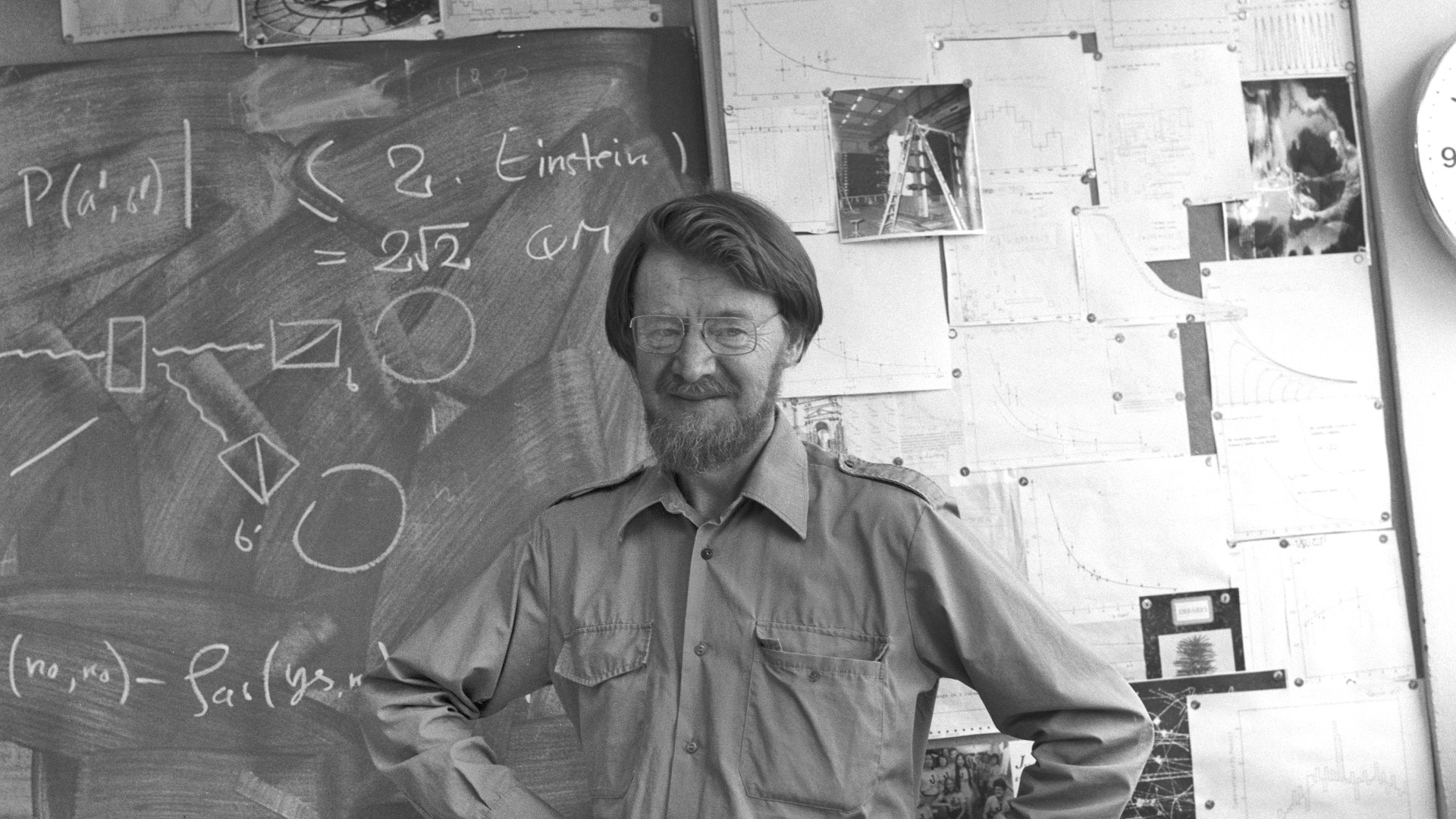
    Featured image: Portrait of theoretical physicist John Bell at CERN, June 1982 (CERN, CC BY 4.0)

  • Quantum entanglement: non-locality and the state of a two-particle system

    Quantum entanglement: non-locality and the state of a two-particle system


    To this day, quantum entanglement and its effects are phenomena which still leave physicists scratching their heads when trying to get a deeper understanding of what is actually happening. This series on quantum entanglement is going to be a two-parter. In this post, we will discuss what is meant by locality and non-locality and what quantum entanglement is. The term quantum entanglement has been used in many instances of popular culture pertaining to spirituality, healing, and a flurry of new age approaches to human consciousness. This is not the kind of ‘quantum entanglement’ we will discuss here. We will purely look at the physics of it, its original and proper meaning. We will study the state of a two-particle system. In the next post, we will discuss what Einstein and his friends proposed, what Bell wrote, and whether Einstein was right. And then there are also exciting caveats which we will explore.

    The basics

    Let’s go over the basics one more time. ‘Particles’ aren’t particles in the classical sense at all – they’re absolutely not like tiny balls or pellets. They are best described by the wave function, a mathematical expression containing all possible states the particle can be in. This pertains to its energy levels, its positions or a number of other properties it can have.

    As long as no measurements have been performed on it, the particle has no definite state or states. It displays wave-like behaviour like being caught in a haze of all possible states. However, as soon as you measure it, the particle will snap out of its haze and it will appear to be a particle, an actual particle in the classical sense, with a definite state.

    Note that ‘the state of an electron’ can refer to a particle with no definite set of states when no measurement was performed. The state of an electron is then best described by the wave function, which contains all possible definite states upon measurement.

    Hereafter, ‘wave function’ and ‘state’ are used interchangeably.

    In This is not an atom, the wave function is discussed. In The double-slit experiment, the wave-like and the particle-like behaviours are showcased.

    Locality vs non-locality

    Isaac Newton knew he had a problem when he formulated his theory of gravity. While it beautifully described the extent to which two masses exert gravitational forces upon each other, his theory didn’t explain how they did that. He didn’t like the conclusion that the gravitational influence between Earth and the Moon seemed to spookily operate at a distance through the vacuum. He wrote it was ‘so great an Absurdity that I believe no Man who has in philosophical Matters a competent Faculty of thinking can ever fall into it’. He famously stated to leave this unsolved mystery to ‘the Consideration of my readers’[1].

    In other words, Newton wasn’t big on non-locality. And yet, his own theory did entail an invisible force operating over vast distances through the vacuum. Moreover, it seemed to be an instantaneous effect: if the Sun were to suddenly disappear, then Earth would be flung off its trajectory immediately. Of course, today, we know that nothing can travel faster than light, so the gravitational changes of the Sun would take about eight minutes to ‘reach’ Earth.

    The following years, physical phenomena such as magnetism and electricity proved, in fact, to be very local indeed. It became clear there is always an indirect way through which one object is able to influence another object at a distance. What is meant with locality? Here’s the mechanism: an object interacts with its immediate environment, a field embedded within the three-dimensional space we live in, i.e. the electromagnetic field, which then passes on that ripple of disturbance onto the other object. In terms of ‘fields’, one could say that at one particular location the field’s value is changed by some object. That value change then changes the values of the field in the direct vicinity, which then change the values in their vicinity, and so on. It’s a bit like ‘the wave’ done by thousands of sports fans in a stadium. Or like falling dominoes. Every change is ever local and the propagation of that change through space is limited to the speed of light.

    Tumbling telephone boxes are definitely a ‘local phenomenon’. The sculpture Out of Order by David Mach is situated in Kingston upon Thames (UK). Photo by 272447.

    Many years later, Einstein replaced Newton’s theory with his own theory of gravity, General Relativity (GR). It showed that Newton’s intuition was correct. Gravity couldn’t be non-local and Einstein showed it isn’t. In GR, space and time itself are the stretchy substance through which gravitational disturbances propagate at the speed of light towards the other object. When a mass curves or disturbs spacetime around it, that curvature or disturbance then ripples through the universe, on its way to influence other objects. In fact, on 11 February 2016, a large collaboration of incredibly talented scientists physically measured these gravitational ripples in spacetime as predicted by Einstein in 1916. It won three key figures the Nobel Prize.

    And so, it seems there is no spooky influence at a distance in physics. Even still to this day, in modern quantum physics, our best understanding and most successful theory is that quantum fields pervade our universe, forming the mediums through which forces are propagated, limited by the speed of light.

    Non-locality entails a change in one patch of space instantaneously influencing another patch of space irrespective of their distance. Locality entails the propagation of change through space by influencing only neighbouring patches of space at a maximum of the speed of light.

    Spin

    Electrons have several properties. One of the more obvious is (negative) charge. The Stern-Gerlach experiments showed that they possess another property which was given the name spin angular momentum or simply spin for short, for lack of a better term as electrons aren’t exactly like spinning balls.

    Nevertheless, as it stands, electrons have an intrinsic spin, which cannot in any sensible way be described like a classical-mechanical rotation. Like with any object in three-dimensional space, you can measure its spin along any angle within 360 degrees in three dimensions. With respect to whichever axis you choose, they can only ever spin clockwise or anticlockwise(beginfootnote)Yes, this does sound like there is an actual rotation around an axis in the classical sense. And maybe, in some deep sense, there is after all, however, this deserves a post of its own, so suffice to say for now, our language is simply too limited to avoid using classical terms for quantum mechanical phenomena, misleadingly.(endfootnote). The latter is called spin up and the former spin down, according to the right-hand rule.

    If electrons were like tiny, fluffy balls such as displayed here, you could picture their spin as an anticlockwise or clockwise rotation about the axis of measurement. Using the right-hand rule, we can designate this spin-up or spin-down. Of course, in three dimensions, any axis of measurement at any angle can be chosen with respect to which it will be found spinning. Disclaimer: this classical-mechanical illustration does not portray actual electrons nor actual quantum mechanical spins. But it’s perhaps useful as a simile. (Illustration by KJ Runia)

    Symbols

    As we take our readers seriously, we’ll take this opportunity to introduce a few mathematical symbols which will prove to come in handy at later stages of this series.

    Let’s use the symbol $\lvert A \rangle$ to denote the state of the electron in Amsterdam with respect to its spin. As long as we haven’t performed any measurements on the electron, it has no definite state. However, upon measurement, its spin with respect to the vertical axis of measurement is ever either spin up or down. Let’s write these two possible measurement outcomes as $\lvert\uparrow\rangle_A$ or $\lvert\downarrow\rangle_A$.

    Likewise, if the state of an electron in Boston $\lvert B \rangle$ is spin up or spin down, we write $\lvert\uparrow\rangle_B$ or $\lvert\downarrow\rangle_B$.

    Assuming the state of the electron in Amsterdam hasn’t been measured yet, we can express this (with respect to spin) as a combination of both spin states:

    $$\lvert A \rangle = \alpha \lvert\uparrow\rangle_A + \beta \lvert\downarrow\rangle_A .$$

    This is why physicists often poetically say that the unmeasured particle is in a state of both spins at the same time while it’s more accurate to say it has no definite state. Mathematically, its state is an amalgam of all possible, linearly superposed (added together), algebraic solutions to the Schrödinger equation, hence, it’s said to be in quantum superposition.

    What’s that $\alpha$ and $\beta$, you ask? Well, they’re numbers of probability we need to find in order to complete our expression. The Born rule states that if we square the (modulus of the) wave function (the state), we will get the probability (density) of either possible outcome after measurement. Now, experiments have shown that either outcome, spin up or spin down, $\lvert\uparrow\rangle_A$ or $\lvert\downarrow\rangle_A$, appears in 50% of the total number of measurements. In other words, the probability of measuring either spin state is exactly $\frac{1}{2}$. So, if we put $\alpha=\beta=\frac{1}{\sqrt{2}}$, then $\lvert\alpha\rvert^2 = \lvert\beta\rvert^2 = \frac{1}{2}$. After all, $(\frac{1}{\sqrt{2}})^2 = \frac{1}{2}$, which is exactly what we want. So, the state (wave function) of our Amsterdam electron with respect to spin can be represented by

    $$\lvert A \rangle = \frac{1}{\sqrt{2}} \lvert \uparrow\rangle_A +\frac{1}{\sqrt{2}} \lvert \downarrow\rangle_A .$$

    Similarly, the state of the electron in Boston with respect to spin is then represented by

    $$\lvert B \rangle = \frac{1}{\sqrt{2}} \lvert \uparrow\rangle_B +\frac{1}{\sqrt{2}} \lvert \downarrow\rangle_B .$$

    What you need to take from this is the following: the state of an electron before measurement is the sum of all possible states (multiplied by a probability factor, in this case $\frac{1}{\sqrt{2}}$).

    In the case of spin as measured along the vertical axis, the state of the electron is the sum of two possible states, spin up $\lvert \uparrow \rangle$ or spin down $\lvert \downarrow \rangle$.

    Note that there are other possibilities: we could measure the spin along a horizontal axis. We could represent this with spin left $\lvert \leftarrow \rangle$ or spin right $\lvert \rightarrow \rangle$. Or we could measure the spin at angles of +120 or -120 degrees from the vertical axis, which we might represent as $\lvert \nwarrow \rangle$ and $\lvert \searrow \rangle$ or $\lvert \nearrow \rangle$ and $\lvert \swarrow \rangle$. We will get to that in the discussion of Bell’s Theorem in the next post.

    Quantum entanglement

    So, what is quantum entanglement? Recall that the most complete description of a particle is the wave function. This has always been about a free, single particle, not interacting with anything. In the case of quantum entanglement, however, this doesn’t fly anymore.

    When the state of a particle can no longer be described without a description of the state of another particle, those two particles are said to be quantum entangled. No longer can we describe either particle by one wave function each. They can only be described as a two-particle system by one and the same wave function.

    This has an astonishing consequence. Suppose our two electrons become entangled in such a way that they always have opposite spins(beginfootnote)Producing spin-entangled electrons is difficult but clever experimental physicists have their ways.(endfootnote). So, if one has ‘spin up’, $\lvert \uparrow \rangle$, the other always has ‘spin down’, $\lvert \downarrow \rangle$, or vice versa(beginfootnote)It’s also possible to have them correlate such that they have identical spin, but for our example, let’s not.(endfootnote). So, we now have one system with two particles who always have opposite spins, which means that the total spin of our system is 0, zero. Let’s denote the total spin of our system with $\lvert S \rangle$.

    Before our experiment takes place, they are both separated. One is staying in a laboratory in Amsterdam. The other is transported to Boston. Since no measurement has taken place on either particle, they are in a superposition according to the one wave function. They haven’t an exact location (although one is very likely to be somewhere in Amsterdam at the moment of measurement and, likewise, the other in Boston), their energy levels are all over the place, and their spin isn’t either spin up or spin down along this or that axis.

    We can represent this whole situation with respect to spins as follows:

    $$\lvert S \rangle = \dfrac{1}{\sqrt{2}} \left( \lvert \uparrow \rangle_A \lvert \downarrow \rangle_B – \lvert \downarrow \rangle_A \lvert \uparrow \rangle_B \right) .$$

    When you’re looking carefully at the expression above, you can see that the state of the total spin $\lvert S \rangle$ of our two-particle system is a combination of two situations: the electron in Amsterdam is spin up and so the electron in Boston is spin down or the electron in Amsterdam is spin down and the electron in Boston is spin up. They need to be subtracted from each other because the total spin equals 0, remember? Hence, the minus sign. Lastly, both states are multiplied by the fraction $\frac{1}{\sqrt{2}}$ because both states have a 50% chance of occurring (which you get if you square the whole thing).

    And so, what does this mean? As soon as you perform measurements on the one in Amsterdam, and you find it has spin up, the other electron in Boston immediately has spin down along that particular axis upon measurement, even though the probability before measurement was still 50%! How does the electron in Boston ‘know’ what the measurement result in Amsterdam was? En how does it know this so fast? Faster than the speed of light! Besides this, turns out, you’ll always get a definite spin from the other particle opposite to the one you measured first. As soon as the measurement in Amsterdam took place, the measurement outcome in Boston being the opposite result is always 100% all of a sudden! (Or the other way around.) There are never any exceptions!

    In other words, as soon as you do the measurement, the mathematical description changes from

    $$\lvert S \rangle = \dfrac{1}{\sqrt{2}} \left( \lvert \uparrow \rangle_A \lvert \downarrow \rangle_B – \lvert \downarrow \rangle_A \lvert \uparrow \rangle_B \right) ,$$

    to either

    $$\lvert S \rangle = \lvert \uparrow \rangle_A \lvert \downarrow \rangle_B ,$$

    meaning, the state of the total spin equals the one in Amsterdam being spin up and the one in Boston being spin down, or, vice versa:

    $$\lvert S \rangle = \lvert \downarrow \rangle_A \lvert \uparrow \rangle_B .$$

    And here’s the astonishing part: this will always work this way, no matter how great the physical distance between the two particles. Locality out the window. Welcome back, non-locality.

    Einstein accepted this prediction in quantum mechanics as being correct. However, he didn’t like it. How did the other particle instantly ‘know’ which spin to exhibit when Einstein’s fantastically successful theories of relativity relied on the universal law that nothing can exceed the speed of light? He accepted the theory but he concluded it wasn’t complete. There had to be some sort of hidden mechanism which they had overlooked.

    We will discuss Einstein’s attempt at saving the principle of locality and the universal speed limit in the next post. As well as John Bell’s and Alain Aspect’s subsequent work. For now, the question of whether Einstein was right, we will ‘leave up to the Consideration of our readers.’


    [1] Newton, I. (1756) Four Letters from Sir Isaac Newton to Doctor Bentley: Containing Some Arguments in Proof of a Deity [Online]. Available here. (Accessed: 14 May 2020)

    Featured image by KJ Runia

  • The double-slit experiment

    The double-slit experiment


    Over three hundred years ago, grumpy old men with 17th-century wigs or 18th-century black-ribboned man ponytails were divided into two camps. They were squabbling over what type of phenomenon light is. ‘Light is waves’, said Huygens, Hooke, Euler and friends. ‘No no, light is particles’, said Newton, Laplace and colleagues. Fast forward to 1990 and even my physics teacher in high school confesses he still wasn’t sure about the correct answer.

    His confusion is understandable. Even though he could have known the correct way of thinking about it, the reason for these murky waters can be traced back to the now famous set of double-slit experiments.

    So, join me in tumbling through the slits of science, into the mad world of quantum physics, where one thing was proven be in two places at once. Or was it?


    NEW: Listen to the audio |


    (not really meant as podcast since referrals are made to figures in the article)


    The set-up

    Suppose you had a shotgun capable of spraying a cloud of numerous tiny lead pellets in one shot. If you’d aim it at a screen containing two thin slits, so only some might get through, what shooting pattern should you expect to appear on a screen behind it?

    Figure 1. A screen with two slits
    Figure 1. A screen with two slits

    I’m quite confident your answer will correlate strongly with the situation as depicted in Figure 2.

    Figure 2. The screen with the double slits and a screen behind it with the typical impact pattern of pellets or particles
    Figure 2. The screen with the double slits and a screen behind it with the typical impact pattern of pellets or particles

    This is exactly what you would expect if the things you’re using to shoot with are tiny pellets or tiny particles. No surprise here.

    Now imagine, we’d slowly submerge the screen with the two slits half-way into a pond. Water waves are slowly rolling towards the first screen as depicted in Figure 3.

    Figure 3. Both screens are now partly submerged in water. Water waves are approaching the first screen.
    Figure 3. Both screens are now partly submerged in water. Water waves are approaching the first screen.

    What would these waves look like after they’ve gone through the slits? When seen from above, it would look like Figure 4.

    Figure 4. As the waves go through the two slits, they transform into two circularly spreading waves like two stones in a pond.
    Figure 4. As the waves go through the two slits, they transform into two circularly spreading waves like two stones in a pond.

    The two slits transform the waves into two circularly spreading waves. Like two stones thrown into a pond. You can see how the waves will intersect with each other. You might expect some interaction to occur at these crossroads and you would be right.

    In fact, let’s have a look at a real pond. In the GIF of Figure 5, you can clearly see how these two circular waves interfere with each other. If two crests meet, they amplify each other’s amplitude, whereas two troughs meeting, they amplify each other’s trough-ness (also amplitude but in the other direction). And where a crest meets a trough, they cancel each other out!

    Figure 5. Two circular waves in an actual pond.
    Figure 5. Two circular waves in an actual pond.

    Now have a look at the animation of Figure 6 and observe especially what the second screen receives: patches where the waves hit the screen are white and patches where there are no waves at all are black.

    Figure 6. The white areas are where the (amplified) waves hit the second screen, the black areas are the parts where no waves are present due to mutual cancellation
    Figure 6. The white areas are where the (amplified) waves hit the second screen, the black areas are the parts where no waves are present due to mutual cancellation

    So, now we know what happens if waves would be thrown at the two slits. Contrary to what you see when you would shoot pellets towards the screen, you would see what’s depicted in Figure 7.

    Figure 7. The double-slit set-up with the typical pattern on the second screen when waves have gone through

    So, now we have two options. If whatever we’re shooting at the slits is particles, we get what’s on the left in Figure 8. If we’re aiming waves at the slits, we get what is on the right in Figure 8.

    Figure 8. If particles went through the slits, you get to see the pattern on the left. If it’s waves, you get the pattern on the right.

    Young’s interference experiment

    Thomas Young was a polymath and physician. In the 1790s, he wrote a thesis on the physical and mathematical properties of sound. In 1800, he presented the Royal Society, the UK’s national academy of sciences, his theory that light is a wave too. He was met with great skepticism as the likes of Newton and Laplace were proponents of the light-is-particles theory. 

    Young then showed how they were wrong. A notable fact is that he didn’t actually use two slits. He had a bundle of sunlight pass through a pinhole so as to obtain a very tiny bundle of sunlight. He then placed a ‘slip of card’ in front of the pinhole, essentially splitting the small bundle in two even smaller bundles which then interfere with each other. The resulting light pattern would have looked like the one shown in Figure 9.

    Figure 9. The pattern which Young produced by splitting sunlight

    If light were particles, you would have seen an entirely different pattern. This result, however, completely corresponds to the wave theory of light. Young concluded therefore that light is indeed a wave phenomenon. He called this the most important of his achievements.

    This marked the beginning of the acceptance of the wave theory of light (yay for Huygens and friends) and a departure from the particle theory of light (nay for Newton and fr… well, colleagues, at least).

    Or particles after all?

    Figure 10. Individual electrons

    Of course, Max Planck, Albert Einstein, and a few other colleagues would later show that light is particles after all. In a previous post, The formula that got Albert Einstein the Nobel Prize and should stop us getting sunburn all the time, we discussed Einstein’s finding which won him the Nobel Prize.

    In short, Max Planck and Albert Einstein showed that certain behaviour of light could only be explained if it consisted of small packets of energy, quanta as they were labelled.

    But apart from that, experimenters found another peculiarity. In the 1960s, electrons were generally expected to behave like particles – like pellets or ball bearings. So, instead of light, they fired one electron at a time towards a splitter and have a screen behind that capture the electron. What they initially saw was to be expected. A few (11) loose dots on the screen as shown in Figure 10. However, as the individual electrons kept being fired, one after the other, an astonishing pattern started to emerge – the kind you would expect to see in the case of interfering waves! Wait, what?

    Are they waves after all? But they were individual electrons! How?

    Needless to say, experimenters did the same thing with individual photons, the quanta of light Max Planck and Einstein were talking about. Extremely low-intensity light was produced up to the point where single photons were shot at the screen. The same result. They seem to behave like particles at first but then this wave pattern emerges.

    Two places at once?

    Theorists then theorised that the only explanation was that a single electron and a single photon somehow went through the two slits at the same time, enabling some kind of self-interference so that this wave pattern would emerge while also preserving a particle pattern at the same time.

    To test this theory, people put particle detectors at the two slits in order to see if the single electron or the single photon indeed flew through both slits at the same time.

    The result was again astonishing: the wave pattern disappeared and what they got was instead the pattern you’d expect to see if the particles were actual particles – the pattern was like the pattern in Figure 2. At the same time, they never detected the particle at both detectors. They were ever only detected by one detector – as if they were particles.

    As soon as they removed the detectors, however, the wave pattern emerged again.

    And even if they placed just one detector at one slit, the wave pattern disappeared again and the particle pattern showed up.

    It was as if the electron and the photon knew when they were being watched and then decided to behave differently.

    This is called the measurement problem. In the next post, we will discuss this at greater depth.

    People now started talking about the wave-particle duality of elementary particles. Are particles truly particles or waves? They’re both, people now said. Sometimes they’re waves, sometimes they’re particles.

    Fields

    Of course, nowadays, the reigning theoretical paradigm is quantum field theory – mathematical field descriptions to capture the behaviour of ‘particles’ such as the electron, the photon, and a whole zoo of elementary constituents of our reality. The most successful quantum field theory to date is called the Standard Model of particle physics. In a previous post, Why, exactly, do glass and liquids refract light?, we dive a little bit into quantum field theory.

    In short, the question of whether light is particles or waves has been answered: it’s fields. The same goes for electrons. And all the other elementary ‘particles’. It’s all fields.

    As long as no interaction with the outside world such as detectors take place, a photon or electron are part of the wave functions of their respective electromagnetic and electron fields, governed by the Schrödinger equation. They are very much like waves. However, as soon as they interact with something, such as a detector, what is detected is a particle, merely a slice of a photon’s or electron’s entire wave function.

    I promise we will unpack these two last paragraphs in a later post. We expounded on that a little bit already in This is not an atom.

    But, please, tell me now, are they in two places?

    No, not even technically. Linguistically then? Also, no. That statement is likely the result of mixing-up or lack for a better way of providing both metaphorical and physical descriptions of what is going on – it also reveals the still-present, outdated notion of what photons and electrons were supposed to be. If electrons were in two places at once, you still imagine them being small, little pellets, two copies of which fly through both slits, somehow interfering with each other. And that’s just not so.

    The correct expression is that electrons and photons and the likes don’t have a definite location: their existence is simply spread out in space according to the wave function, the time-evolution of which in turn obeys the Schrödinger equation. Again, do give This is not an atom a read where this is explained in more detail.

    Pretty mind-bending stuff, right? Good. Welcome to the club. Great minds before you have had to take their time to wrap their heads around the double-slit experiment. Now you’re one of them.


    Featured image by Free-Photos

    Sunlight diffraction pattern by Aleksandr Berdnikov under CC BY-SA 4.0

    Single electron build-up series. Results of a double-slit-experiment performed by Dr. Tonomura showing the build-up of an interference pattern of single electrons. Numbers of electrons are 11 (a), 200 (b), 6000 (c), 40000 (d), 140000 (e). By Belsazar under CC BY-SA 3.0.

  • This is not an atom

    This is not an atom


    Today, many people know that all things around us – the chair we sit on, the screen we look at – are a composition of all sorts of different molecules and that they are in turn composed of all sorts of different atoms. Indeed, ancient Greek philosophers such as Democritus hypothesized matter consists of tiny, physically indivisible entities, which they then named atoms.

    However, we also know that the Greeks weren’t entirely correct: the atom itself is composed of electrons, protons, and neutrons. We also know that the latter two are composed of even smaller things – quarks and gluons.

    What not many people know, however, is that this classical picture:

    A out-dated image of an atom. Several tiny balls fly in fixed orbits

    is absolutely not what an atom is!

    Old ideas

    If you hung out in the wrong street corners, you might have been told that electrons whizz around the nucleus like tiny planets around the Sun or tiny moons around a planet. If that were the case then you have been lied to.

    If you hung out in yet other unsavoury street corners, you might have been told that quantum mechanics is something magical, spiritual, and the doorway to a deeper understanding of love, consciousness, and healing. Telepathy, even. Again, you have been lied to.

    Admittedly, the famous physicist Richard Feynman is often quoted as saying that nobody understands quantum mechanics. In a specific way, that’s true. Particles don’t behave like everyday objects and that is a strange fact. Furthermore, the mathematical descriptions of particles tell us what they do but not what they are. We know all the equations but we don’t know what they mean – as opposed to knowing the meaning of the words ‘microscopically tiny ball’.

    However, this doesn’t mean we shouldn’t make an effort to making particles predictable, useful, and less mysterious and esoteric. It doesn’t mean we can’t harness the power of a good theory of quantum behaviour.

    In fact, that’s exactly what we’ve been doing rather successfully since quantum mechanics took shape in the 1920s. Hence, the existence of your mobile phone, computers, cameras, and self-checkout in the supermarket.

    So, let’s slice off the fat and cut to the chase.

    Classical mechanics versus quantum mechanics

    In high school, we were taught Newtonian mechanics. We were told that the world is reigned by Newton’s laws, the most powerful of them being the second: force equals mass times acceleration,

    $F = ma.$

    We were taught that when an object is moving, it moves according to Newton’s second law.  The beauty of his mechanics was that physicists and engineers were now able to predict the future (and retrodict its past) of a sliding block, for instance, based on just a few known initial conditions.

    Inclined plane problems are the staple in physics class for senior high school students

    More generally speaking, and in physics jargon, Newtonian mechanics is capable of describing the state of a system over time with mathematically infinite precision based on a sufficient set of initial conditions. We call this a deterministic theory as it’s possible to determine past and future of the state of a system. Thanks to this property even space vessels such as the Apollo Lunar Module and Mars Rover Curiosity were able to arrive successfully at their extraterrestrial destinations.

    In quantum mechanics, we study the behaviour of subatomic stuff, such as electrons and quarks. After many twists and turns throughout history, it turns out we can’t actually determine the past and future of, say, an electron – not as we could for blocks and balls in Newtonian mechanics. Why not? Because it’s simply not a tiny block or ball. It’s not even a particle in that sense (assuming a particle is like a tiny ball)! It’s a wave function, a mathematical expression describing all the possible states of a ‘particle’. Quite a different beast.

    Possible states? Yes, in quantum mechanics, things aren’t so deterministic. Turns out that to describe the state of an electron, for example, Newton’s second law doesn’t apply. It’s fundamentally impossible to predict or retrodict where an electron will be at any given time, for instance. Or how fast it’s moving at a particular point in time. The best we can do is calculate the probability it’ll be here or there or whizzing at this or that velocity. In other words, the state of an electron can only be described in terms of probabilities.

    It also turns out that the probabilities of this set of possible states may change over time. Luckily, like in Newtonian mechanics, there’s an equation for that. In quantum mechanics, the analogue of Newton’s second law is called the Schrödinger equation. It tells you how a wave function, i.e., the set of all possible states of a particle, changes over time. In its most compact form(beginfootnote)Although, technically, using Newton’s notation instead of Leibniz’s, an even more compact form is $i \hbar \dot{\Psi} = \hat{H} \Psi.$(endfootnote) it goes like this:

    $i\hbar \dfrac{\partial}{\partial t}\Psi = \hat{H}\Psi.$

    No need to understand all the symbols but here you can see that also in quantum mechanics there’s a beautiful equation at its centre, and it’s this one(beginfootnote)There are other ways to calculate the time-evolution of the wave function, of course, such as in Heisenberg’s matrix mechanics, Feynman’s path integral formulation, and Dirac’s formulation for matrix mechanics and the Schrödinger equation combined. However, this one is invariably taught at undergraduate level.(endfootnote). It tells you the evolution of $\Psi$, the symbol for the wave function.

    Deterministic theories, such as Newtonian mechanics, are called ‘classical’ as opposed to quantum mechanics, dealing with probabilistic wave functions(beginfootnote)Note that the Schrödinger equation is deterministic. It’s the wave function itself that yields probabilities, or, if you’re a stickler for accuracy like me, it’s the wave function’s norm squared that yields probability densities (by integrating the norm squared over a volume, area or distance).(endfootnote).

    Wave functions

    As we’ve learnt in the previous section, a particle is not a particle. Granted, we still talk about a ‘particle’ but that’s only for lack of a better term. It’s an artefact of humankind’s limited understanding of the Universe back in the day. The idea of a particle simply fits among the things we already know. We can picture a little ball because we grew up playing with little balls. Or marbles, or whatever. Admittedly, sometimes particles do look like particles, which we’ll discuss in the last section.

    Nevertheless, experiments from the early 20th century proved that tiny balls were definitely the wrong idea. Therefore, nowadays, our best descriptions of ‘particles’ are indeed wave functions, mathematical expressions. The fundamental question is whether the wave function is the particle or just a mathematical representation of it. This question hasn’t been answered yet, however, the personal opinion of the author of this post is that after about a century of the highly successful theory of quantum mechanics, it’s maybe time to start regarding the wave function as the thing that is a ‘particle’.

    Just to illustrate the difference between a particle and wave, have a look at this point-like particle. The horizontal axis is the x-coordinate in space and the vertical axis is the y-coordinate in space.

    Now tell me, where in space is the particle located? You probably got the answer straight away. It’s at coordinate (2,3). Good.

    Now, have a look at this (two-dimensional) wave.

    So, tell me, where in space is the wave located? You may find it harder to pinpoint the wave to a specific set of coordinates. That’s because it’s in several places at once. It doesn’t have a specific position. In physics speak, this is called a superposition.

    This is also the case for an electron (or any other ‘particle’). It’s in a superposition, and not just in terms of its position: it’s also in a superposition in terms of its energy, momentum, and a few other properties. In other words, it’s in all places at once at several energy levels at once, whizzing at all kinds of velocities at once.

    Note, however, that the wave function is absolutely not the same as a simple sine wave in normal space which was merely displayed here for reasons of clarity(beginfootnote)And, indeed, those who read a previous post on light refraction in glass know that ‘particles’ are oscillations in their respective three-dimensional quantum fields in quantum field theory. The wave function plays a central role in this highly successful theory. Secondly, the wave function is a so-called complex function and therefore exists in so-called complex space $\mathbb{C}$, not in the ‘regular’ number space $\mathbb{R}$, we all grew up with. Lastly, and at the cutting edge of our scientific knowledge, there is actually only one wave function, the wave function of the Universe. Every field and particle in it are mere parts of that wave function, which can be thought of as small, individual wave functions to keep it manageable.(endfootnote).

    Maybe now you can appreciate how revolutionary quantum mechanics truly is compared to the simple mechanics of the blocks and tiny balls of everyday life.

    Picture of an atom

    So, we’ve arrived at the correct picture of an atom. We already learnt that an electron isn’t a point-like particle, it’s a wave function. What do wave functions look like then? Well, they are cloud-like but not clouds, smeared out in space, yet both size- and location-less. They don’t have a specific position, they don’t have a specific momentum, they don’t have a specific energy value. They are in a superposition of all these possible states. The probabilities of these states may oscillate over time as dictated by the Schrödinger equation.

    That doesn’t help much, does it?

    Well, fear not. Dillon Berger, a PhD student of Theoretical Particle Physics at UC Irvine, made a beautiful animation of a cross-section of a hydrogen atom using the Schrödinger equation. The contours represent the wave function of the electron. The colours denote the probability of the electron being in that particular state. Note, there is only one electron in a hydrogen atom. So, yes. It’s almost everywhere at the same time, while also oscillating over time. (This animation has time slowed down by a thousand trillion. The nucleus, a proton, is too small, so it’s invisible.)

    That whole tiny balls or planets revolving around the nucleus analogy? Flush it out of your system. For good.

    Unless we’re looking

    Now, hold on, you might say. Why is it then that professional physicists still talk of particles? And what did you mean, when, earlier, you said they’re size-less? How then do you explain the fact that in scientific tables we saw in high school, actual, physical sizes of particles are listed? And how do you explain this classical picture of the readout of a cloud chamber demonstrating the existence of a subatomic particle? That trajectory certainly looks like it was created by a point-like particle and not at all a wave.

    Source: Anderson, Carl D. (1933). “The Positive Electron”. Physical Review 43 (6): 491–494

    You’re quite right to doubt the whole story about wave functions in the face of these empirical findings. You’ve also arrived at a mystery that is at the heart of quantum mechanics, worthy of a Nobel Prize, which, of course, has a name: the measurement problem.

    Turns out, particles are indeed wave functions but only if we’re not looking. As soon as we do measurements, trying to gauge their position, for example, we won’t find them at all places at once, like a wave. Instead, we will find them at one particular location – just as we would expect from an actual particle!

    This is what the famed double-slit experiment demonstrated. In another post, we discussed this.

    This is why, to this day, you might have heard of the ‘wave-particle duality’ of the subatomic world. The wave function is the most complete description of a particle. As soon as we do measurements, we see only a sliver of its original wave function, a mere shard of the set of all possible states.

    Therefore, Dillon Berger’s animation shows a hydrogen atom when left completely alone. This is its fundamental state of being: its electron being a wave function in superposition, oscillating over time according to the Schrödinger equation. And as soon as it interacts with its environment, only a metaphorical slice of its full existence will show (a slice corresponding to the disguise of an actual particle).

    How this happens or what actually happens when we do measurements is still up for debate. We will most certainly dive deeper into a variety of views on how to tackle this phenomenon in another post. Expect a post on the Copenhagen interpretation of quantum mechanics, the Many-Worlds interpretation, and others soon.

    Now you have a better mental picture of an atom, at least. Probably.

  • Is microwave oven radiation unhealthy?

    Is microwave oven radiation unhealthy?


    Some say that the radiation inside a microwave oven is bad for our health. And that it’s bad for our food. It’s uncertain from where these contentions originate exactly. Even though the introduction of the microwave oven(beginfootnote)They were called ‘electronic ovens’.(endfootnote) in our homes took place in the 1960s, among some, they never got rid of their unhealthy reputation entirely. In this article, we will have a look at what its radiation is and how that influences food and vitamins. We will then proceed to answer the question: Is microwave oven radiation unhealthy?

    The word ‘radiation’

    Pripyat, near Chernobyl, Ukraine. When we hear 'radiation', we may associate it with the Chernobyl disaster. That is absolutely not at all what microwave oven radiation is.
    Pripyat, near Chernobyl, Ukraine. When we hear ‘radiation’, we may associate it with the Chernobyl disaster. That is absolutely not at all what microwave oven radiation is.

    In physics, ‘radiation’ is the emission or transmission of energy in the form of waves or ‘particles’. Not all radiation is a health hazard to our species as we have evolved to be immune in most cases. Radiation emitted by nuclear reactors is dangerous. However, it may not surprise you that we have evolved to withstand the radiation of tea lights.

    While society generally might not care about what physics says ‘radiation’ means, this is what we’re going to be using throughout this article.

    Radiation is not always dangerous. There are more things in everyday life than you might think which are forms of radiation.

    Bananas, also those growing in the wild, naturally possess radioactivity. Our species can handle this. It's infinitely more dangerous for other reasons. Don't litter, folks.
    Bananas, also those growing in the wild, naturally possess radioactivity. Our species can handle the radiation. It’s infinitely more dangerous for other reasons. Don’t litter, folks.

    Some examples of sources of radiation: bananas (which are naturally radioactive), magnets, candle sticks, central heating, club and stage lights, any light source for that matter, including your bathroom light, human bodies, microwave ovens, the Sun, the uranium and plutonium rods of a nuclear plant, and furthermore, anything you can see with your eyes either emits or reflects radiation, right here, right now.

    Just look straight into the eyes of your partner, or friend with merits, lying next to you the next morning: whether you want to or not, they have been literally gushing their radiation all over your body, right here, and are still, right now, the whole time. And not in any spiritual or venereal sense, no no, you have been and are being exposed to actual spurts of electromagnetic radiation discharging from their bodies(beginfootnote)Infrared, mostly. Note that our bodies are also radioactive. We emit ‘particle’ radiation too. On average, about 5000 of our atomic nuclei decay every second (5000 Bq) and emit radioactive radiation.(endfootnote), at energy levels literally more than a hundred thousand times higher than microwave oven radiation.

    In fact, in all the examples above, it’s the same type of radiation as microwave oven radiation, called electromagnetic radiation. The difference is that the examples are more than a hundred thousand times more energetic than microwave oven radiation. Except for a big chunk of the Sun’s radiation, and uranium and plutonium rods. Those entail dangerous forms of ionising radiation, and involve more than just the electromagnetic kind.

    Ionising radiation

    The dangerous form of radiation is called ionising radiation. This is the type of radiation many people think of when they hear the word ‘radiation’. Microwave oven radiation isn’t that.

    If incoming radiation has so much energy that it strips one or more electrons away from their nucleus, we call this ionising radiation. An atom which has lost one or more electrons, we consider to be ionised, and so, we now call it an ion.

    Why is this dangerous? Well, our bodies are made of large strings and knots of intertwined atoms. Our skin, organs, cells, DNA—it’s all made up of trillions of atoms. Those atoms are only able to form these large chains and knots because their electrons keep them together this way.

    Thus, if ionising radiation strips away those electrons from their nucleus, then our molecules, cells, DNA—it all falls apart. And especially damage to our DNA is dangerous as this could develop into cancerous growth. Fortunately, our body has evolved to possess certain superpowers, if you will, enabling it to repair damaged cells and even DNA to an astonishing degree.

    Sadly, there are limits. A sufficient blast of ionising radiation may cause damage beyond our bodies’ repair capabilities and thereby may be the cause for cancer.

    Ionising radiation breaks down atoms, thus molecules, thus organic cells. When our body’s repair mechanism is overwhelmed by the amount of ionisation, this may eventually lead to cancer and organ failure. Microwave oven radiation, however, is not ionising at all. Far from it. It is simply not energetic enough. Not by a stretch.

    Examples of ionising radiation are:

    • subatomic particle radiation: such as protons, neutrons, separate or combined to an atomic nucleus(beginfootnote)Also known as alpha particles.(endfootnote) as well as electrons and positrons(beginfootnote)Also known as beta particles.(endfootnote) flying about, aimed at your general direction;
    • high-energy electromagnetic radiation: cosmic rays, gamma rays(beginfootnote)This is what Dr Bruce Banner was exposed to, turning him into what we call a Hulk. But please, don’t try this yourself. Most likely, you’ll die. At best, you might end up looking like former KGB agent Emil Blonsky or General Thaddeus Ross. If you’re unfamiliar with their tragic fates: Universal Misery.(endfootnote), X-rays(beginfootnote)In hospitals, you will receive much less the amount of X-ray radiation than would be dangerous. Your body is capable of repairing any damage, in this case. It still means that one must be careful, hence, only highly-qualified medical personnel should administer X-ray doses.(endfootnote), the higher-energy UV-light.

    Electromagnetic radiation

    Microwave oven radiation is electromagnetic radiation. What is the latter then? In physics, we have the most successful of theories called quantum electrodynamics (QED), which arose in the 1930s. Do watch these amazing, very accessible videos of the genius and Nobel laureate Richard Feynman, who brought major contributions to QED. It’s the first theory within a larger physical framework called quantum field theory (QFT). In short, without QED, we wouldn’t have had electromagnetism-based technology such as microprocessors—which means we wouldn’t have had TVs, computers, mobile phones, and internet. To understand the theory is to make a few mental steps. In Why, exactly, do glass and liquids refract light?, we’ve mentioned QFT already. We paraphrase the essence down below.

    Space throughout the entire observable Universe is filled with three-dimensional fields. In fact, fields are a property of space. Space without fields does not exist. With space come fields.

    There are many fields. Two of these fields are the electromagnetic field and the electron field.

    We perceive oscillations at specific frequencies in the electromagnetic field as photons, ‘particles’ of light, if you will, sometimes visible light but most of the time it’s invisible light.

    We perceive oscillations at specific frequencies in the electron field as electrons. If we measure them—interact with them using an electric probe in the lab for instance—we perceive them as ‘particles’. Usually, we speak about them as ‘particles’, even though they’re not.

    Electrons influence the electromagnetic field. The latter influences electrons in return. Photons are oscillating parts of the electromagnetic field, and so, electrons influence photons, while photons influence electrons. However, electrons are only influenced by photons when the latter have specific energy values, not just any energy value.

    Photons, or, the electromagnetic field disturbances caused by a microwave oven, which we call ‘radiation’, do not have the correct energy value to ionise the atoms in our body.

    Luckily, photons emitted by the person lying next to you don’t have the correct energy value to destroy our atoms either, nor do the regular lights in our home, even though they carry a hundred thousand times more energy than those of a microwave oven.

    All this is perfectly calculable. Because maths and physics.

    A schematic depiction of two fields spanning throughout the entire observable universe. Here, they look like two-dimensional planes hovering over one another with a little bit of empty space between them but in reality they are three-dimensional fields pervading all of space. They are completely intertwined with each other, three-dimensionally. Electrons are specific oscillations in the electron field and are here depicted as darker yellow blobs in the yellow-coloured electron field. Photons, light, or electromagnetic radiation (they are all the same thing) are likewise depicted as darker green blobs in the green-coloured electromagnetic field. The lighter-green blobs represent the influence in the electromagnetic field caused by electrons.
    A schematic depiction of two fields pervading through the entire observable universe. Here, they look like two-dimensional planes hovering over one another with a little bit of empty space between them but in reality they are three-dimensional fields pervading all of space. They are completely intertwined with each other, three-dimensionally. Electrons are specific oscillations in the electron field and are here depicted as darker yellow blobs in the yellow-coloured electron field. Photons, light, or electromagnetic radiation (they are all the same thing) are likewise depicted as darker green blobs in the green-coloured electromagnetic field. The lighter-green blobs represent the influence in the electromagnetic field caused by electrons.

    How do we know?

    Max Planck, a German theoretical physicist (1858-1947), found a way to calculate the energy values for photons. Einstein subsequently used Planck’s formula to come up with another formula allowing us to calculate if atoms would become ionised by certain forms of radiation. In The formula that got Albert Einstein the Nobel Prize and should stop us getting sunburn all the time, we discuss Einstein’s groundbreaking work in quantum mechanics which would later develop to become quantum electrodynamics (QED). Warning: mathematical equations are given in that article.

    This cheery-looking fellow was a physicist, a genius, and a Nobel laureate. He was one of the founders of quantum mechanics. His name was Max Planck. This is a photograph from 1933.
    This cheery-looking fellow was a physicist, a genius, and a Nobel laureate. He was one of the founders of quantum mechanics. His name was Max Planck. This is a photograph from 1933.

    And so, after many more contributions by really clever people, the fascinating branch of science arose through which we are now able to harness the power of electromagnetic radiation, including that of the microwave oven as well as, incidentally, radio signals, TV signals, Wi-Fi, and mobile phone signals.

    If you want to know where in the ‘spectrum of danger’ microwave oven radiation lies, have a look at this diagram. Hint: if radiation in a microwave oven were dangerous, then the lights in your toilet would liquidate you instantly to a warm, sliding, sneakers-covering pulp of mashed guts, lung pudding, and brain leftovers. Also, Planck, Einstein, and others, would be turning over in their graves.

    Heat

    Knowing this, the natural thing to ask is, what about all the heat? If microwave oven radiation is really that low-energy, how does it manage to cook my food boiling hot? The answer is friction.

    Remember that time when you bent a piece of steel wire back and forth quickly for a while? And that the bend eventually became very hot? That’s because you had been moving many molecules back and forth quickly enough to have them heat up the wire due to friction. You don’t need life-threatening amounts of energy—merely the energy of your arms—to make something really, really hot. Microwave radiation does that mainly with the water molecules in food.

    Under the influence of the electromagnetic field inside the microwave, the slightly polarised water molecules rotate back and forth about 2 400 000 000 times per second. Friction with their surroundings cause heat.

    It’s like rubbing your hands together the same number of times per second, which entails friction and causes heat. This is why it’s easier to heat up solid food in the microwave oven than liquids, such as a cup of water: in the latter, water molecules experience less friction than in the first.

    The radiation does nothing to the composition of the atoms. It merely causes molecules to move. Just as a flame does. Or a conventional oven. Making molecules move, that’s all there is to it.

    This also means that you shouldn’t put your hand in an operating microwave oven. Your molecules will start moving too, just like in a conventional oven or when you would put your hands into a flame on the hob. Though, admittedly, in a microwave oven that would mostly only be your water molecules, while in a conventional oven or on the hob, all of your molecules are affected.

    Vitamins

    Does microwave oven radiation destroy vitamins? As stated before, the radiation isn’t ionising, so it does not destroy vitamins. Heat does, however. Just as flames and conventional ovens heat up food and through that heat destroy vitamins, so does radiation. Not because of the radiation but because of simple heat.

    If microwave oven radiation did destroy vitamins, then the light hanging over your dinner table should obliterate the entire dish in an instant. That would be overdoing the concept of having a quick meal, somewhat.

    Here’s a silver lining. The longer food is exposed to heat, the more vitamins are destroyed. So, if there would be a means to heat food as quickly as possible, less vitamins would be destroyed. It might just be that, depending on all kinds of settings and situations, heating food quickly inside an efficient microwave oven spares more vitamins than a slow burn on the stove.

    We see a gas stove. Flames are engulfing the bottom of a pot. Vitamins are destroyed by heat, not microwave oven radiation.
    Vitamins are destroyed by heat, not microwave oven radiation. Beyond a certain temperature, a certain number of vitamins per second are starting to be destroyed. The longer it takes to heat up food after that, the more vitamins are broken down.

    Moreover, cooking food in a pot in its liquids and then throwing away the liquids equals throwing away the dissolved vitamins in those liquids. This happens a lot while cooking on a conventional hob. In a microwave oven, however, everything stays on the same plate. So, even if vitamins have dissolved in the food’s liquid, you’d still have them on your plate.

    Lastly, while microwave ovens don’t emit radiation that is carcinogenic, food itself may very well be, especially when it’s burnt. So, particularly when cooking on the flames and in a conventional oven: don’t burn your food. You know this. Don’t burn it to a crisp and then eat it.

    Incidentally, microwave oven radiation is very unlikely to burn food on a plate(beginfootnote)Which is why many don’t like it since, more often than not, a little bit of that browned-burnt-y flavour does taste good.(endfootnote).

    Is microwave oven radiation unhealthy?

    Courtesy of quantum physics, microwave oven radiation is not unhealthy and by itself, it doesn’t destroy vitamins (heat does). There is also no residual effect that might be dangerous: it’s like switching the light on and off, only a hundred thousand times less energetic than light. One might mix things up with the residual effect of a nuclear bomb or a nuclear disaster. This is due to the billions of heavy atomic nuclei having been hurled into the environment which in turn emit ionising radiation for thousands of years. Microwave ovens don’t hurl atomic nuclei into your food. That would have been deadly, indeed.

    Any text online, in books or magazines, stating otherwise is basically fighting against the quantum mechanical facts of the Universe. And a grumpy Einstein. In which case, other forces and motivations must have been at play in stating these uninformed propositions.

    So, if someone is telling you microwave ovens are unhealthy, ask them for the exact quantum mechanical equations supporting their claim. Sorry but it is what it is, and it is simply this Universe. If quantum mechanics weren’t correct, they’d have never been able to read their uninformed online source, anyway. Computers wouldn’t work. Their mobile phone would be nothing more than a fancy brick. Internet would never have existed. They would never be able to spread false rumours online about microwave ovens if physics were incorrect. Heck, they themselves wouldn’t even exist.

    We see a shirtless man in a canoe. Don't do this without sunscreen. This is dangerous. Not microwave oven radiation.
    Don’t do this without sunscreen. This is dangerous, not microwave oven radiation.

    By the same science, however, do watch out for the Sun’s UV-light this summer. And avoid at all cost, cosmic rays, gamma rays, and particle beams(beginfootnote)Unless exposure takes place briefly, as conducted by awesome and life-saving medical professionals.(endfootnote), so, whatever you do, do not stroll outside your international space station without a protective suit. And don’t eat yellowcake. Ever. Instead, radiate some green beans in a microwave oven. And eat a radioactive banana. Much healthier.


    Photo of Pripyat, near Chernobyl, Ukraine by Денис Резник from Pixabay.

  • The formula that got Albert Einstein the Nobel Prize and should stop us getting sunburn all the time

    The formula that got Albert Einstein the Nobel Prize and should stop us getting sunburn all the time


    A copy of page 5 of the newspaper The Times of 10 November 1922. Near the bottom, a small article is printed. The title is Nobel Prize for Einstein. The text goes as follows. Stockholm, Nov 9.—The Nobel Prize for Physics—1921—has been awarded to Professor Albert Einstein, of Berlin, in recognition of his work in theoretical physics. The 1922 prize for physics has been awarded to Professor Niels Bohr, of Copenhagen, in recognition of his research work into the structure of atoms.—Reuter.
    ‘Nobel Prize for Einstein’, one sentence was spent in The Times of 10 November 1922.

    In 1921, Albert Einstein won the Nobel Prize “for his services to Theoretical Physics, and especially for his discovery of the law of the photoelectric effect.” Not a word about relativity. So, no, he did not win the Prize with $ E=mc^2 $. Though it is his most famous equation—which, by the way, is not the complete version—it is not his Nobel Prize-winning formula. We will write it down, but first, we describe what this photoelectric effect is.


    Different stuff is made up of different molecules. Different molecules are made up of different atoms. Different atoms are made up of a variety of nuclear composites and different numbers of electrons. So far, nothing new, perhaps, but here’s the thing. If electrons are exposed to particular amounts of energy, they can be ejected away from the nucleus.

    An atom of which one or more electrons have been blasted away is called an ion. The process is called ionisation. Whether this occurs, depends on a few things such as the type of stuff (=the type of atoms and how they are bound together) and the specific energy it is exposed to.

    If ionisation at the surface of a material is achieved by normal light, we call this the photoelectric effect: light (the ‘photo’-part) causing electrons to leave their nucleus (the ‘electric’-part).

    A diagram of the ionisation of an atom (not to scale). (1) The yellow cloud represents an electron’s (probable) whereabouts. The tiny pink core represents the atom’s nucleus. (2) Photons of a specific colour radiate towards the atom. (3) The electron has flown off. The nucleus remains. The atom has become an ion.

    Not about intensity

    One peculiar thing is worth mentioning. In fact, it was this puzzle that led Albert to his equation. It turned out that what matters is the frequency of the light beam, i.e. the colour of the light, not the intensity of it, i.e. the power per square metre, or Joule per second (watt) per square metre.

    Imagine, in the diagram above, that a billion yellow photons would radiate towards the atom and nothing happened; the electron would stay where it was. Now imagine a billion billion billion billion yellow photons approaching the atom. Still nothing would happen as it is not about intensity.

    Yellow light is less energetic than blue light, so if you would replace the light bulb for a source that delivers pure blue light, with even one blue photon, it could happen easily (though you would have to aim impossibly precise, so it makes sense to actually radiate a lot). This puzzled many scientists, but Albert solved it and won the Nobel Prize.

    With his discovery, quantum physics was starting to get momentum. He, and other good physicists of his time, showed that light could be seen as little packets of energy, which scientists started calling photons. A beam of light was now a stream of photons. The intensity, the amount of photons per second per square metres doesn’t matter but the frequency of a photon, or energy per photon does.

    DNA

    While this is all cool and useful for scientific purposes, we certainly do not want any electrons of the DNA molecules of our skin breaking away from their atomic confines. Atomic bonds would be destroyed and our DNA would become mutated. Even though astonishing molecular biological processes in our body repair defects like this in a staggering, basically inconceivable number of cases, some errors might slip through and may even become the start of tumour growth. Therefore, it is important to know what energy domains would cause our beloved bodily electrons to be blasted off so that humanity can learn to avoid those dangerous environments.

    The problem arises when we get into the mid to high-energy electromagnetic radiation, or light, or photons, if you will. We’re talking the dangerous kind of ultraviolet here, the type of UV causing DNA mutation to occur: UVB to be precise. A photon of UVB-light is about 1.8 times more energetic than a photon of the yellowish light in your home and almost a million times more energetic than a mobile phone photon. So, don’t be scared of being home. As soon as you set foot outside, though, be afraid. Not of the dark, but of the light, for ionising UVB-light is emitted by the Sun.

    A diagram of electromagnetic radiation. Far right, we see the dangerous types of radiation: cosmic rays, x-rays, gamma rays, UV-light. In the middle, we see visible light. Far left, we see the lowest energy photons: WiFi, mobile phones, microwave ovens.
    A diagram (not to scale) of electromagnetic radiation, or photons, if you will. The mentioned values are the frequencies of the photons, expressed in gigahertz (GHz). The higher the frequency, the higher the energy of the photon.

    Fortunately, as stated before, our bodies have evolved to repair the damage when necessary. This is why even X-rays are okay and hospitals and dentists make sure not to expose you to doses of energetic photons you wouldn’t survive. Continuous monitoring of its uses and effects is prerequisite.

    It’s partly a question of the law of large numbers, though. If the number of freely whizzing electrons is large enough, they themselves will become the main cause of an increasing number of damaged DNA molecules, and, eventually, some repairs will fail or not even take place. So, while it is not instantly dangerous, we do recommend some reading up on the subject of sunbathing. Use UV protection. Don’t get sunburnt. And give your body a chance to recover from the ruthless blasts of ionising UV radiation. Forget microwaves, the problem is crispy skin.

    The formula

    So, now we finally get to Albert’s Nobel Prize-winning formula. Here it is

    \[ \frac{1}{2}m_ev^2_\text{max} = h\nu – \phi. \]

    It doesn’t look as sassy as the other one, right? And yet, it’s the one that allows us to calculate if, for instance, electrons of our body’s carbon atoms get blasted out by the photons emitted by the lamp in your lavatory (they do not). Or if the laser pointer knocks some electrons out (it doesn’t), which we use anyway, because we need to point at things on our PowerPoint slides as they might well be ill-designed (they are).

    So, $ \frac{1}{2}m_ev^2_\text{max} $ means maximum kinetic energy, which is simply the energy with which an electron flies away from its nucleus. If its value turns out to be smaller than or equal to zero then the electron is not affected at all. It’ll keep stuck to its nucleus. If it is larger than zero then off it goes. The symbol $ h $ is a constant, which we needn’t worry too much about. It’s a number and it’s called the Planck constant. The Greek letter $ \nu $ is the frequency of the photon. In the diagram above, a few have been mentioned. Mind you, $ h\nu $ means $ h \times \nu $ and is the energy of a photon. Mathematicians, physicists, engineers, and other folks, just like to leave out the $ \times $-sign. The Greek letter $ \phi $ is the so-called work function. It is the minimal energy needed for the occurrence of a photoelectric effect. Its value depends on the type of atom, molecule, material, and surface you want to calculate the photoelectric effect of.

    In conclusion

    Notice Einstein’s formula does not have any term relating to the number of photons radiated per second per square metre towards the atom of interest, i.e. the intensity. Only the frequency is important. This means that atoms—such as your body—will be left undisturbed irrespective of the power of the radiation they are exposed to. There may be a bit of heat but there is no ionisation. The potential danger lies in frequency ($ \nu $), such as that of UV light and higher. Here, both dosage and capability of recovery play a crucial role.

    Young Albert Einstein

    The value of the Planck constant is $ h = 6.626070 \times 10^{-34} $ Js (Joulesecond). The value of the work function of carbon, of which our entire body is made, including our DNA, is $ \phi = 8.0108831 \times 10^{-19} $ J. If a WiFi photon has a frequency of 2.5 GHz, you can calculate yourself if it would yank the electrons from a carbon atom. Remember to convert 2.5 GHz to $ 2.5 \times 10^9 $ / s (per second). Thanks to Albert, calculating this has become child’s play. We could do the maths on the back of an envelope. If all the terms on the right hand side of the equal sign turn out to be larger than zero, then sell your router immediately and—based on this diagram—you most definitely ought to refrain from switching on the light while frequenting the lavatory. Good luck with the calculation! (Or check the working out.)


    Featured image: a 14-year-old Albert Einstein, photographed in 1893. Credits EMILIO SEGRE VISUAL ARCHIVES / AMERICAN INSTITUTE OF PHYSICS / SCIENCE PHOTO LIBRARY / Universal Images Group. Source: Young Albert Einstein, physicist. [Photography]. Encyclopædia Britannica ImageQuest. Retrieved 9 Mar 2019, from 
    https://quest.eb.com/search/132_1258083/1/132_1258083/cite

    Smaller image of an even younger Albert Einstein: Credits EMILIO SEGRE VISUAL ARCHIVES / AMERICAN INSTITUTE OF PHYSICS / SCIENCE PHOTO LIBRARY / Universal Images Group. Source: Young Albert Einstein, physicist. [Photography]. Encyclopædia Britannica ImageQuest. Retrieved 9 Mar 2019, from https://quest.eb.com/search/132_1255429/1/132_1255429/cite

    Newspaper article: “Nobel Prize for Einstein.” Times, 10 Nov. 1922, p. 5. The Times Digital Archive. Retrieved 8 Mar 2019 from http://tinyurl.galegroup.com/tinyurl/9Q37o0.