If you haven’t yet seen it, next time you see a rainbow, you will look for it: an intense difference between the inside and the outside of the primary rainbow. Also, next time you see a rainbow, you will know why this is. Not always as visible but certainly present if there are enough water drops to go around and the intensity of light is sufficient, there will be a secondary rainbow. The darker space between the primary and secondary is called Alexander’s (dark) band.1
Just in case you didn’t know, there are three requirements for a rainbow. The Sun should be shining behind you. There should be raindrops in front of you, be it thousands of meters up and away from you or even just a few meters (e.g. a lawn sprinkler). And there should be no clouds or anything else in the way between the Sun, the raindrops, and your eyes.
Refraction and dispersion
As you may know, light bundels are refracted by any transparent material they encounter. Twice, actually, at the two surfaces they pass through. This is due to the fact that light, being an electromagnetic disturbance, changes the electric properties of the material, which in turn changes the electromagnetic field inside the material, which in turn changes the direction of the light. In a previous article, we delved deeper into the quantum physics of the matter.
Figure 2
It just so happens that red light gets refracted at a smaller angle than violet light, i.e. red light gets ‘bent’ less. Furthermore, the angle between the incident light ray and red light exiting the water drop is always maximally about 42º, while in the case of violet light this is maximally about 40º. In other words, you won’t see violet light exiting the raindrop at 42º – it’s all red in that region. Everything in between is yellow, green, and blue – the rest of the rainbow colours. This is depicted in Figure 3. This is the reason why the ‘white’ light from the Sun – which is rather a blend of all the colours of the rainbow and not at all white – gets dispersed in a specific order of different colours.
Figure 3
Now, suppose millions of tiny raindrops linger in the air in front of you. Depending on a raindrop’s height relative to you, you are only able to see its outgoing light (having been refracted and reflected inside of it) at a specific angle. Some are at a height just right for you to spot only their red light refractions, while others are at a height offering you a view on their violet light refractions.
In Figure 4, you can see the relation between the (order of the) colours you can see, the different angles at which different colours exit a raindrop as well as the height of the raindrop. When the raindrop is low enough, all colours are mixed again. Red, yellow, green, violet – they can all exit the raindrop at an angle smaller than 40º. This is the reason why ‘white’ light is being brought about ‘inside’ the primary rainbow.
Figure 4
The raindrops don’t reflect light just once, as shown in Figure 3. Sometimes light gets reflected twice inside, as shown in the first two drops in Figure 5. This is how the inverted order of the colours of the secondary rainbow arises. Sometimes light exits the drop but never reaches your eye because they are too high. Some light is ‘lost’ in a sense. This is why the band between the primary and secondary rainbow is extra dark compared to the rest of the sky.
The Greek philosopher Alexander of Aphrodisias was the first to mention this phenomenon in one of his commentaries on Aristoteles’ work on meteorology.[↩]
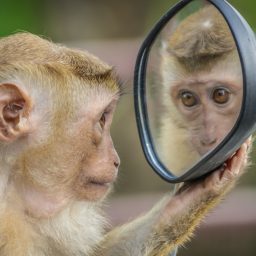
Ever wondered why sentences, words, and letters always exclusively seem to have their left and right reversed in the looking glass, while mirror writing is almost never projected upside down? Things are happening which may not be obvious. For starters, mirrors do not reverse left and right.
We are intelligent types with (sometimes too much) self-awareness. We look in the mirror, and we know it is our reflection and not someone else staring back at us. However, if you were ever under the impression that, for instance, the left and right sides of your face are reversed, you might want to re-evaluate the depth of this appreciation. You are probably still mistaking your mirror image for a real other person facing you. Even though the situations look similar, they are not equal—not just in the metaphysical sense but, more relevantly, in the mathematical sense. This relates to why letters, words, and sentences seem left-right-reversed by the mirror and almost never projected upside down, but we will get to that later.
Mirror Guy
Let’s reflect on the photo below for a moment. The Tie Guy in front of the mirror, trying to tie his tie for a white tie dinner, is looking at himself in the mirror. Who knew? I know but bear with me, because both peculiarly and crucially, it is important to acknowledge that it is, in fact, himself, and not someone else.
Let’s perform a thought experiment. Imagine Tie Guy drawing a big L on the palm of his left hand and a big R on that of his right.
Tie Guy has an L on the palm of his left hand and an R on the palm of his right hand;
Mirror Guy is not someone else: Mirror Guy is Tie Guy;
Tie Guy presses his left hand with an L against the mirror;
if a mirror would reverse Tie Guy’s left and right, Mirror Guy should use the hand with an R, since that is Tie Guy’s right hand;
Mirror Guy does not, he uses the hand with an L;
hence, Tie Guy’s left hand with an L is Mirror Guy’s left hand with an L;
therefore, a mirror does not reverse left and right.
Point 6 is probably hardest to grasp at first. Clearly, the Ls of both Guys are up against the mirror. Yet, we still think a mirror reverses left and right. The cognitive hurdle is perhaps that while we accept our mirror image to be us, we are hardwired to continue to treat it as though it were someone else facing us. On a daily basis, chances are we interact more with people facing us than we do with our mirrored selves.
We have grown accustomed to mentally reverse left and right, which evidently has proven to be useful during our interactions with everyday humans. We were taught already at an early age that ‘your left is her right’ or ‘her left is your right’. Similarly, a mathematical physics professor, upon turning around, causing her to face the audience in the lecture hall again, knows all too well that the strings of equations on the blackboard on her left are in fact on her students’ right.
Ironically, left and right get reversed in the real world and not in mirrors. Our left hand is simply our mirror image’s left hand and not ‘their right’—that is just how the Mirror Universe works.
Transformation
Wait, did I just write ‘turning around’ in italics for a particular reason? Indeed, I did. Turns out, rotations, reflections, and symmetries are tricky. Hence, what follows is an important distinction.
Mathematically, someone facing you—be it your biological clone—has been rotated (180 degrees) with respect to your position and direction, whereas your mirrored self is not. Instead, your mirror image is a… well, a reflection. (Surprise.) Here is the crux: rotation and reflection are distinct geometrical transformations. Stating that a mirror reverses left and right is similar to confusing rotation with reflection.
Rotation and reflection are not the same
After a rotation of 180º, we need to use the antonym of ‘left’ or ‘right’, which is not needed in the case of a reflection. However, it is highly plausible one does not encounter reflected human beings very often. We often deal with rotated bipeds. So, in the case of looking at your mirror image, you just need to un-think your mirrored self is someone else. In a way, even more than you would expect, being the conscious, intelligent life form that we are supposed to be, you need to accept that the mirrored self is you.
Funnily enough, accepting that a mirror does not reverse up and down either is, without doubt, a lot easier. Imagine Tie Guy banging his head against the mirror. Mirror Guy does not then bump his feet against the mirror. Therefore, a mirror does not reverse up and down nor left and right.
Why mirrored letters look weird
So, what’s up with the mirror writing? Clearly, something is going on with letters, words, and stacks of writings as Leonardo da Vinci knew all too well. Yeah, something is going on indeed, but not what you might think. In fact, a mirror has little to do with it. I blame the opaqueness of the material we usually use to write letters on for our lack of immediate insight into the matter.
Have a look at the drawing in Figure 1. We have replaced a more or less symmetric human by an asymmetric object, resembling the Greek uppercase letter gamma ($\Gamma$) which makes a reflection a bit easier to grasp.
Figure 1. An asymmetric object standing in front of a mirror. Note that point A and B are not reversed in the mirror image.
As you can now immediately see, points A and B in our original object have not been reversed in the mirrored object. If you imagine yourself standing behind the original object, looking in the direction of the mirror, point A would be on your left and point B would be on your right. The same is true for the mirrored object: its point A is also on your left and point B is also still on your right. As you have now come to appreciate, this is because the object is reflected—hallmark of a fine mirror.
Now imagine the shape of the object being ‘glued’ onto a large sheet as is drawn in Figure 2, representing a large letter printed on a piece of paper.
Figure 2. Our letter object is glued onto a large piece of paper, representing a printed letter
So, now we have written a letter on a piece of paper, as it were. The problem is, we don’t see anything in the mirror but the large sheet. What should we do about it? Turn the paper around, you say? Turn around? Okay, cool, sure thing. So, as shown in Figure 3, we rotated the paper. Now, look at what happened to point A and point B. Indeed, A and B have reversed position! And you know why? Because you rotated it about the vertical axis!
Figure 3. The sheet has been rotated about the vertical axis. The letter is now on the other side but is, for educational purposes, still mildly visible. The positions of points A and B have now reversed.
How about the mirror? Well, look at Figure 4. It is showing exactly what you are presenting it: the mirror image of a rotated letter. Point A is now on the right, point B is now on the left.
Figure 4. The mirror is showing you exactly what you are presenting it: a rotated letter
Conclusion
And so, letters look weird in mirrors because you rotated them towards the mirror. It is this rotation that makes them look weird.
Since one usually rotates writings around the vertical axis, it seems like letters, words, and sentences only get reflected in the left-right-direction. They do not the moment they get rotated about another axis.
Two interesting afterthoughts to reflect on. [1] The way you see yourself in the mirror (reflection) is not the way other people see you (rotation). [2] To have letters look as weird as they seem to do in the mirror, you don’t actually need a mirror; just write on a good old transparency, rotate it about the vertical axis, and then hold it in front of you.
And so, you see, there is no mirror, for it is not the mirror that is reversing the letters: it is only yourself.
For the sake of completeness, we mention that while mirrors do not reverse left and right, nor up and down, they do reverse front and back—the third of three options in 3D space. But, as letters are symmetric in this direction (they can be regarded as flat, for that matter), this does not usually explain why they look weird, which is why we did not discuss this property. Instead, we emphasised the distinction of a mirror’s reflection (reversal of front and back) from an object’s rotation.