Tag: gravity

  • Finding the normal force in planar non-uniform circular motion using polar coordinates

    Finding the normal force in planar non-uniform circular motion using polar coordinates


    In this post, we will derive an expression for the normal force on a uniform mass which is in planar non-uniform circular motion using polar coordinates. Finding this expression is enormously useful to calculate under which circumstances a mass would be slung off its orbital path. Of course, there are numerous situations for which we should be able find the normal force. Here, we will look at a system as shown in Figure 1. Sometimes, obtaining an expression in terms of the variables given is not straightforward. You will find a useful trick in step 7 to arrive at an expression in terms of a simple $\theta$ instead of its secondary-order derivative $\ddot\theta$ which we initially obtain.

    This could be seen as an undergraduate-physics-level post. Download this article


    Notation

    We will apply Newton’s notation (the dot notation) whenever possible as this is the most compact form. For instance, if $\mathbf{x}$ is a vector, then its first-order and its second-order derivative with respect to time $t$ are denoted by

    \[ \dot{\mathbf{x}}\text{ and }\ddot{\mathbf{x}}, \]

    respectively. Where needed, in order to state explicitly that we are dealing with a time-derivative and to help in solving a time-integral for example, we will use Leibniz’s notation, i.e.

    \[ \frac{\text{d}\mathbf{x}}{\text{d}t}\text{ and }\frac{\text{d}^2\mathbf{x}}{\text{d}t^2}. \]

    Assignment

    Look at the system as sketched in Figure 1. Imagine we stand in front of this system. Mass $m$ is attached to a model string. At $t=0$, it rests at level with the centre of the cylinder with radius $R$ with the string draped over the top. A constant force $\mathbf{P}$ pulls the string downwards. At a later time $t$, mass $m$ has slid over the top with a coefficient of friction $\mu$. Let $\theta$ denote the angle between its initial and its current position, subtended at the centre of the cylinder. Calculate the normal force on $m$, and, hence, proof that the radius of the cylinder is irrelevant.

    Figure 1. The system

    Step 1. Force diagrams and unit vectors

    It is essential to draw force diagrams and unit vectors to define the acting forces and parameters. We choose the unit vectors to be the radial and the tangential vectors. This makes calculating most forces a lot easier. This is done in Figure 2.

    Figure 2. Force diagram and unit vectors at time $t>0$

    We identify the following forces on $m$:

    • $\mathbf{P}$ is the vector denoting the constant force pulling the model string,
    • $\mathbf{N}$ is the vector denoting the normal force acted on $m$ by the cylinder,
    • $\mathbf{F}$ is the vector denoting the frictional force,
    • $\mathbf{W}$ is the vector denoting the weight of $m$ as a result of the gravitational field of whatever planet the system is located,
    • $\mathbf{e}_r$ is the radial unit vector,
    • $\mathbf{e}_\theta$ is the tangential unit vector.

    Step 2. Apply Newton’s second law

    As this is a dynamical system, where $m$ is in non-uniform circular motion, we apply Newton’s second law, more specifically in the following form:

    \begin{equation}
    \sum\mathbf{F} = m\ddot{\mathbf{r}},
    \end{equation}

    where $\ddot{\mathbf{r}}$ is the rate of change of the rate of change over time, that is, the second time-derivative of the displacement vector $\mathbf{r}$ of mass $m$. We can now easily identify the constituents of the vector sum as we did that already in Step 1. And so, equation (1) becomes

    \begin{equation}
    m\ddot{\mathbf{r}} = \mathbf{P} + \mathbf{N} + \mathbf{F} + \mathbf{W}.
    \end{equation}

    Step 3. Rewrite the forces in terms of their magnitudes and unit vectors

    As pulling force $\mathbf{P}$ with magnitude $|\mathbf{P}|$ acts in the direction of tangential unit vector $\mathbf{e}_\theta$, we can write for $\mathbf{P}$:

    \begin{equation}
    \mathbf{P} = |\mathbf{P}|\mathbf{e}_\theta.
    \end{equation}

    Since we don’t have any other information regarding this force, we leave it at that.

    Normal force $\mathbf{N}$ points in the direction of radial unit vector $\mathbf{e}_r$, so, we write:

    \begin{equation}
    \mathbf{N} = |\mathbf{N}|\mathbf{e}_r.
    \end{equation}

    Friction $\mathbf{F}$ is in the opposite direction of the tangential unit vector $\mathbf{e}_\theta$, so, we need to place a minus-sign in its expression. Furthermore, as (dry) friction is usually modelled by the product of the coefficient of friction and the magnitude of the normal force, we can write:

    \begin{equation}
    \mathbf{F} = \mu|\mathbf{N}|(-\mathbf{e}_\theta).
    \end{equation}

    Lastly, weight is the force due to gravity, $|\mathbf{W}|=mg$, where $g$ is the gravitational constant. However, we need to express this force in terms of its components. In this case, those components are directed parallel to the radial and tangential unit vectors. As the latter are pointed (partly) upwards, as opposed to the downwards-pointing weight, we already know that both its components carry a minus-sign, i.e. $(-\mathbf{e}_r)$ and $(-\mathbf{e}_\theta)$. What remains, is the correct expression for the magnitude of the weight in terms of its respective unit vectors.

    To clearly show how we get an expression for $\mathbf{W}$ in terms of its components along the directions of $\mathbf{e}_r$ and $\mathbf{e}_\theta$, have a look at Figure 3.

    Figure 3. Finding the components of $\mathbf{W}$

    What you see is just the weight vector $\mathbf{W}$ from our force diagram in Figure 2, including the radial and tangential unit vectors $\mathbf{e}_r$ and $\mathbf{e}_\theta$. For visual clarity, we subtended them on mass $m$. Also added are the two component vectors in the opposite direction of the unit vectors for which we need to find expressions.

    Let component vector $\mathbf{v}_r = a(-\mathbf{e}_r)$ and component vector $\mathbf{v}_\theta = b(-\mathbf{e}_\theta)$, where $a$ and $b$ are some magnitude value such that the vector sum of $\mathbf{v}_r$ and $\mathbf{v}_\theta$ equals $\mathbf{W}$. In other words,

    \begin{equation}
    \mathbf{W} = \mathbf{v}_r + \mathbf{v}_\theta = a(-\mathbf{e}_r) + b(-\mathbf{e}_\theta).
    \end{equation}

    To find the values of the magnitude of $a$ and $b$, we use the fact that the magnitude $|\mathbf{W}| = mg$. So, using high school trigonometry, we deduce that

    \begin{align}
    a &= mg\sin\theta, \\
    b &= mg\cos\theta.
    \end{align}

    Now, we can write $\mathbf{W}$ in terms of its components by substituting equations (7) and (8) into (6):

    \begin{equation}
    \mathbf{W} = mg\sin\theta(-\mathbf{e}_r) + mg\cos\theta(-\mathbf{e}_\theta).
    \end{equation}

    And so, if we substitute equations (3), (4), (5), and (9) into equation (2), we get:

    \begin{align}
    m\ddot{\mathbf{r}} &= |\mathbf{P}|\mathbf{e}_\theta + |\mathbf{N}|\mathbf{e}_r + \mu|\mathbf{N}|(-\mathbf{e}_\theta)\nonumber \\
    &\hspace{2em}+ mg\sin\theta(-\mathbf{e}_r) + mg\cos\theta(-\mathbf{e}_\theta).
    \end{align}

    Step 4. Express the Cartesian $\ddot{\mathbf{r}}$ in polar coordinates

    As we know that the expression for the second time derivative of non-uniform circular motion is

    \begin{equation}
    \ddot{\mathbf{r}} = -R\dot{\theta}^2\mathbf{e}_r + R\ddot{\theta}\mathbf{e}_\theta,
    \end{equation}

    where $R$ is the radius of the circular motion, i.e. the cylinder. We proceed to substitute this into equation (10).

    And so, we get

    \begin{align*}
    m(-R\dot{\theta}^2\mathbf{e}_r + R\ddot{\theta}\mathbf{e}_\theta) &= |\mathbf{P}|\mathbf{e}_\theta + |\mathbf{N}|\mathbf{e}_r + \mu|\mathbf{N}|(-\mathbf{e}_\theta) \\
    &\hspace{2em}+ mg\sin\theta(-\mathbf{e}_r) + mg\cos\theta(-\mathbf{e}_\theta),
    \end{align*}

    which, of course, after expansion, becomes

    \begin{align}
    -mR\dot{\theta}^2\mathbf{e}_r + mR\ddot{\theta}\mathbf{e}_\theta &= |\mathbf{P}|\mathbf{e}_\theta + |\mathbf{N}|\mathbf{e}_r + \mu|\mathbf{N}|(-\mathbf{e}_\theta) \nonumber \\
    &\hspace{2em}+ mg\sin\theta(-\mathbf{e}_r) + mg\cos\theta(-\mathbf{e}_\theta).
    \end{align}

    Step 5. Resolve radially and tangentially

    We can now resolve equation (12) into its radial and tangential components.

    \begin{align}
    \mathbf{e}_r &: -mR\dot{\theta}^2 = N – mg\sin\theta, \\
    \mathbf{e}_\theta &: mR\ddot{\theta} = P – \mu N – mg\cos\theta.
    \end{align}

    Step 6. Write down the equation of motion (in polar coordinates)

    Rearranging equation (14), we can write down the second-order differential equation of motion:

    \begin{equation}
    \ddot{\theta} = \frac{P – \mu N – mg\cos\theta}{mR}.
    \end{equation}

    While we could have solved equation (14) for $N$, this would still leave us with the second time-derivative of $\theta$. Instead, we want an expression of $N$ in terms of a simple $\theta$. This means that we need to get rid of $\ddot{\theta}$ in some way. It is not immediately clear how equation (14) or (15) should be operated on to achieve this. However, here is a neat trick.

    Step 7. The trick

    Have a look at the following equation where we apply the chain rule:

    \begin{equation}
    \frac{\text{d}\dot{\theta}^2}{\text{d}t} = \frac{\text{d}\dot{\theta}^2}{\text{d}\dot{\theta}}\frac{\text{d}\dot{\theta}}{\text{d}t} = 2\dot{\theta}\frac{\text{d}\dot{\theta}}{\text{d}t} = 2\dot{\theta}\ddot{\theta}.
    \end{equation}

    So, if we substitute equation (15) into (16), we get

    \begin{equation}
    \frac{\text{d}\dot{\theta}^2}{\text{d}t} = 2\dot{\theta}\left(\frac{P – \mu N – mg\cos\theta}{mR}\right).
    \end{equation}

    If we now integrate both sides with respect to time, we get

    \begin{align}
    \int \frac{\text{d}\dot{\theta}^2}{\text{d}t}\text{d}t &= \int 2\dot{\theta}\left(\frac{P – \mu N – mg\cos\theta}{mR}\right)\text{d}t, \nonumber \\
    \dot{\theta}^2 + A &= 2 \int \frac{\text{d}\theta}{\text{d}t}\left(\frac{P – \mu N – mg\cos\theta}{mR}\right)\text{d}t, \nonumber \\
    &\text{where $A$ is an arbitrary constant}, \nonumber \\
    \dot{\theta}^2 + A &= 2 \int \left(\frac{P – \mu N – mg\cos\theta}{mR}\right)\text{d}\theta, \nonumber \\
    \dot{\theta}^2 + A &= \frac{2}{mR} \int (P – \mu N – mg\cos\theta)\,\text{d}\theta, \nonumber \\
    \dot{\theta}^2 + A &= \frac{2}{mR} \left( P\int 1\,\text{d}\theta – \mu N\int 1\,\text{d}\theta – mg\int \cos\theta\,\text{d}\theta\right), \nonumber \\
    \dot{\theta}^2 + A &= \frac{2P\theta}{mR} – \frac{2\mu N\theta}{mR} – \frac{2mg\sin\theta}{mR} + B, \nonumber \\
    &\text{where $B$ is an arbitrary constant}, \nonumber \\
    \dot{\theta}^2 &= \frac{2P\theta}{mR} – \frac{2\mu N\theta}{mR} – \frac{2g\sin\theta}{R} + B – A, \nonumber \\
    \dot{\theta}^2 &= \frac{2P\theta}{mR} – \frac{2\mu N\theta}{mR} – \frac{2g\sin\theta}{R} + C, \\
    &\text{where $C=B-A$} \nonumber.
    \end{align}

    Solving the initial condition problem to find $C$, we use the fact that at $t=0$, angle $\theta = 0$, thus $\dot{\theta} = \ddot{\theta} = 0$. This renders $C = 0$ in equation (18), and so, we have

    \begin{equation}
    \dot{\theta}^2 = \frac{2P\theta}{mR} – \frac{2\mu N\theta}{mR} – \frac{2g\sin\theta}{R}.
    \end{equation}

    Note, we now have obtained an expression for $\dot{\theta}^2$ which already appeared in equation (13). We can, therefore, substitute equation (19) in (13), and we obtain:

    \begin{equation}
    -mR\left(\frac{2P\theta}{mR} – \frac{2\mu N\theta}{mR} – \frac{2g\sin\theta}{R}\right) = N – mg\sin\theta.
    \end{equation}

    Expanding and rearranging this, we get

    \begin{align}
    N – mg\sin\theta &= -2P\theta + 2\mu N\theta + 2mg\sin\theta, \nonumber \\
    N – 2\mu N\theta &= -2P\theta + 2mg\sin\theta + mg\sin\theta, \nonumber \\ N(1 – 2\mu \theta) &= -2P\theta + 3mg\sin\theta, \nonumber \\
    N &= \frac{3mg\sin\theta – 2P\theta}{1-2\mu\theta}.
    \end{align}

    So, now we have an expression of $N$ in terms of the gravitational constant $g$, the variables $m$, $\mu$, and $P$, and the more reasonable $\theta$ instead of $\dot\theta^2$.

    And so, if we want to calculate when a mass would be slung out of its orbital path, we write $N = 0$ as this means, in physical terms, that the mass isn’t resting on the cylinder anymore (since it doesn’t exert a normal force on the mass). In other words, find the roots of equation (21) to find the one unknown variable. Note, $R$ does not play a role. Of course, bear in mind that $m$ is a point mass.
  • Just a minute: what is a black hole?

    Just a minute: what is a black hole?


    Much like any question in the vain of ‘what is (…love…)’, for which mathematical, physical, molecular, biological, psychological, philosophical, literary, and artistic approaches could be employed, here too, are several ways to approximate the answer to the question ‘What is a black hole?’


    Let’s take the notion of escape velocity, which is the minimum speed (in a specific direction) needed for an object to break loose of the gravitational domination of a massive body. Larger gravity means that you have to fly faster to get off the planet.

    Instead of a planet, let’s pretend we have a rocket on the surface of the Sun. Why the Sun, you might ask. Rest assured, we’ll definitely get to that. In the sketch below you see the situation at hand.

    Turns out, the larger the Sun’s mass, the stronger its gravitational influence on the rocket on its surface. Sounds obvious enough, right? In the sketch, the Sun’s mass is symbolised by ‘big $M$’. Of course, the rocket has a mass too, so this is denoted by ‘small m’. Lastly, the distance between the centre of the Sun(’s mass) and that of the rocket plays a big role. The larger the distance, the weaker the gravitational influence. This distance is denoted by the letter $r$. This obviously also means, the smaller the distance, the stronger the gravitational influence.

    Assuming the mass of the rocket (‘small m’) stays constant, we say that the gravitational influence is proportional to $M$ and inversely proportional to $r$. We can now begin to describe a mathematical relationship between the gravitational influence, $M$, and $r$. We can write:

    \begin{equation*} \text{gravitational influence} \propto \frac{M}{r}. \end{equation*}

    This weird $\propto$-sign means ‘is proportional to’. The fraction $\frac{M}{r}$ means that, if $M$ grows bigger, the division grows bigger. If $r$ grows bigger, the division shrinks smaller. Let’s just fill in some numbers to see how this works. Suppose, $M = 600$ and $r = 5$.

    \begin{equation*} \text{gravitational influence} \propto \frac{600}{5} = 120. \end{equation*}

    Let’s make $M$ six times bigger: $M = 3600$. We get

    \begin{equation*} \text{gravitational influence} \propto \frac{3600}{5} = 720. \end{equation*}

    Not surprisingly, the division becomes six times larger too. If we make $r$ smaller, say $r=2$, the result becomes even larger:

    \begin{equation*} \text{gravitational influence} \propto \frac{3600}{2} = 1800. \end{equation*}

    So, what would happen if—in a thought experiment—we would add more mass $M$ to our Sun? Indeed, the gravitational influence on the rocket would become larger. In turn, the rocket would have to fly faster in order to leave the Sun.

    What would happen if—in a further thought experiment—we would not just add more mass $M$ to our Sun but also shrink its radius $r$, so that it becomes a small, very dense ball of stuff? Indeed, the gravitational influence would become even larger, so, the rocket would have to fly even faster.

    Schwarzschild

    The real formula that Newton came up with for the gravitational influence, which we call Newton’s law of universal gravitation, is a little different from what we have used up until now, and goes as follows:

    Of course, Einstein came up with an even more accurate set of formulas, but for our purpose, we won’t be using them as Newton’s law works just as well, in this case.

    John Michell, an 18th-century, English philosopher and clergyman, basically wondered if the ratio between mass $M$ and distance $r$ could lead to a gravitational influence so big that the required speed for a rocket to fly off to the stars would exceed the speed of light. He wasn’t sure if anything with that much mass and such short a radius could ever exist, but if so, then, in theory, ‘dark stars’ could exist.

    When some stars reach the end of their lives, they become supernovae. They explode their outer shells into space, while the inner shells of matter move inwards. This means that the surface quickly shrinks towards the centre of mass. This means that things, such as rockets, can get closer to the centre of mass while experiencing the gravitational influence of all that mass underneath it.

    Given the amount of the star’s imploding mass $M$, at some point, there will be a distance $r$ around it where the gravitational influence is so large, that the minimum speed for a rocket to escape it will have to be larger than the speed of light.

    Karl Schwarzschild

    It was Karl Schwarzschild, a German physicist who found this distance using Albert Einstein’s equations of general relativity (the more accurate set of formulas compared to Newton’s).

    Given a certain mass, the Schwarzschild radius is the distance from the centre of mass below which the magnitude of the escape velocity is larger than the speed of light. And so, this part of the universe will be black, whence no one returns. Every point around the centre of this mass as described by the Schwarzschild radius, forms what we call the event horizon.

    A black hole is thus a region in the universe where the gravitational influence is so large that nothing, not even light, can escape it. Or, to put it a bit more technically, it is a region of spacetime where every possible future leads to its singularity. We might explain the latter in another article, in the future.

    Event Horizon Telescope

    A vast array of radio observatories and telescope facilities around the world basically turned our entire planet into one big telescope, called the Event Horizon Telescope.

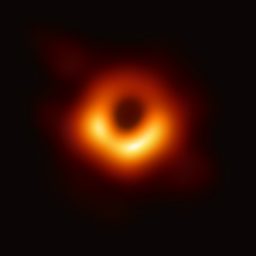
    On Wednesday, 10 April 2019, at 15:00 CET, the first photo of a supermassive black hole in the middle of a galaxy called Messier 87 was presented. Later, a photo of the black hole in our own Milky Way, called Sagittarius A*, will be expected.

    The observations may test Einstein’s general relativity yet again. Perhaps more on that in another article.

    We highly recommend watching the recording of the live stream of the presentation of the results.

    We have been focussing on non-rotating black holes. The physical models for a rotating black holes differ to some degree, but not significantly for the scope of this article.

    Featured image: the image of the supermassive black hole Messier 87. Credit: EHT Collaboration

  • Just a minute: why do large and heavy ships not sink?

    Just a minute: why do large and heavy ships not sink?


    Until they do due to a mistake, ships do not sink, not even the large and heavy ones. Now and then, textbooks say this is because of dissimilar density. Though not wrong, it is also not a fundamental reason. While ships may sink to the bottom of the ocean thanks to gravity, they also float thanks to gravity.


    When a vessel is launched in the water, it will always sink a little bit under the surface, until it stops sinking, preferably at a safe distance from where humans tend to loiter. And since, in this universe, water and the submerged part of a hull cannot occupy the same space at the same time, the submerged volume equals the volume of displaced water. This causes, however small, to raise the surface of the water. Due to the sheer size of most bodies of water, that rise is unnoticeable.

    In spite of this usually insignificant level increase, gravity is still ‘pulling down’ every cubic part of the raised water, which is then, through pressure, also pushing on the ship. The force of the weight of the displaced water is equal to the force exerted upwards on the bottom of the ship. This is called Archimedes’ principle.

    In other words, while the ship exerts a force on the water due to gravity, the water around the ship exerts a force back at it, through pressure, due to gravity. Notice how it is working against itself, as it were. But, as long as the force of the weight of the water is equal to the force of the weight of the ship, it’s fine. Yes, water pressure also pushes on all submerged sides of the object, but they cancel each other out as they work against each other with equal strength so we can leave them out of the equation.

    The trick, of course, is to design the shape of a hull in such a way that its submerged volume displaces a volume of water weighing as much as the ship’s weight. These choices influence the ratio between its volume and its mass. And the latter is why referrals to density are made—often accompanied by a nifty display of algebra. Though not fundamental, density is a useful property to work with on Earth, such as when explaining why oil floats on water.

    Until you are not on Earth but on the International Space Station, for instance. Do have a look at what happens when the lower-density oil and higher-density water are put together when gravity is out of the mix.

    In Figure (1), a mass is launched in the water. The water level is indicated by the dashed line. In Figure (2), part of the mass is submerged, thereby displacing upward a certain volume of water left and right. The grey arrow denotes the (force of the) weight of the mass. The downward blue arrows denote the (force of the) weight of the displaced volume of water. The latter two cause an upward pressure to the bottom of the mass, as denoted by two upward arrows. Notice how the sum of the length of these two arrows equals the length of the grey arrow: our mass is buoyant.

    Of course, air pressure also exerts a force on the ship. However, it does so on the water surface too. As we also wanted to keep things simple, we thus did not take this any further into consideration.

  • Why your coffee does not have tides

    Why your coffee does not have tides


    The Moon orbits the earth and its gravity is causing the tides. But why don’t swimming pools have tides? Or a cup of coffee? Human bodies consist of water, mostly. Aren’t they tidally influenced by the Moon? If you’re asking all these beautiful questions, then what you thought is causing the tides is probably wrong, and here’s why.


    Remember, back in high school, when the science or physics teacher had all the air sucked out of a large, transparent tube which contained a feather and a little steel ball or something like that? And that she asked you to predict which would drop to the bottom first if she would turn the tube upside down?

    Of course, both objects turned out to fall to the bottom at the exact same speed. We learnt it did not matter if the steel ball had more mass than the feather. Earth’s gravity works the same on both. In fact, anything which is being ‘pulled down’ by our planet’s gravity gets to be pulled down at the same rate, no matter how much mass these things have (provided we ignore any form of friction).

    Lunar gravity

    Even though the Moon’s gravity is smaller than Earth’s, the principle is the same. Irrespective of an object’s mass, it falls straight to the lunar surface at precisely the same rate as any other thing. On 2 August 1971, NASA Commander David Scott demonstrated that a feather and a hammer hit the Moon’s soil simultaneously.

    Photo: NASA

    The Moon’s gravity is strong enough to have a noticeable effect on Earth, as we all know. Indeed, it is the reason why our oceans have tides. However, if gravity, whether on our planet or on the Moon, acts the same way on every object irrespective of their mass, how come our bathtub does not experience tides, for instance? Yes, it has less mass, but by Cmdr David Scott’s experiment, that shouldn’t matter. And if the Moon’s gravity is capable of pulling on vast bodies of water such as oceans causing them to rise literally meters high, why does our rubber duck not start levitating up in the air as soon as the Moon rushes past our homes?

    The answer sounds both obvious and contradictory: because the force of the Moon’s gravity is negligibly small, except when it is not.

    The wrong picture

    Let’s have a look at the simplified drawing of Figure 1. Just to make things a little less complicated, we imagine our planet to be covered by water entirely. There are no continents for now.

    We see a schematic drawing of earth and the moon. Earth is covered with water with bulges left and right, representing the two high tides. Point A is the point closest to the moon on the right, located on the surface of the earth in the middle of the bulge on the right. Point B is at exactly the opposite location on the far side of the earth, the most distant point from the moon.
    Figure 1. Earth’s tides and the Moon. (Not to scale!)

    First misconception. Even though, intuitively, it may seem to be the case, the bulge at point A is not because the Moon’s gravity is tugging at it, contrary to popular belief.

    And in many texts, you might encounter the following incorrect explanation for the bulge at point B. ‘The Moon’s pull is smaller at point B than at point A, so, point B stays more or less where it is, while point A gets pulled more towards the Moon. Everything in between A and B gets stretched like chewing gum. So, from the perspective of someone standing (on land) at point B, the water rises there as well.’

    This is also mostly incorrect. It is true, the Moon’s gravitational pull is smaller at B than it is at A. But that is not what is causing the bulge at point B. Not in the direct way as stated here, that is.

    Many a little makes a mickle

    Why don’t we have a look at points C and D in two different, little patches of water in Figure 2? The Moon’s force of gravity acts on these points at a certain angle as is represented by the blue arrows, or vectors. At the same time, the entire earth experiences a slight force towards the Moon as is modelled by the red vector.

    Same schematic as the previous one, but more points are added. Point C is located more or less on top of the earth, a little to the right of the North Pole. Point D is located between the North Pole and point B. Little blue arrows, called vectors, are drawn from points C and D, pointing towards the centre of the moon. A little red vector is drawn at the centre of the earth, pointing to the centre of the moon. These vectors represent the forces acted on these points caused by the moon's gravity.
    Figure 2. The force of the Moon’s gravity acting on points C and D and the entire earth

    So, point C and D undergo two simultaneous forces as is explicitly shown in Figure 3. Note that the blue and red vectors have different directions. Our high school physics or maths teacher then taught us that two or more forces acting on the same point can be modelled as one resultant force.

    Now we need to take two important steps: 1. Newton taught us that a force is an acceleration, so, from now on we will regard the arrows in Figure 3 as being accelerations. 2. To determine the acceleration of the patches of water at points C and D relative to Earth’s surface, we subtract the red vector from the blue vector. What’s left is the green vector, the resultant.

    We see a close-up of points C and D. The red vector, representing the force of the moon exerted on the earth, originates here from point C. The blue vector, representing the force of the moon exerted on point C, still originates from point C. So, we have two vectors coming from point C. A little green vector is drawn between the heads of the other vectors, pointing down, towards the location of where the bulge closest to the moon will emerge. And so, the combination of the two real forces exerted by the moon results in a net force. The exact same procedure has been applied to point D. Only here, the green net force vector is pointed the other way, towards where the other bulge, on the other side of the planet, will emerge.
    Figure 3. The resultant forces are represented by the green vector

    In Figure 3, it is shown how the combination of the two gross forces blue and red yield a net force as represented by the green vectors. Do note, the net forces are what is called apparent forces. Think of a car suddenly accelerating. Relative to the ground, your head is standing still for an instant of time. However, from within the car, your head seems like it is being pushed back by some invisible force. Tides are thus being caused by so-called tidal forces, which are apparent forces.

    So, if we do the same for many other points, you get many green vectors as they are shown in Figure 4. And guess what, all the green (now black) arrows point in a way that look a lot like bulges in the water.

    We see the earth where all the net force vectors are lined up in a way that, together, result in a picture exactly the same as our tides: two bulges on either side.
    Figure 4. An array of net forces (the green arrows are here the black arrows)

    This shows that what actually happens is that every minuscule patch of water gets influenced by a tiny bit of net force in the direction of the places where the bulges will emerge, pushing every other patch in front of it towards the bulges, thereby creating the bulges in the first place.

    Now, in the drawing, all arrows are relatively massive, so we can actually see them. In reality, however, the net forces are tiny. Microscopically tiny.

    And this is the key to solving the paradox. Even though a net force, resulting from the Moon’s gravitational influences, is utterly insignificant on a single patch of the water, the amount of ocean on Earth is quite the opposite of negligible, rendering the sum of all net forces on every cubic patch within the oceanic liquid highly significant, and in some cases, depending on the shape of the land, dangerously significant.

    Conclusion

    The Moon’s influence on tiny things is tiny. It does not noticeably influence your cup of coffee, your body, your bathtub, ponds, and lakes. Any tidal height difference in a cup of coffee could be thinner than a bacterium, the significance of which is immediately squashed by the mere presence of, well, a bacterium in your coffee, practising its back crawl. If your coffee starts to display any tidal effects, prepare for the Apocalypse and/or escaped dinosaurs. Either case, something is really wrong then.

    Even a lake the size of Lake Michigan will only rise a couple of centimetres—easily negated by its murmuring surface on a sunny day in May. So, you can imagine, your body does not feel a thing. The pressure needed for delivering oxygen to your brains alone squashes out every single tidal influence by the Moon, which would have been smaller than a hair’s thickness anyway. If you feel less capable of rational thought, you now know it’s not the Moon. But do check your blood pressure.

    However, in the case of an ocean, a body with many, many, many tiny, watery parts which can roll, slip and slide freely on top of one another, there will be bulges about where the Moon whizzes. However, the swelling occurs by virtue of pushing not pulling, directly.

    In short, a quindecillion minuscule little net forces on every cubic piece of the ocean cause an upward push so the two bulges emerge. Lakes, ponds, bathtubs, human bodies, and coffee mugs do not come close to even a little bit of that amount.

    EDIT: the original article omitted to mention how tidal force is an apparent force, resulting in a fundamental misinterpretation of Figures 3 and 4. This has been corrected.

    Figure 4 is an adapted version (cropped) of the original made by Krishnavedala under CC BY-SA 3.0.

    We did not consider the rotation of the earth, the Coriolis effect, the presence of the sun, the presence of land, etc., just to keep it simple. This changes the situation somewhat, but does not change the gist of it all.